Australia’s renewable energy transition is being made more expensive by poor planning, fragmented market structures and ideological battles, when what is needed is a slower, more technically grounded assessment of how to keep the grid reliable and affordable.
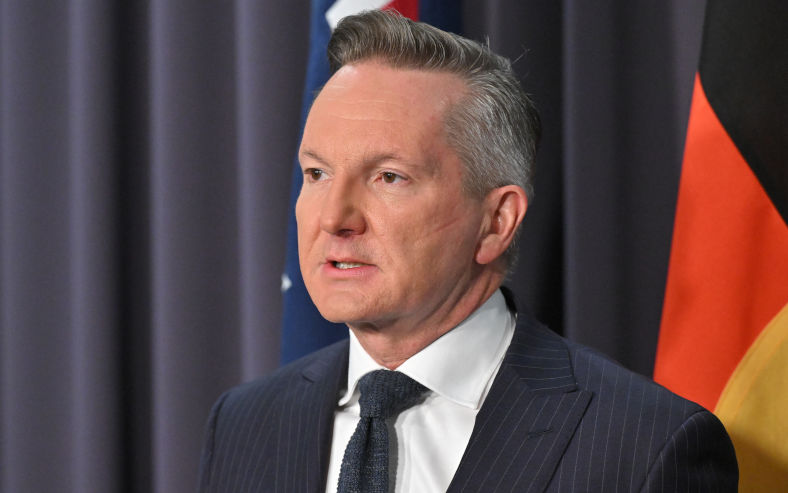
Energy Minister Chris Bowen was recently reported (AFR 4 June) as being open to re-nationalising “a large chunk of the energy grid.”
The plan, put forward by the Electrical Trades Union (ETU), proposes supplying cheap, subsidised power for heavy industry as an alternative to bailouts, like those made or proposed for the Boyne and Tomago aluminium smelters.
Any proposal to guide or plan what is often represented as Australia’s current blundering and blinkered transition to renewable electricity generation should be welcomed.
A recent critic of the transition was former head of the Energy Security Board, Kerry Schott. Schott called for an AI-powered rethink of the delayed and over-budget build-out of the nation’s electricity grid after pointing to billions of dollars’ worth of blowouts.
Last year it was reported that the cost of building NSW’s first Renewable Energy Zone had blown out from $650 million to $5.5 billion over five years.
The Australian government has a target of 82 per cent renewable electricity by 2030. The nation’s two largest electricity grids – the NEM (eastern and central states) and the SWIS (Western Australia) – now source 35 per cent to 40 per cent of electricity from renewables.
Concerns about costs blowouts are exacerbated by the fact that to fully replace fossil fuel generation, Australia’s renewable capacity must be oversized by three to five times the baseline demand. This massive overbuild – alongside substantial investments in long-duration storage – is required to cover peak demand periods during times when variable wind and solar generation are low or non-existent.
Further cost – and fraying of community support for the rollout – is caused by the need to build expensive new transmission lines to link this renewable generation to users. For example, the cost of the NSW section of the new interconnector to South Australia blew out by over $1 billion with the owner, Transgrid, expecting to recoup the blowout from consumers.
When it comes to solving problems, Minister Bowen is certainly not operating in an advice-free environment.
Apart from his own Department of Energy, Mr Bowen has the Australian Energy Market Operator (AEMO), the Energy Security Board (ESB), the Australian Energy Regulator (AER), Australian Energy Market Commission (AEMC), plus the Clean Energy Regulator (CER), the Australian Renewable Energy Agency (ARENA), the Clean Energy Finance Corporation (CEFC), matching departments in all states and territories and more special interest groups than there is space to list.
This quagmire of quangos is mainly due to the privatisation of electricity provision and the need for the industry to operate as a market. It is increasingly questionable whether a market structure is the ideal format for managing a transition from fossil fuel to renewable generation. This link contains a detailed analysis of the limitations of markets in this regard.
The market system worked reasonably well when most generation came from just 24 large coal-fired power stations. Today there are literally millions of generators, with every home roof top solar installation adding one more point of complexity to the system.
Chris Bowen and ETU might be on to something in trying to turn back the clock.
But another major problem bedevils the transition: there is absolutely no clear agreed path. Sadly for all of us who have to live with – and ultimately pay for – this process, the transition has become massively infected with conflicting views, ideologies, dogmas and outright bastardry – as well as the entrenched obstinacy of those making a good quid out of the current arrangements.
At one extreme we have those who maintain the whole process is unnecessary because climate change is not a “thing” and emissions don’t matter (Scott Morrison cuddling his coal chunk in Parliament comes to mind). At the other are those who demand ‘Climate Action Now’ and an immediate end to the extraction and use of all fossil fuels. Between the extremes are many other partisan positions. The ETU provides a good example – very pro the transition, but not if it involves nuclear energy. Such views are off-set by the pro-nuclear warriors who see nukes as the only way to go.
Right at the back of the shouty ‘my-way-or-the-highway’ crew are scientists and power system engineers. Power system engineers are an actual thing, but until relatively recently, few were trained in Australian universities. That’s why many don’t speak English as a first language. Professions that predominate in the energy business these days are economists, accountants, lawyers, communications and marketing experts, financiers and free-booters. How many contribute to the actual running of the system?
Despite this, it is the view of power system engineers consulted for this article that Australia will probably muddle through and achieve a transition to “mainly” renewable electricity generation. However, it is also their view that we will make many mistakes and pay massive amounts more than we would need to than if the transition was more planned and orderly. Many on the technical side want more emphasis placed on planning and testing rather than blindly rushing for emissions reduction or percentage of renewables ‘targets’.
What would make a difference? Two things: a slower pace of change and a completely agnostic evaluation of all available – and emerging – technologies.
Rather than ‘Climate Action Now’ how about we ‘learn to walk and chew gum?’ That is, we plan proactively rather than reactively. Nuclear options need to be considered, even if it’s only to make other expensive options more palatable.
One expensive transition project which may never have been commenced if properly planned is Snowy 2.0. The original Snowy Scheme was completed in 1974 at a total cost of $820 million – this was on time and on budget. On completion, the Scheme consisted of seven power stations, 16 major dams, 80 kilometres of aqueducts and 145 kilometres of interconnected tunnels.
The current Snowy 2.0, building one new power station and connecting two exiting dams with tunnels was originally budgeted at around $2 billion in 2017. In 2023 it was re-budgeted at $12 billion and today, with the inclusion of costs of building new transmission lines to connect it to the grid, costs are estimated to be around $42 billion!
And this is just for back-up power. Maybe planning to keep a couple of gas peakers might have been a better option.
Where might better planning impact? One suggestion involves making better use of the existing massive penetration of household rooftop solar. On most days, more electricity is generated from household rooftops than grid scale solar farms. As most of this generation cannot be controlled by the system operator, to keep the grid in balance they are forced to turn off (“constrain” in the jargon) large solar and wind farms. Their generation capacity is simply wasted. Worse, for their shareholders and financiers, they earn nothing when constrained.
In the AFR, Kerry Schott criticised this failure to capitalise on rooftop solar and the boom in installation of home batteries. Schott said the system needed an overhaul and described the situation as “distressing” where households were reluctant to participate in “virtual power plant” programs offered by electricity retailers. Perhaps “participation” in a national scheme could have been a condition of receiving the subsidy from the government? On the other hand, AEMO CEO Daniel Westerman seems content with the passive assistance the batteries provide by simply reducing the amount of generation actually entering the grid, so less constraining is required.
In fact, reality is already biting in other ways and forcing a slower pace of transition. Fears about the stability of the grid and reliability of supply have forced a delay of closure of many coal-fired power generators. At the same time, the importance of keeping some gas generation to fill the gaps when renewables are unavailable seems to have discouraged the demonisation of gas by certain politicians.
The fact that many in the energy industry are concerned that Australia is falling behind in the rate of building new renewable generation if we are to meet renewables targets may be a good thing, giving us more time to actually get it right.
A last word: “smearing”. This is a piece of industry jargon used to describe the practice of spreading unanticipated costs across the electricity bills of all consumers. Chris Bowen would be the first person to be pleased if there was less need for “smearing”.

Currently a consultant to Sunlands Co, an energy storage project. Previous roles have included: Chief of Staff and adviser to Federal Ministers and Shadow Ministers, senior executive roles in the Australian Public Service, private and not-for-profit industry and as a TAFE and technical secondary teacher in Victoria.