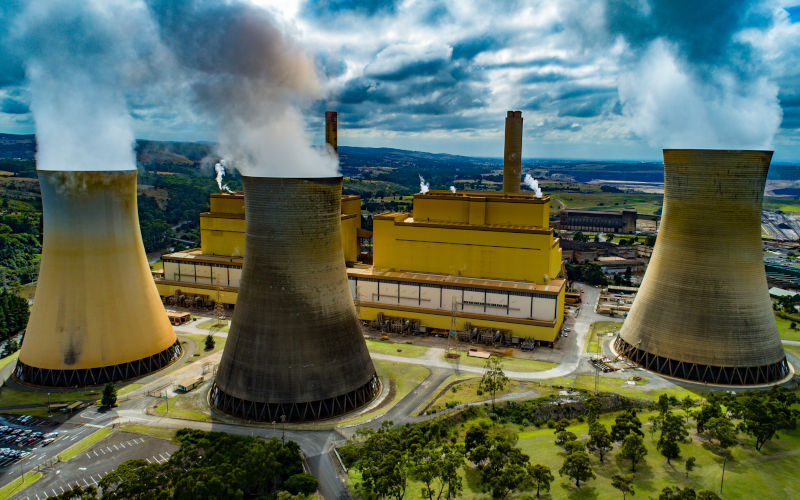
Uncertainty over coal plant closure dates is weakening investor confidence in renewable energy, creating a circular problem where coal stays open because new investment is delayed.
The failure of state and federal governments to set and adhere to firm end-dates for coal-fired power generation around Australia remains a thorn in the side of the renewable energy transition, industry says, creating investor uncertainty and suppressing the ability to attract the capital necessary to fund the shift.
Black and brown coal generators still make up more than 42 per cent of Australia’s the electricity supply, with four coal plants still dominating the mix in New South Wales, three in Victoria, eight in Queensland and three in Western Australia.
While many of these coal plants have dates penciled in for their retirement, these are largely set by the private companies that own the majority of them. And repeated delays and uncertainty over future changes is now cited as one of the main, if not the main, issue haunting the backers of new renewable developments.
On top of this, state governments have shown a propensity to intervene in coal plant retirement timelines, most notably in New South Wales and Queensland, where the abject political fear of “the lights going out” has led to public spending on keeping coal clunkers operating past their use-by date.
And while costly, eleventh-hour coal extensions might settle political nerves, and cause a softening in wholesale electricity prices, they do nothing for the confidence of renewable energy developers or the international investors who back them – and nothing for the pace of the very transition that is needed to replace coal.
Laura Caspari, who is the CEO of the Australian arm of France-based Engie, which closed the Hazelwood brown coal generator on short notice nearly a decade ago, says recent investment committee debate at the renewables giant’s Paris headquarters was “almost entirely” about the certainty or uncertainty of coal retirements in Australia.
“I’ll give you Yallourn as an example, because it was an example in this case,” Caspari told the Australian Clean Energy Summit in Sydney on Tuesday.
“We all have the strong belief that Yallourn’s going to come out, when we’ve been told, on the 30 June, 2028. But from my management’s view, in Paris – they’re looking at it on a global scale – they’re seeing how coal continues to be extended under certain circumstances.
“We’ve got Strait of Hormuz, we’ve got all these issues and this volatility and they feel like, you know, we can’t have the certainty around that. And so that that was the debate.
“It was very frustrating… And that lack of certainty could have [prevented investment]. I’m very fortunate that it didn’t prevent that investment, but it will in other cases,” Caspari told the Summit.
“And we need to really address what we can do to give a better signal there, because the signal is too weak. And then it becomes a circular thing, where you can’t retire the coal because you’re not getting the investment, but you’re not getting the investment because you’re not retiring the coal.”
Angela Catt, the executive general manager of government and sustainability at Tilt Renewables, also confirmed that uncertainty around coal retirement in Australia “certainly does change things in the investment committee and the boardroom.”
And Catt also invoked the example of EnergyAustralia’s Yallourn power station, in Victoria, in a separate panel discussion on the topic.
For its part, EnergyAustralia has held firm about the aging plant’s mid-2028 retirement – reaffirming its plans in March of last year, following Murdoch media reports that it was in secret meetings with government and the market operator to keep Yallourn open beyond that date.
“EnergyAustralia has publicly announced, and reaffirmed multiple times, the closure of the Yallourn power station by 2028. We have committed to Net Zero by 2050 and closing Yallourn by 2028 is part of that commitment,” the company said at the time.
To help replace Yallourn, EnergyAustralia has also made good on its promise to build the 350 megawatt (MW), 1,400 megawatt-hour (MWh) Wooreen Energy Storage System (WESS), a four-hour big battery in Victoria’s Latrobe Valley.
Last week, developers announced that the Wooreen ESS was on track to begin operations in 2027, after the 1,038th and Wärtsilä Quantum unit was safely delivered and installed, marking the completion of all battery installations on the project.
Certainly, renewable energy developers are watching and hoping that EnergyAustralia does what it has promised with Yallourn and sets a new paradigm for orderly coal retirement in Australia.
“I think we need a tangible proof point,” said Catt on Tuesday. “We need a tangible proof point that the next coal power station that is set to retire, retires, and it retires on time. And, you know, Yallourn could be that perfect example.
“Five years ago they announced the the retirement timing of that – they gave seven years’ notice – and what we’re seeing is actually the right signposts on the way.
Republished from Renew Economy

Sophie Vorrath
Sophie is editor of One Step Off The Grid and deputy editor of its sister site, Renew Economy. She is the co-host of the Solar Insiders Podcast. Sophie has been writing about clean energy for more than a decade.