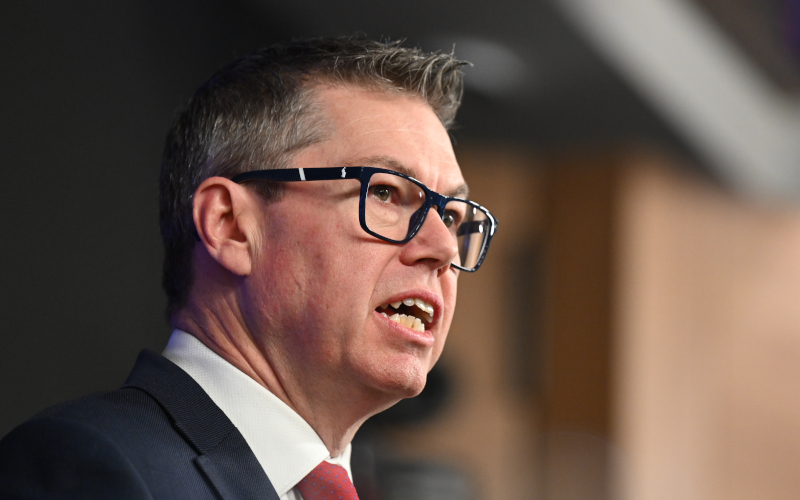
Pat Conroy presents AUKUS as an expression of Labor values and Australian sovereignty. But its enormous costs, troubled procurement record and dependence on Washington tell a different story.
In July this year in a National Press Club address, the minister for defence industry, Pat Conroy, tried to pitch the fuzzy notion of ‘progressive patriotism’ to the nation. This concept had been mentioned briefly by the prime minister in his 2025 election victory speech.
Wrapping what he called ‘our investment in defence’ in the traditional Labor values of fairness, equality, social justice, democracy and multiculturalism, Conroy evoked Labor’s wartime and security history under a string of leaders – from Fisher to Curtin to Gillard. He then transferred the Curtin legacy to Albanese as the new defence torchbearer and declared Labor to be the ‘natural side of national security’.
This was unabashed spin aiming to reposition AUKUS as the protector of progressive Australian values.
Interestingly, it was not one of the big three, Albanese, Marles or Wong, giving this speech. It was delegated to the minister for AUKUS to manufacture a case for the project by wrapping the controversial deal in the flag. He meant to tap the zeitgeist of today – a sense of patriotism. His opening gambit was clever. He did the unexpected by criticising the track record of the very Department of Defence he has co-led for the last four years. The mainstream media hook was the revelation that $29 billion had been wasted across a range of Defence procurement projects over the past decade. His solution was to release a new version of the Defence Industry Development Strategy and to replace the Defence Investment Committee with a new Defence Investment Board. Underwhelming to say the least.
Conroy’s line of argument is the government’s domestic AUKUS sales talk. It conveniently sidesteps the fundamental sovereignty problem tangled up with the US alliance. Instead, he flips that concern to present it as an assertion of Australia’s defence autonomy. Conroy pretends that somehow AUKUS is both home-grown and essential to the defence of the nation. In his words:
“I want to be clear: the goal of growing our self-reliance is deterrence. We don’t want a fight. Labor invests in defence to deter aggression and maintain peace, stability and security. Failing to invest in defence leaves Australia vulnerable to aggression and coercion. Leaving Australia vulnerable to aggression will undermine our sovereignty. And without sovereignty, we cannot pursue all the goals of a progressive political party: standing up for human rights, charting our own foreign policy and growing our economy through trade and exports.”
No one in the debate around AUKUS seriously argues that Australia should not be able to defend itself. But if one looks closely at recent defence and security debates in Australia, most of the political energy is focused on the percentage of GDP Australia should invest to satisfy the demands of Washington.
The problem for Conroy and the government is that slick rhetoric does not translate into a policy rationale for AUKUS.
Adding to the faux contrition about wasteful defence spending, Conroy also acknowledged the massive cost overruns that have beset Defence procurement for over a decade. This is a central issue that all AUKUS critics agree on – the gigantic cost of $368 billion likely to blow out further still. AUKUS is a budget burden that maims proper funding headroom for both domestic and legitimate defence priorities. One has only to consider the pressures in the health and aged care systems to see the social cost.
Seemingly unable to criticise the defence establishment directly, Conroy instead blamed ‘the system’ of defence procurement that has led to disasters such as the Adelaide class frigate upgrade in 2008. Here he noted that Defence had seriously asked for “the laws of physics to be broken” because selected anti-missile and anti-torpedo defence systems could not be fitted, leaving our ships vulnerable to attack. After colossal cost overruns and further work on all six ships to make them service capable, two of the vessels were decommissioned to offset the cost of upgrading the remaining four ships. The two decommissioned warships were sunk as dive wrecks.
Conroy also mentioned the current ‘high point of decadence’ in Defence decision-making. That is the expert assessment of Strategic Defence Australia director Michael Shoebridge regarding the Hunter class frigate program now under construction in Adelaide. Conroy criticised the RAN record of prioritising “gold-plated requirements without considering cost and schedule impacts”. In 2018 British company BAE Systems won a $35 billion tender to build nine frigates at $3.8 billion each – with the first frigate scheduled for delivery in 2027. By 2020 the cost had blown out to $45 billion with delivery time extended to 2034. Construction in Adelaide began in 2024. Shoebridge noted that the Hunter class will only have a 32 ‘vertical launching system’ (missile) capability, just one-third of the armament of the Chinese frigate that circumnavigated Australia in 2025. Some claim the Hunter class is already obsolete.
Last year Defence Minister Marles made the decision to cut the nine Hunter class frigates ordered to six – at the same extra cost as the original nine announced. As well as allowing obscene cost overruns and an added weight problem, the RAN has finally acknowledged that it ordered too many anti-submarine frigates and not enough multi-purpose surface ships capable of anti-aircraft and anti-ship combat. Consequently, the Albanese government has entered into a separate $10 billion contract with Japanese shipbuilder Mitsubishi Heavy Industries to build three new all-purpose ‘off-the-shelf’ frigates for the RAN. The first ship is scheduled for delivery in 2029; the final two by 2034. The warships have yet to be designed.
While naval insiders and various defence experts argue quietly that Australia’s naval priority should be a more capable and expanded surface fleet, the government has prioritised the AUKUS submarine acquisition. Leaving to one side the scepticism over the acquisition of three second-hand US Virginia class submarines, BAE Systems has been selected to build the five SSN AUKUS submarines in Adelaide although there is no final design yet decided. There is mounting evidence here and in the UK that British naval manufacturing is in no shape to deliver on its own domestic priorities, let alone take on a project as complex as AUKUS.
Having made his case for a reformed Defence procurement system that has left behind ‘gold-plated requirements’, Conroy concluded his pitch for AUKUS with breathtaking hyperbole:
“Let’s be crystal clear: AUKUS is the greatest industrial project we have ever undertaken: fundamentally, about sovereign manufacturing, making the subs here, and training Australians so that we have a sovereign capability for decades to come. There is no doubt it is a mammoth undertaking. But it’s been brilliant to see progress happening on this huge endeavour and uplift in our defence industry and workforce.”
The misguided importance attached to AUKUS by successive Australian governments has corrupted both defence and foreign policy priorities. Its failure risks Australian prestige and whatever soft power we retain in our region. Allowing AUKUS to dominate Australian defence and foreign policy is a huge mistake. But the mistake is bigger than the likely failure of AUKUS. It matters that Australia’s international standing and national security have been attached so profoundly to a flawed defence project.
If this is progressive patriotism let us dispense with patriotism.
This article is drawn from a submission made to the recent AUKUS Public Inquiry hearing held in Adelaide.

Kym Davey
Kym Davey is a former Chair of the SA ALP Platform Committee and a member of Labor Against War. He is a Board member of the Australian Peace and Security Forum.