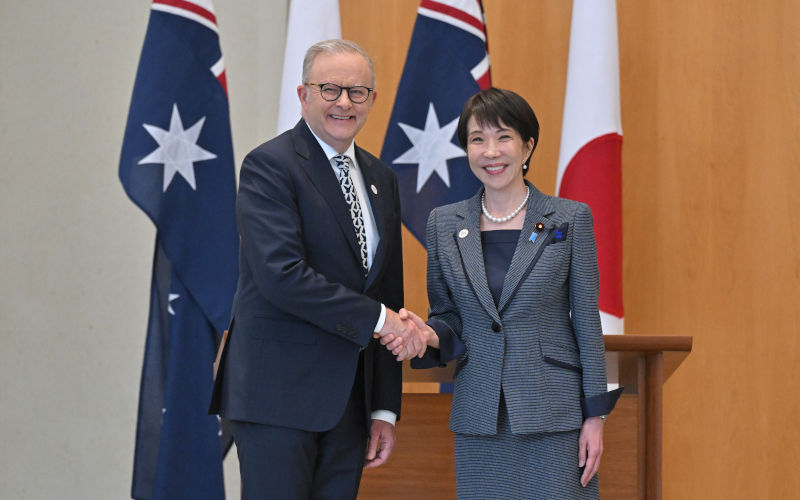
Japan’s Prime Minister, Sanae Takaichi, who is visiting Australia from 3 to 5 May 2026, shares the anti-China feelings of most Japanese hard-liners. This colours her foreign policy.
How and when does an ally become an adversary, or an adversary an ally? Japan changed to adversary back in the 1930s due mainly to its bad behaviour towards China. Its change back to the ally we embrace today was due to defeat in war.
But people who have fought a war for a cause they once saw as just, and have been defeated, can usually be expected to feel some resentment against the victors. That was the case with Germany after defeat in the First World War. That resentment in turn bred the hard-liners, Hitler for example, who led the move to the Second World War.
And in the case of Japan?
As we welcome Japan’s leader Sanae Takaichi to Australia as a close ally we should be asking the same question.
Japan has its genuine pacifists; I have met many of them. They would make wonderful allies. In 2002 they used North Korea’s cooperation in locating and returning abducted Japanese as a lever to negotiate an agreement that would have seen Pyongyang come out of its seclusion. It would have ceased to be an adversary.
But Japan also has its hard-liners. At the time, and before his assassination, it was led by Shinzo Abe, later prime minister. Abe made sure the agreement with Pyongyang was aborted by inventing the fiction that North Korea was still holding many abductees. Pyongyang became an adversary again.
It is no secret that Takaichi was a close supporter of Shinzo Abe, who may have done much for her rapid rise in Japan’s politics. She shares the anti-China feelings of most Japanese hard-liners. And she does not apologise for Japan’s Pacific war; she sees it, partly correctly, as caused by the trade sanctions imposed on Japan by Western nations, Australia included, for its attacks on China.
Japan seemingly still cannot shake off its anti-China bias. Unfortunately, and like most of Japan’s hardliners, the current Prime Minister’s anti-China, pro-Taiwan feelings dominate much of her foreign policy and are being used to justify increases in Japan’s defence spending.

Gregory Clark was the first postwar Australian diplomat trained in Chinese, with postings to Hong Kong, Moscow and the UN before retiring in protest against the Vietnam War. After PhD studies at the ANU he became Japan correspondent for The Australian. A spell in Canberra’s Prime Ministers department led to professorships at Tokyo’s Sophia University and emeritus president of Tama University, Tokyo, before becoming co-founder of the very successful English language Akita Kokusai Daigaku. He has now retired to Latin America (Peru) and Kiwi fruit growing in Boso peninsular south of Tokyo.
His works include ‘In Fear of China’ (1969) and several books in Japan on education and foreign policy.
He used to speak Chinese and Russian with fluency. He now speaks Japanese and Spanish.