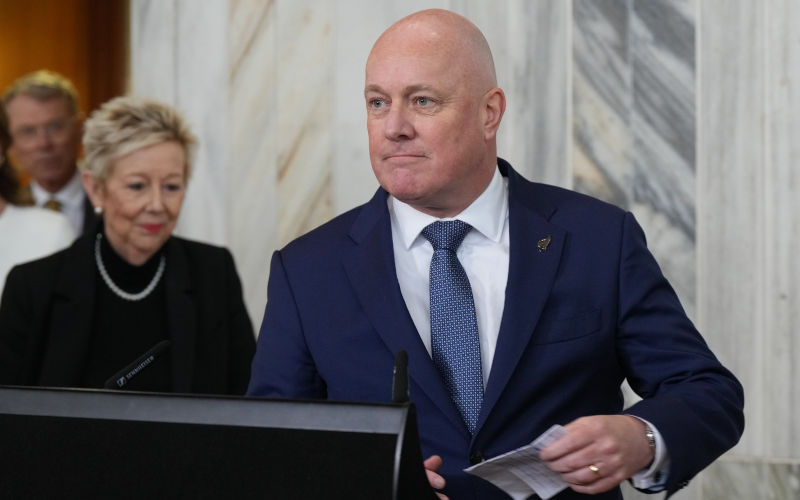
Christopher Luxon has survived another confidence vote, but the failed leadership challenge has exposed a government under strain, a deeply unpopular political class and an electorate increasingly underwhelmed.
New Zealand Prime Minister Christopher Luxon has just survived a coup attempt partially engineered by … himself. Confusion reigns in the capital after Luxon staggered out of the caucus room bloodied but still standing after Defence Minister Chris Penk launched a challenge. His MPs were ‘unified’ behind him, Luxon said, shortly before sacking Penk. Other ministers named in the putsch ran for cover this morning denying any involvement despite leaks to the contrary. “Penk was working for himself,” MP Chris Bishop, named by some as a co-conspirator, told journalists.
The NZ National Party have a long, proud history of efficiently decapitating leaders who have passed their use-by dates. The Minister of Defence left without firing a shot and last night announced that he was standing down from Parliament.
New Zealand is still three months out from the elections, and now would have been an ideal time to fire the gaffe-prone Luxon. At best, it may have been decided to wait till after the election to roll Luxon but that carries real risks if the blunderfest continues.
A Labour Party strategist told me today, “It’s utterly bizarre. I’ve seen a lot of leadership challenges and changes over the years, and I’ve never seen one like this.” He suggested the government has harmed itself by having a second vote of confidence in Luxon in four months – and then bungling it.
After days of speculation about possible challenges, it was Luxon himself who called for a confidence vote. The National MPs gathered on Wednesday morning. We saw the usual media siege of the caucus room when the leadership is on the line. For a laugh, Labour MPs wandered by and handed out popcorn to the journos.
Independent polling shows Luxon is massively unpopular with the electorate but such is the state of politics in the country he is slightly less reviled than every other politician. New Zealand is suffering from a charisma and competence crisis. Luxon’s miserable 17 per cent support in the preferred prime minister rating, according to a 1News Verian poll released yesterday, puts the PM two points ahead of Labour’s Chris Hipkins (15 per cent). Both men have failed to spark enthusiasm from any but the true believers.
Previous leaders such as Jacinda Ardern, John Key and Helen Clark often tipped 50 per cent.
A well organised Green Party with a strong policy platform has failed to get above 12 per cent in the polls and its co-leader Chlöe Swarbrick commands just 6 per cent in the preferred PM stakes.
One of Luxon’s problems is that he gets confused about what job he’s in. The man constantly refers to himself as a ‘CEO’ perhaps looking wistfully back to easier, happier, more lucrative days when he was the CEO of Air New Zealand.
The hard truth is that after nearly three years in the job Luxon just doesn’t understand how politics works. He consistently emphasises how good it is for CEOs to run the country, while manifestly proving that this is not the case.
And he has a chronic foot-in-mouth problem. Earlier this month he sat in a room full of business people (his core support base) and insulted them; telling the small business owners that they should start being adults and stop sticking their hands out and expecting assistance from the government.
This week he made a surprise announcement. If re-elected, he said, he would put the electoral system of New Zealand up to a referendum, apparently in response to the kind of parties that dominate under a system of proportional representation. There had been no consultation within his own party, and no careful testing of the waters first.
In government, Luxon and the Nats have been bossed around by the two junior parties of the coalition – New Zealand First and ACT. Bad poll numbers could panic skittish MPs fretting over increasingly marginal seats as old loyalties fade and insurgent parties grab a bigger share of the vote.
In Australia something similar is happening. The percentage vote of the Liberal National Coalition and the ALP combined is at historic lows. One Nation is trading on the same anti-immigrant, white nostalgia narratives as Nigel Farage’s Reform party in the UK, Le Pen’s far-right National Rally in France and here in New Zealand, with the New Zealand First Party.
Three months is a long time in politics. It gives plenty of opportunity for Luxon to lose mouth control again or external factors such as a long-feared energy shock being transmitted from the Strait of Hormuz just in time to rattle the ballot boxes. Watch this space.

Eugene Doyle is a writer based in Wellington. He has written extensively on the Middle East, as well as peace and security issues in the Asia Pacific region. He hosts the public policy platform solidarity.co.nz.