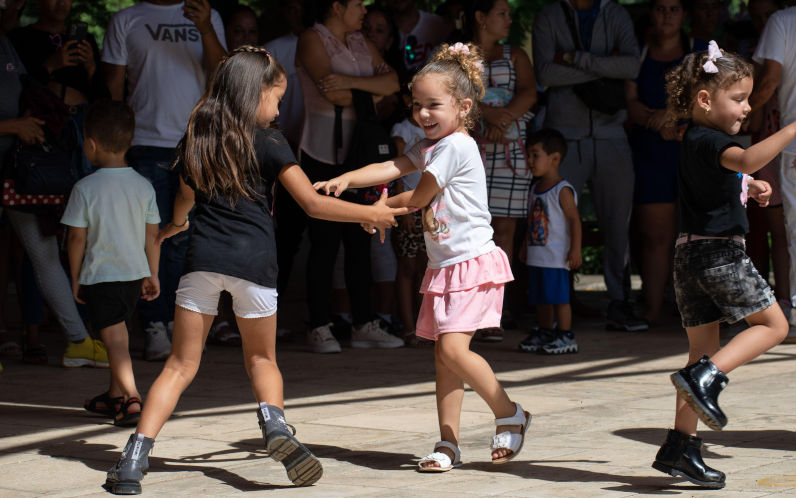
New research links unilateral economic sanctions to more than half a million deaths each year, with children under five disproportionately affected. Cuba shows how policies intended to punish governments can instead devastate civilian lives.
US unilateral sanctions, the kind being imposed on Cuba today, are deadlier for children than war, according to a major piece of research published in The Lancet, the world’s leading medical journal. The report’s findings should call into question the use of sanctions to impose punishments on entire populations for the actions of their governments. A staggering half-million civilians die annually due to US and EU unilateral sanctions that many western countries help enforce.
The report by Professor Francisco Rodríguez, Silvio Rendón and Mark Weisbrot vividly underscores US president Woodrow Wilson’s comment that sanctions were “something more tremendous than war”.
Effects of international sanctions on age-specific mortality: a cross-national panel data analysis data-mined major studies covering the years 1971–2021. Its primary source was the Global Sanctions Database (GSDB), internationally the most comprehensive aggregator of global datasets on sanctions.
Analysing research covering the years 1971–2021 across 152 countries, the researchers found that unilateral sanctions (such as those imposed on Cuba, North Korea, Iran, Yemen and Iraq) were “associated with an annual toll of 564,258 deaths, similar to the global mortality burden associated with armed conflict”.
Imagine that: every year, for decades, sanctions (primarily US and EU sanctions) have taken the lives of hundreds of thousands of civilians – and that rate has accelerated, not declined, because American use of sanctions has exploded in recent years.
According to the Global Sanctions Database (GSDB), 25 per cent of all countries have been put under US, EU or UN sanctions in the 2010–22 period. That’s a massive leap from 8 per cent in the 1960s. For this short article I will focus on Cuba, but the same lessons apply to whatever countries are targeted for unilateral sanctions.
Saving the babies of Cuba
Professor Francisco Rodriguez, an economist at Denver’s Josef Korbel School of International Studies, is the lead author of the study. He says: “Our findings reveal that unilateral and economic sanctions, particularly those imposed by the USA, lead to substantial increases in mortality, disproportionately affecting children younger than five years.”
Medea Benjamin, the great American activist from the CodePink peace organisation, recently visited Cuba to bring medicines and medical supplies to Cuba’s paediatric hospitals. She is now under investigation for doing so – for breaking US unilateral sanctions.
“Basically, we want to help save babies, and that, according to Trump, is something that must be investigated. Because ‘How dare we want to help the Cuban people? How dare we love the Cuban people?’ If indeed the charge is that we love the Cuban people – ‘Guilty!’ I want my government to leave the Cuban people alone, not to be strangling them by keeping oil from the island, by sanctions that are so brutal,” she says.
“I want them to stop threatening to invade Cuba. I want them to listen to the global world opinion that every single year at the United Nations overwhelmingly says: lift the blockade.”
Sanctions: the modern ‘siege engine’
Why the silence from the mainstream media about the report’s findings? Dr Josephine Varghese of the University of Canterbury suggests this is because the west puts great effort into burying inconvenient truths. She specialises in the intersections of colonialism, capitalism and structural violence and told me this week: “The United States has openly admitted that the purpose of the sanctions is to create conditions so bad that the people in Cuba will turn against their own government.”
Cuba’s entire electricity grid collapsed last week, driving millions of Cubans to the brink; just what the US wants.
“At the ground level, sanctions have a deadly impact,” Dr Varghese says. “Cuba had such impressive achievements in health, for example, in lowering infant mortality. The current sanctions and punishments are targeting this. We are seeing nurses and doctors having to manually operate ventilators and incubators for premature babies.”
Luis Ernesto Morejón Rodríguez, Cuba’s ambassador to Wellington, New Zealand, reinforced this message when he told me of the human impact of the blockade:
“I think about children fighting cancer whose chances of survival have been devastated because the chemotherapy drugs and other essential medicines they need are simply not available. Years ago, around 65 per cent of these children could expect to survive. Today, because treatments are interrupted or cannot be provided at all, that figure has been tragically reversed: as many as 85 per cent may not survive. I think about the parents waiting for a phone call that never comes because more than 100,000 Cubans – including over 12,000 children – are still waiting for surgery.
“Cuba once had one of the lowest infant mortality rates in the Americas. Today that rate has more than doubled, rising from around four to more than nine deaths per thousand live births. These are not just numbers. They are children who should still be alive, families carrying unbearable pain, and healthcare professionals forced to make impossible choices every day. Political differences should never be settled at the expense of ordinary people, and certainly never at the expense of children.”
Now that we know that sanctions have effects on the health and mortality of civilian populations similar in magnitude to those of armed conflict, what should we do about it? Will we continue to shrug and look the other way out of fear of the US or indifference to human suffering?
Isn’t it time to find the courage to oppose this? The reform of the entire sanctions framework must be a global priority. Unilateral secondary sanctions (forcing other countries to implement sanctions) are already illegal under international law. Such is the power of the US and the EU – controlling as they do a large portion of the levers of international trade and finance – that most countries bow down and comply. For the sake of children suffering now and millions more not yet born, that must end, and a new era which restrains and reforms the use of sanctions must be ushered in.
As the great Brazilian educator Paulo Freire said: “Washing one’s hands of the conflict between the powerful and the powerless means to side with the powerful, not to be neutral.”
Eugene Doyle is a writer based in Wellington. He has written extensively on the Middle East, as well as peace and security issues in the Asia Pacific region. He hosts the public policy platform solidarity.co.nz.