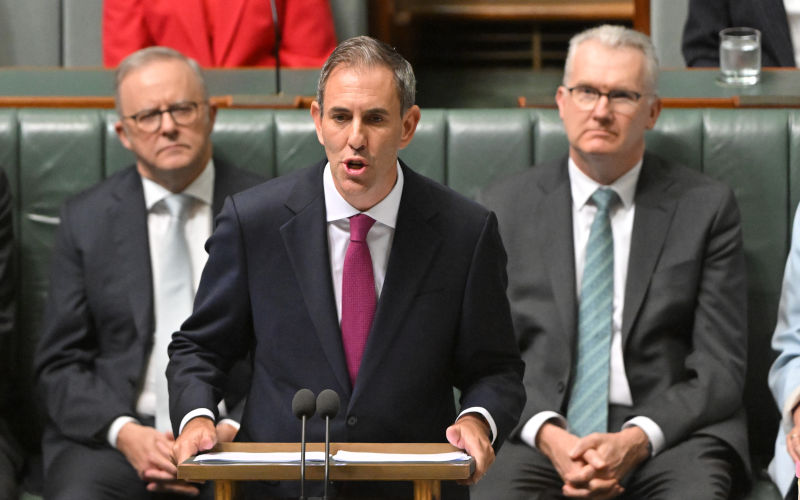
As the government’s hearing on its tax changes enters its second day, tax reform will be harder to defend if capital tax changes are left standing alone, and Labor should link them directly to bigger income tax cuts for wage and salary earners struggling with the cost of living.
Federal Treasurer Jim Chalmers went about his tax reform the wrong way. He thought that if he could get the negative-gearing, trust, and capital-gains changes over the line in the Budget process he would be in a position to offer some income-tax cuts in subsequent years.
He has copped an onslaught from greedy, self-interested parties, using every specious argument and scare tactic in the book to oppose the changes to the way capital is taxed.
He should not have done taxes on capital on their own. He should have tied the increase in capital taxes with big reductions in income taxes: a total package of major tax reductions for low-income earners (with the emphasis on “earners”) which would only be available if the changes to the tax on capital and trusts went ahead.
It is still not too late to do this.
About $40 billion in tax is lost to schemes and loopholes that reduce tax on the earnings from capital – negative gearing, capital-gains concessions, cash franking credits, and trusts. They are basically government hand-outs to non-working Australians.
What we need is for Jim’s Mowing to come along and scoop up that $40 billion into the grass-catcher and give it to deserving people who work for a living and pay tax through the Pay As You EARN system – the people who get up in the morning, grab some toast and a coffee, put on a hi-vis shirt, and hit the construction site or a child-minding centre, an office, or a shop.
These are not the people who sit round the trusty family dining-room table waiting for unearned income to come around on the Lazy Susan.
With the transfer of the $40 billion from people getting income from capital to people earning money from labour, no wage or salary earner would have to pay any tax on the first $65,000 of income.
But Chalmers must make the link. He must say the only way to help hard-working Australians (emphasis on “working”) is to remove the hand-outs to capital. A general move in the overall tax rates does not differentiate between capital and labour.
It is simply not possible to give big, meaningful tax cuts to working Australians struggling with the cost of living if capital gets all the tax breaks and gets even more tax cuts every time labour gets a tax cut.
Labor should display itself as the party that, in the words of One Nation Leader Pauline Hanson, “stands with hardworking Australians, the ones who roll up their sleeves, put in the hours, and ask for nothing more than a fair go”.
It should show it with actions – not just words and slogans – that Labor stands for working Australians, as its name suggests. And that it does not stand for aircraft-donating billionaires or for spending 5 per cent of hard-working Australians’ national income on defence, particularly US-made weapons, as Hanson said when she went arm-in-arm with President Donald Trump at Mar-a-Lago late last this year.
Labor had the right idea in the Budget with the $1,000 work-expenses deduction and the small rebate reserved for wage and salary earners, but it went nowhere near far enough for working people to cope with the rising cost of living.
It is inequitable that a struggler living in a caravan park and earning $45,000 a year from a couple of desperately insecure casual jobs pays more than $4000 in income tax.
If Jim’s Mowing could redirect that $40 billion hand-out to non-workers, it would mean that wage and salary earners would not have to pay any tax at all on the first $65,000 that they earn. If resources like gas were taxed properly the tax cuts could be even bigger.
That would be a genuine addressing of the cost-of-living crisis.
Most people do not understand the sheer massive size of the money dished out in concessions to people with income earned from capital or the amount lost through tax-avoiding trusts, and the enormous burden imposed on people earning from labour.
No doubt Chalmers understands it, but he has not communicated it effectively, and has not done enough quickly enough.
The reason Labor got to this position is that it used the Budget process.
I wrote in early April that “the Budget process is the wrong vehicle for an overhaul of the tax system. It is inherently secret, so there will be no input from academics, think tanks, and other outside experts and no scrutiny or testing of proposals until it is too late and the Government is locked in.”
The Budget process produces a cake that is already cooked and very hard to make more irresistibly palatable after the event.
Even so, this is a very good cake, and the government should not allow the greedy few to continue to escape paying a fair share of tax.
The major reason someone creates a trust is for people on the top marginal tax rate to avoid tax. A non-working beneficiary (usually an adult child) of a trust pays about $4000 in tax on the first $45,000 paid out. Without the trust Daddy or Mummy would have had to pay about $22,000 in tax – an $18,000 totally unjustified tax rort.
Bear in mind, One Nation voted in the Parliament for this rort to continue. And One Nation (which says it stands for “hard-working” Australians) voted against even the very small tax cuts specifically directed to Australians who work for a living.
One Nation and the Coalition cite “trust” as the reason for not supporting these measures. You can trust them to side with big capital and big military against hard-working Australians every time.
Politicians in Australia have to stop falling for the stupid “rule in, rule out” media game. It results in things like the “never, ever GST”, “Fire the Liar”, and the “Juliar carbon tax” and the silly headlines: “PM fails to rule out X Y or Z.”
The public should start seeing that politicians who rule things out are letting the country down. If things are not working, they should be fixed. If circumstances change so should policy.
Judge the policy and the actions not the words uttered in the past. The continuation of patently bad policy is a far greater breach of public trust than doing something about the bad policy which a politician had earlier “ruled out”.
These tax policies should be argued and judged on their merits and there are lot of them, not on whether they had been ruled in or out.
After all, in a democracy, the whole government can be ruled out at the next election.
This article first appeared in The Canberra Times and other Australian media on 16 June 2026.
Republished from Crispin Hull

Crispin Hull
Crispin Hull has written for The Canberra Times for 30 years on a huge range of topics, but mainly legal and constitutional. He was Editor for seven years. He taught journalism at the University of Canberra, and is the author of ‘The High Court of Australia 1903-2003’ and ‘Canberra – Australia’s National Capital’. He is also a marine rescue skipper on the Great Barrier Reef with Marine Rescue Queensland.