Blistering heat and poor rains warning, Xi’s acceptance of North Korean nukes, the Pope’s Pyongyang visit plan, military crowd control in Jakarta protests, India’s recognition of women’s unpaid work, and China’s new ‘she economy’.
Authorities in Asia are bracing for the risk of a super El Niño, with higher temperatures and lower rainfall hitting residents, farmers and industrial operations.
Meteorological agencies in India,Thailand and Japan have joined Australia in declaring that El Niño conditions have formed in the Pacific Ocean.
A story in The Japan Times said dry weather was disrupting crop planting across Asia, raising concerns about food supplies in the world’s most populous region.
It said one of the strongest El Niños on record was widely expected to develop in the second half of this year.
Hot weather and below normal rains were hurting crops and forcing farmers to reduce planting from India’s grain-producing northwest to Thailand’s rice fields, Indonesia’s palm oil plantations and Australia’s eastern wheat belt.
Wheat prices had risen 20 per cent this year and rice prices at Southeast Asia export hubs had climbed by about 15 per cent in the past month.
Ucanews.com cited a report in the journal Science saying there was a 63 per cent chance the El Nino will grow into a very strong event later this year – double the odds assigned in May – and that it might become the strongest this century.
The World Meteorological Organisation had said Cambodia, Laos and southern Vietnam could expect extreme heat and water shortages.
Thailand, Indonesia, Myanmar and Malaysia faced heat waves, followed by storms and flash floods, the story said.
India is already suffering from a water deficit as the arrival of monsoon rains is being delayed in many regions. The Hindu said the mid-June water deficit was 35 per cent, rising to 63 per cent in central India.
“While a rainfall deficit in June, the first of the monsoon months, is not unusual, it assumes additional significance in a year that forecasters globally have warned will likely be a ‘Super El Niño’ year,” the paper said.
In Thailand, climate expert Seree Supratid, of Rangsit University, said temperatures could rise by 1.5-to-2.5 degrees Celsius by April next year, Bangkok Post reported. Average temperatures in Bangkok could reach 39-to-41C.
The Thai government is concerned about a region called the Eastern Economic Corridor – the eastern seaboard and hinterland. It has a big population, extensive agriculture and a large slice of the country’s industry.
Bangkok Post reported government spokesperson Rachada Dhnadirek as saying water demand in the region next year would be almost double current levels.
The Japan News said temperatures were likely to soar this summer. “The El Niño this year deviates from the typical pattern,” said an official at the Japan Meteorological Agency. “We hope people will be well-prepared for the heat.”
Silence a turning point in denuclearisation debate
North Korea’s nuclear weapons remain a serious issue for G7 leaders. At their meeting in France this week, they expressed deep concern about Pyongyang’s nuclear and ballistic missile programs, according to a Reuters report. They reaffirmed their commitment to the denuclearisation of North Korea, in line with UN resolutions.
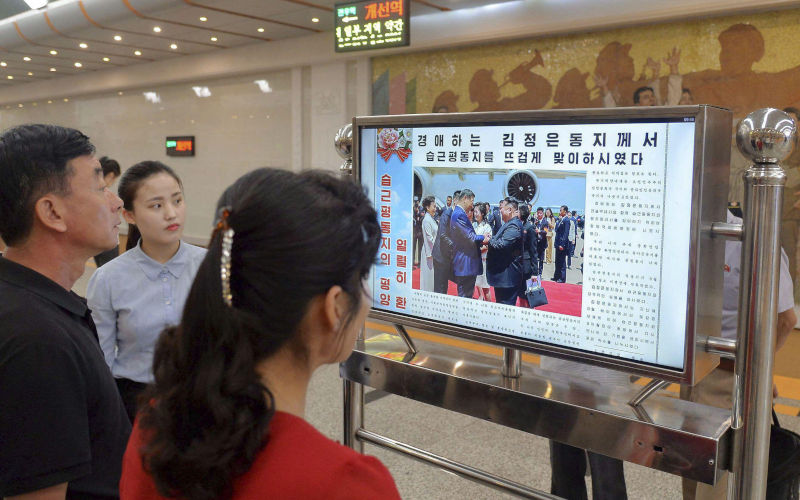
Yet their cause had already been undermined by Xi Jinping’s recent visit to North Korea. Over two days, China’s president did not mention denuclearisation, turning a blind eye to Pyongyang’s nuclear weaponry.
Donald Trump met North Korean leader Kim Jong Un three times during his first term in office and failed in his attempts to get an agreement on dismantling the program. He said last year he would love to meet Kim again.
An analysis in Hong Kong’s South China Morning Post says Trump should recognise what much of the region already understands: denuclearisation is no longer a realistic policy objective.
The commentary, by North Korea expert Gabriela Bernal, says Xi’s visit to North Korea last week might be remembered as a turning point in the international debate over its nuclear weapons.
“The most significant development may have been what was left unsaid,” Bernal writes. “Neither side publicly referenced the denuclearisation issue. On the contrary, Xi called for expanded co-operation in the military sphere – marking a remarkable shift in China’s long-held position in support of the Korean Peninsula’s denuclearisation.”
China was the chair of the six-party talks of 2005 that set out the goal of denuclearisation. The group included North Korea. An article in The Chosun Daily says that since then the international community has regarded the six-party statement as a fundamental principle for resolving the North Korean nuclear issue.
Xi’s silence has led to assessments that this process has effectively reached its end, the analysis says.
Beijing has been watching from the sidelines as North Korea’s involvement in the Russia-Ukraine war has deepened Pyongyang-Moscow ties, says an opinion piece in The Diplomat, the Asian online news magazine.
The stagnation of Beijing-Pyongyang ties showed China it did not have the economic leverage to compel North Korea to give up its nuclear weapons, the article says.
“The Russian example… indicates that tacit acceptance of North Korea’s nuclear program is a prerequisite to advancing bilateral ties,” it says.
President Lee, Pope Leo and peninsula peace
South Korean President Lee Jae Myung has invited Pope Leo XIV to visit Seoul next year, to attend World Youth Day activities. The invitation was a courtesy, as the event is a massive, week-long gathering of young Catholics.
But Lee also had another visit in mind: he and the Pope discussed ways of promoting peace on the Korean Peninsula and, behind the scenes, Seoul planted the idea of a papal visit to North Korea.
Lee met the Pope in the Vatican last week, on his way to this week’s G7 meeting in France. He briefed the Pope on South Korea’s efforts to build peace between the two Koreas and the Vatican reaffirmed its unwavering support for helping achieve peace, The Korea Times said.
The paper said Seoul wanted to engage the Vatican in its efforts. “Lee and Pope Leo XIV also presumably discussed the possibility of the pope’s visit to North Korea,” it said.
A story in Singapore’s The Straits Times quoted a senior South Korean official as saying the pope’s potential Pyongyang visit had been raised with the Vatican Secretary of State, Pietro Parolin.
But a South Korean cardinal said that whether the pope visited North Korea depended on Pyongyang, The Korea Herald reported. Lazzaro You Heung-sik said a visit by the American-born pope might also make it possible for him to play a role in North Korea-US relations.
The Korea Times said in an editorial inter-Korean relations had deteriorated to their lowest point in years. Channels of communication were largely severed and mutual hostility was deepening.
“A possible papal visit to North Korea would not merely be a religious event,” the paper said. “It would be a powerful diplomatic and symbolic gesture, potentially creating space for dialogue where conventional diplomacy has reached an impasse.”
Prabowo’s soldiers step into civilian space
Indonesia students have taken to the streets to protest against wasteful government spending but demonstrators in Jakarta have found themselves blocked by police, backed up by the military.
The protests are fuelled by a list of grievances, according to a story in The Jakarta Post. A fresh wave of student-led demonstrations had swept Jakarta and several other cities, the story said.
Protesters had accused the government of neglecting the economic difficulties facing ordinary Indonesians while continuing to fund costly flagship programmes. One of their targets was President Prabowo Subianto’s free meals program, which had been allocated Rp 268 trillion (about A$21.4 billion) this year.
In the first big demonstration, on 12 June, students had planned to rally at the Hotel Indonesia traffic circle in Central Jakarta, the paper said in a separate story, but police intercepted their buses. The students started walking towards the roundabout but were blocked by lines of police officers backed up by TNI (military) personnel.
The presence of soldiers in green uniforms was a rare sight at protests, the story said.
The deployment drew criticism from civil groups and activists. The story quoted Al Araf, described as a military expert from a civil group called Centra Initiative. “Engaging the military in protests is a clear form of militarisation of civilian space,” he said. “It’s even more troubling when it enters democratic spaces and restricts freedom of expression.”
Amnesty International Indonesia executive director Usman Hamid criticised the military deployment. He said security during public demonstrations was primarily the responsibility of the police, the Tempo news site reported.
“The military is trained, educated and armed for war, not for handling issues within society,” he said.
But Tempo also ran a story quoting a military general as saying the TNI involvement was carried out under established security procedures. The assistance had been requested by the National Police, the general, Muhammad Nas, said.
Top court’s ruling: homemakers are nation-builders
India has a female participation rate in the paid workforce of only 31.7 per cent, largely because its society presumes caregiving and domestic work automatically fall to women.
Their domestic work is estimated to contribute more than 15 per cent of the country’s GDP but is unpaid and, until now, unrecognised.
India’s Supreme Court last week held that homemakers deserved to be acknowledged as nation-builders, The Hindu newspaper reported.
“We are of the view that the housewife contributes to the growth of the human being and the nation,” said Justices Sanjay Karol and NK Singh.
The court ruled that unpaid domestic work should be valued at a minimum of R30,000 (about A$450) a month. (This is close to the average salary of R32,000 a month).
It set the rate when ruling on compensation on a road accident claim. It said that in cases involving the death of a homemaker, the Motor Accident Claims Tribunal should award the compensation under the heading of ‘domestic care.’ The value it set would be raised by 10 per cent every three years.
The court decided not to extend the ruling to male homemakers. “We limit its application to the quintessential and traditional image, that of a woman,” the judges said.
But they said society should shift from using the stereotypical terminology of ‘housewife’ to ‘homemaker.’
A commentary in The Statesman newspaper said Indian society had perfected a contradiction: it revered women as selfless nurturers and anchors of the household, yet the labour that sustained families was often dismissed as ‘non-earning’ and unworthy of serious recognition.
That contradiction was finally being confronted. “The significance of the evolving judicial approach towards homemakers lies not in sentiment but in economics,” the article said. “It acknowledges an uncomfortable truth: unpaid care work is work. It creates value, supports productivity and forms the invisible foundation upon which the formal economy rests.
“Recognising that truth is not an act of charity. It is an overdue act of honesty.”
Note: Australia’s female labour force participation rate varies from time to time but is about 63.5 per cent.
Chinese women’s spending power – and purchases
In a theatre in Beijing, an enthusiastic audience of 1,300 people watches a modern dance production. As the show reaches its finale, the dancers remove their tops. “You’re so beautiful,” screams one fan. “Let me help you take it off,” shouts another.
It could be a nightly scene in cities around the world but there is a difference: the dancers are men, all more than 1.8m tall and with ripped abs; the audience is overwhelmingly female.
The hunky-men dance troupe is called Gonggou Theatre, literally Male Dog Theatre. It is riding the wave of China’s new ‘she economy’.
A show like this, called Tan Chunfeng, or Ode to Spring Breeze, would have been inconceivable two years ago, says a feature article in The Straits Times. But, the story says, it has already been seen by 800,000 people, most of them women.
The feature, written by Yew Lun Tian, a senior China correspondent with the paper, says that as women gain access to education, careers and financial independence, many see themselves not just as daughters, wives or mothers but also as individuals with desires and aspirations of their own.
“Some are marrying later,” Yew writes. “Others are choosing not to marry or have children at all. Their income is no longer automatically earmarked for a marital home, household expenses or a child’s tuition fees. Increasingly, they are free to spend it on themselves.”
The result is the growth of the ‘she economy,’ with entrepreneurs now catering directly to women consumers, rather than treating them as family purchasers. One estimate put the 2025 value of this emerging economy at 12.8 trillion yuan (about A$2.69 trillion).
“Where social norms shift and spending power follows, businesses are rarely far behind,” Yew says.
Yew went to a performance of Ode to Spring Breeze and says there is something bemusing, even surreal, about seeing women ogling men’s physiques. “For centuries, Chinese men did the looking while women were the ones being looked at,” she says.
“To be sure, the open admiration of men exists only within the four walls of the dance theatre. Once outside, these women are hardly about to start wolf-whistling at men in the street.
“Moral police can rest easy.”

David Armstrong is the Editor-in-Chief of Pearls and Irritations. David is one of Australia’s best respected reporters, editors and media executives, with more than five decades of experience in Australia and Asia. A contributor for more than 10 years, David writes a regular column on Asian media.