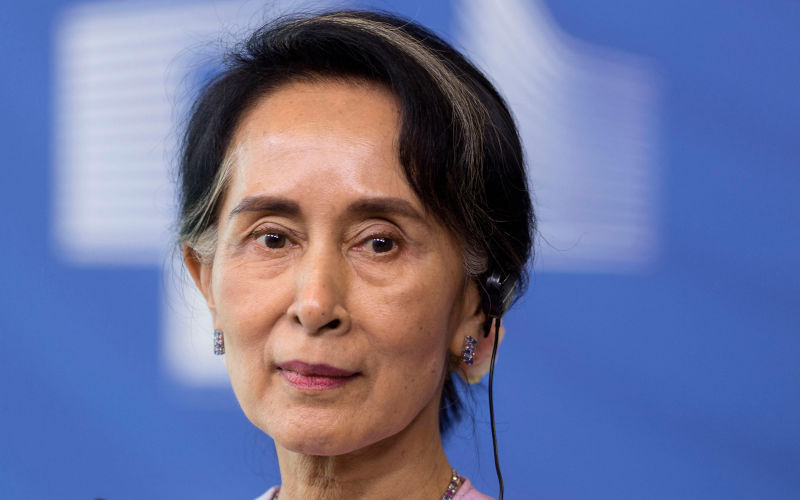
Myanmar’s regime has made some gestures to stabilise its internal situation, moving Aung San Suu Kyi to house arrest, releasing other political prisoners and holding (widely disparaged) elections. This is unlikely to appease its opposition forces, who want the regime gone.
Moving Myanmar’s key democracy figure, Aung San Suu Kyi, from prison to house arrest, along with the reduction in her sentence on trumped-up fraud charges to six years, is a small step in a positive direction. But it is unlikely it represents a substantive change on the part of the military that ousted her National League for Democracy from office five years ago.
Since the 2021 military coup that ended Myanmar’s brief period of democratisation, the country has been engulfed in a civil war estimated to have killed 93,000 people and displaced millions of others. While the military-backed regime retains control of major cities and towns, it has lost control of around two-thirds of the country’s territory to the opposition-based People’s Defence Forces (PDF) and a plethora of armed ethnic groups.
Russia’s recent formalisation of military support for the regime, and substantial support from China, has buttressed the regime’s technological advantage over the armed opposition groups. But, while the regime forces have had some successes, they have also lost a number of key battles, with the current military situation being broadly even.
Myanmar’s economy has largely collapsed since the coup. China wants Myanmar to regularise its politics to safeguard China’s substantial investments and strategic influence. The moving of Suu Kyi to house arrest, along with the recent release of other high profile political prisoners and (widely disparaged) elections, could be seen as a stabilising gesture by the regime.
Notably, too, at 80 years of age, Suu Kyi’s health is believed to have declined while in prison. House arrest will allow her access to better medical care. It would have been hugely embarrassing for the regime had Suu Kyi died in prison.
The regime’s supporters, in particular China, have lauded the elections, the release of political prisoners and Suu Kyi’s removal to house arrest as major steps towards reconciliation. However, opposition groups in Myanmar have viewed the elections as fraudulent, given the restrictions on who could compete, and the release of political prisoners as a welcome but insufficient gesture. Suu Kyi’s removal to house arrest will be seen in much the same light.
Most importantly, Suu Kyi’s house arrest does not indicate a fundamental change in the regime’s position. It is unlikely that it will take the next step and enter into peace talks with an opposition that it has branded as ‘terrorists’.
The civil war has thus become characterised by its ‘all or nothing’ stakes. The opposition groups widely regard the regime’s leadership as having no place in a democratic Myanmar. For them, this is not just a war over the status of democracy in Myanmar but a revolution to completely end the military’s role in politics. The opposition National Unity Government (NUG) appears to agree with its major armed ethnic allies that the constitution must be rewritten to recreate Myanmar as a federation of autonomous states rather than a unitary state controlled from the centre.
Should the opposition groups gain the upper hand, the military would be confined to barracks and the regime’s senior leadership would either go into exile, most likely in China, or face criminal charges at home. Acceptance of the opposition’s claims would imply the regime’s surrender, which is a long way from the regime’s so-far symbolic gestures.
But it is clear the regime is feeling pressure, from China, from its ASEAN partners which regard it, at best, as an embarrassment, and from the wider international community. It is also struggling to conscript recruits to fight the opposition forces, with soldiers’ morale said to be very low and desertion rates high.
Sham elections, the release of some political prisoners and Suu Kyi being placed under house arrest are no doubt viewed by Myanmar’s regime as meaningful steps towards reconciliation. But this only illustrates its profound lack of understanding of an opposition that has its sights firmly set on wholesale political change.

Damien Kingsbury Professor Emeritus, School of Humanities and Social Sciences, Deakin University; author of ‘‘Politics in Contemporary Southeast Asia: Authority, Democracy and Political Change’, Routledge, and ‘South East Asia: A Political Profile’, Oxford UP.