Rapid advances in lithium-metal battery systems, all-electric submarines and autonomous underwater vehicles are reshaping undersea warfare well before Australia is likely to deploy an operational nuclear-powered submarine force.
As the Department of Defence asserts there is no alternative to the lumbering AUKUS program, conventional submarine technology is rapidly evolving. It will constrain what Australia can do with its nuclear-powered submarines (SSNs).
In late March Defence Deputy Secretary Hugh Jeffry said the RAN could maintain a submarine force only through the AUKUS program. The Department would not consider alternatives. Yet such is the pace of technological development in subsea warfare that alternatives will force themselves into Australian defence policymaking well before the deployment of any RAN SSN force.
Seven years ago we drew attention to the implications of emerging light metal battery (LMB) energy systems for submarines. HMAS Attack, first of the then proposed Australian Future Submarine Program, ignored this development and consequently would have been obsolescent before it was delivered in the early-mid 2030s. In 2021 the Morrison government circumvented this issue by initiating the AUKUS agreement to acquire SSNs.
Nuclear power has benefits but is not essential to sustain a lethal undersea warfare capability. China and India, operators of nuclear powered (and nuclear armed) submarines, maintain far greater numbers of conventional vessels. Acquiring SSNs is slow and expensive, their maintenance is complex and even the US Navy cannot meet its mission requirements with its exclusively nuclear-powered fleet. Even with the best of outcomes, Australia will not have an operational SSN capability until around 2040.
By then the undersea warfare environment will have been transformed, forcing a rethink of Australia’s requirements. The submarine LMB energy systems we described in 2019 are now standard for new submarine acquisition programs and the technology continues to evolve.
In March 2020 the Japanese Maritime Self-Defence Force (JMSDF) commissioned JS Oryu, the world’s first operational attack submarine to be equipped with lithium-ion (LIB) main batteries. It now operates seven LIB-equipped submarines, with another five under construction or planned, and a contract awarded to design the successor class for delivery in the early 2030s. By 2040 all of its 23-strong submarine fleet is expected to have LMB energy systems.
The success of Japan’s implementation of LMB energy technology in its submarine fleet, with no disruption to its metronomic construction schedule or discernible impacts on operational performance and safety, has provided other submarine planners and builders with the confidence critical for broad adoption.
European navies including Germany, Norway, Italy, the Netherlands and Greece are now in the process of acquiring LMB-equipped submarines, while Spain and Sweden are evaluating the technology for future adoption.
Of greater significance for Australia, Indo-Asia-Pacific navies including Japan, South Korea, China, India, Singapore, Indonesia and the Philippines are either actively acquiring LMB-equipped submarines or planning to do so in the near future.
The first generation of LIB-equipped submarines has demonstrated a submerged patrol endurance of around 12 days, more than twice that of a typical conventional submarines equipped with lead acid batteries (LAB), and with around three times the submerged high speed endurance. Transit ranges should be 15 to 20 per cent greater given the significantly higher efficiencies of LIB propulsion.
This performance rests on research from the early 2000s in Japan and South Korea, backed by the productive capacity of their advanced industrial economies. LMB cell-level energy densities have been improving by around 4-5 per cent annually since the early 1990s. This rate of improvement has been so consistent that advances in submarine performance can be reliably anticipated.
Around a decade ago submarine developers concluded that LMB energy capacity would increase within a few decades to the level where on-board recharging was infeasible or unnecessary. This would lead to the emergence of a new class of all-electric submarine totally powered by battery energy storage – the SSE.
This era is already dawning, in the shape of autonomous underwater vehicles, small coastal submarines and projected future regional SSEs.
Both South Korea and China have launched prototype small submarines in the 50m/500 tonne class which appear to be powered by LMB battery systems without on-board generators. By the early 2030s battery performance will allow such small craft to outperform current conventional submarines, patrolling submerged for 25-30 days and capable of a submerged advance of 300-350 nautical miles in less than 24 hours.
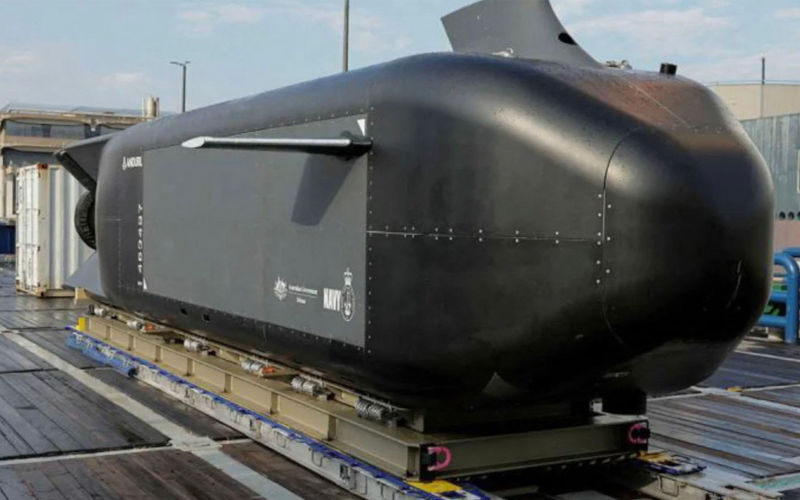
Last year Australia commenced production of the Ghost Shark extra large autonomous underwater vehicle (XL-AUV) and deployment is now commencing. This large underwater drone currently has less range and endurance than crewed submarines but can undertake covert surveillance and mine laying missions. The RAN expects them to be capable of launching strikes against land targets by 2040 (RAN RAS-AI Strategy, p11).
In 2020 France’s Naval Group revealed a Collins-sized concept SSE capable of zero-indiscretion submerged patrols of 40-60 days. Naval Group has been promoting this concept SSE to regional navies as an alternative to nuclear-powered submarines, and expects that an operational version will be available in the early-mid 2040s.
Such vessels foreshadow a technological disruption in undersea warfare. A crewed SSE, with no need for diesel generator sets or their complex fuel, air and exhaust systems, can be radically different. An SSE will have simpler design, lower costs of crewing, acquisition and support, and greater mission availability. SSEs will have significantly lower noise and thermal signatures than either conventional submarines or SSNs, and will be more difficult to detect.
SSEs designed for regional operations should be in service by the mid-2040s – around the time of the first Australian built SSN-AUKUS submarine. Cheap enough to be produced in numbers, such a submarine would effectively close an area, such as the waters around Taiwan, to foreign SSN operations.
It is now evident that conventional submarines newly entering service will be equipped with LMB energy systems. By the time Australia can operationally deploy a couple of SSNs they will be constrained by very large numbers of advanced LMB-equipped conventional submarines, coastal and regional SSEs and UUVs – friendly, suspicious or hostile – but with a presence that will dictate the limits of the RAN’s SSN submarine operations.

Derek Woolner
Derek Woolner is co-author of “The Collins Class Submarine Story: Steel, Spies and Spin”. He is a previous director of the Foreign Affairs and Defence Group in the Parliamentary Research Service.

David Glynne Jones
David Glynne Jones is an independent advocate for the adoption of renewable energy and electrification across all sectors of the Australian economy. He is currently assessing the implications of emerging advanced battery technology for low emission electrification of the Australian transport sector.