
The Catholic Church has not abandoned the right to self-defence, but it has increasingly rejected the idea that modern war can be morally justified.
The category of the “just war” – born with Augustine, systematised by Aquinas – was, for centuries, the Christian conscience’s attempt to subject violence to moral criteria. The magisterium of the recent popes has progressively eroded its ground, down to Leo XIV’s explicit move beyond it.
The turn begins in the atomic era. Pius XII restricted the licit recourse to arms to defence alone. As early as 1944, in his Christmas radio message, he had declared “now out of date” the theory of war as “an apt and proportionate means of solving international conflicts”. It was “out of date” in Pius XII and “outdated” in Leo XIV: the same word nearly 80 years apart.
John XXIII, in Pacem in Terris (1963), declared it alienum a ratione – foreign to reason – to imagine that, in the nuclear age, war could serve as an instrument of justice.
The Council, in Gaudium et Spes, called for war to be evaluated “with an entirely new attitude” and condemned total war as a crime against God and against man himself.
John Paul II carried this line down into history: his “never again war” rang out against the Gulf War and, later, against the intervention in Iraq, while Centesimus Annus had already called war a “self-destruction of mankind”.
Benedict XVI, more sober in tone, had staked out his position while still a cardinal: asked about the war in Iraq (in an interview with Zenit on 2 May 2003), he observed that modern weapons strike far beyond combatants, therefore “today we should be asking ourselves if it is still licit to admit the very existence of a ‘just war’”.
With Francis, the doubt becomes a verdict. In Fratelli Tutti (No. 258) he writes that it is “very difficult” to invoke rational criteria elaborated in other centuries to speak of a possible “just war” and he closes with an imperative: “Never again war!”
From Pacem in Terris to Magnifica Humanitas, the Church has never ceased to recognise the right to self-defence; it has ceased to lend war the comfort of an adjective.
In a footnote, he adds that Augustine “forged a concept of ‘just war’ that we no longer uphold”.
This is not merely the diagnosis of a “world war fought piecemeal”; it is doctrinal development: at Hiroshima, in 2019, he declared immoral not only the use but the very possession of nuclear weapons.
And to Patriarch Kirill, in March of 2022, with Ukraine under invasion, he said that one can no longer speak, as was once done, of “holy war” or “just war”.
Leo XIV takes a further step. In the encyclical Magnifica Humanitas, he denounces a “paradigm shift”: the rehabilitation of war as an ordinary instrument of international politics, even as the ethical principles that once limited its use erode.
In this context, he writes, “without prejudice to the right to legitimate defence in the strictest sense” the theory of the just war, “too often used to justify any kind of war”, is “now outdated”. “Humanity has more effective instruments at its disposal: dialogue, diplomacy, forgiveness.”
He extends the argument to the newest frontier – artificial intelligence applied to weapons, which removes the lethal decision from the reach of conscience. His programmatic formula, proclaimed from the loggia on the day of his election, is a peace that is “disarmed and disarming”.
Not a rupture but maturation: tradition deepening its self-understanding. From Pacem in Terris to Magnifica Humanitas, the Church has never ceased to recognise the right to self-defence; it has ceased to lend war the comfort of an adjective.
Republished from UCAnews
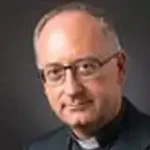
Antonio Spadaro
Antonio Spadaro, SJ, is undersecretary of the Dicastery for Culture and Education of the Holy See. He is a member of the board of directors of Georgetown University and an Ordinary academic of the Pontifical Academy of Fine Arts and Letters of the Virtuosi al Pantheon. He was editor in chief of La Civiltà Cattolica for 12 years.