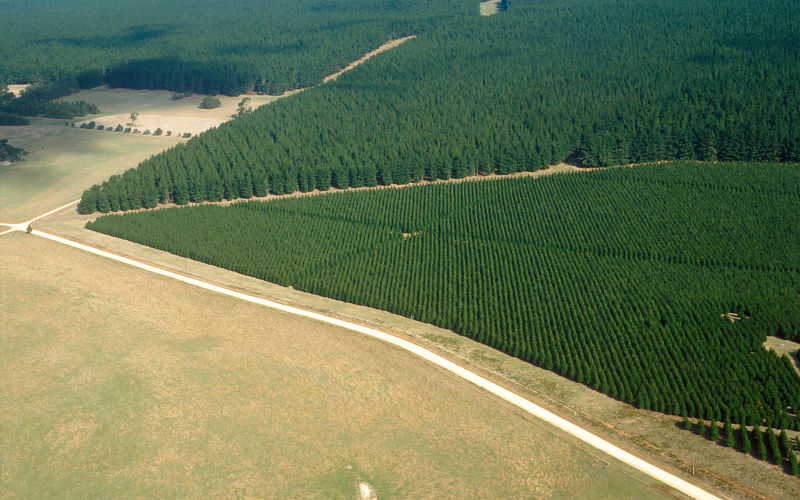
Timber plantations now provide the overwhelming majority of Australia’s sawn wood products and will become even more important as native forest logging declines and climate pressures intensify.
Timber tree plantations are broadly defined as:
Stands of native or exotic tree species that are specifically created by the regular placement of cuttings, seedlings, or seeds through human management for the purposes of wood production
Plantations currently supply over a third of global timber despite occupying only around 3 per cent of forests globally. The global area of plantations is increasing, having expanded by 75 per cent since 1990.
Plantations are important in Australia for a wide range of reasons, but they are especially critical for wood supply. This is because 90 per cent of the nation’s sawn timber – such as roof trusses, floorboards and furniture – comes from plantations, primarily softwood plantations such as those dominated by Radiata Pine (a tree species that initially came from California).
Plantations also contribute to wood security. A comprehensive global study showed that in Australia plantations are four times less likely to burn than logged and regenerated native forests. This means that plantations are far less likely to lose key crops of wood to wildfire.
In addition, wood can be produced far faster from plantations than native forests. As an example, softwood plantations in southern New South Wales are thinned at approximately 15 years, thinned again at 20 years, clearfelled at 25 years, and then replanted. This means there can be nine crops of wood produced in less than 80 years, with up to six of those crops being suitable for sawn wood products. In contrast, a native forest can produce only one crop of sawlogs in that same 80-year period.
Producing wood quickly is particularly important in an increasingly fire-prone world, where greater areas of wood production forest are damaged by wildfires each year. In fact, in some native forest types in Australia, the increased frequency of fire means trees have less than a 20 per cent chance of reaching sawlog age (80 years old) without being burnt. This makes investment in native forest timber extremely risky. By contrast, plantations provide a faster and therefore more secure supply, increasing the likelihood that trees will reach harvestable age before they are burnt.
Although plantations are less flammable than logged and regenerated native forests, they are still at risk of being damaged by wildfires. As stands of some kinds of plantation trees reach 25-30 years of age before they are clearfelled, they can remain fire-prone, although less so than young regrowth trees in native forests. Fire risks in plantations can be reduced through good design practices. For example, fragmenting plantation areas can help limit the spread of fire, and new technologies such as drones and sensor arrays can assist with rapid detection and suppression.
Beyond fire management, plantations must also be carefully managed to tackle weed and feral animal problems, both of which can be significant. Vast areas of softwood plantation in southern Australia, for example, are heavily infested with Blackberry, creating major problems for adjacent landholders. Land managers therefore need to take decisive action to control invasive plants.
Similarly, plantations can be invaded by large numbers of feral animals such as pigs, deer, and foxes. Active management is needed to significantly reduce – and then continually suppress – populations of these unwanted pests.
Although plantations are important for providing timber, the wood sourced from them is also valuable for paper manufacturing. Plantation species such as Blue Gum are more suitable for making paper than traditional kinds of feedstock such as Mountain Ash and Alpine Ash trees. Notably, demand for white paper products in Australia (and globally) has declined dramatically over the past two decades as more people transition to digital communication such as via email.
Parts of Australia produce large volumes of plantation pulplogs, such as in western Victoria. However, about 90 per cent of the nation’s eucalypt plantation pulplogs are exported. It stands to reason that more of this home-grown material should be retained and processed domestically, supporting local jobs and strengthening regional economies. A plantation wood-reserve program, similar to the gas reserve implemented in Western Australia, could be a solution to this problem of predominant export and limited onshore wood processing.
Plantations will become an increasingly important component of Australia’s wood production sector in the future. They are already by far the most important source of sawn timber. Their economic and employment value far exceeds that of the native forest logging sector and this will only continue to increase as Australia transitions further toward a plantation-only industry – as New Zealand did in 2002. This transition is critical for wood supply and security, but plantations must be well designed and well managed to achieve their intended goals.

David Lindenmayer
Professor David Lindenmayer is a distinguished Australian scientist and academic, specialising in landscape ecology, conservation, and biodiversity. His research focuses on integrating nature conservation with agricultural production, improving biodiversity conservation in forestry and plantations, and enhancing fire management practices. With over 1000 peer-reviewed papers and 50 books, David is one of the most published ecologists globally. He leads large-scale, long-term research programs in south-eastern Australia. A Fellow of the Australian Academy of Science, he has received numerous prestigious awards, including the ESA Whittaker Award, multiple Eureka Prizes, and the Australian Natural History Medal.