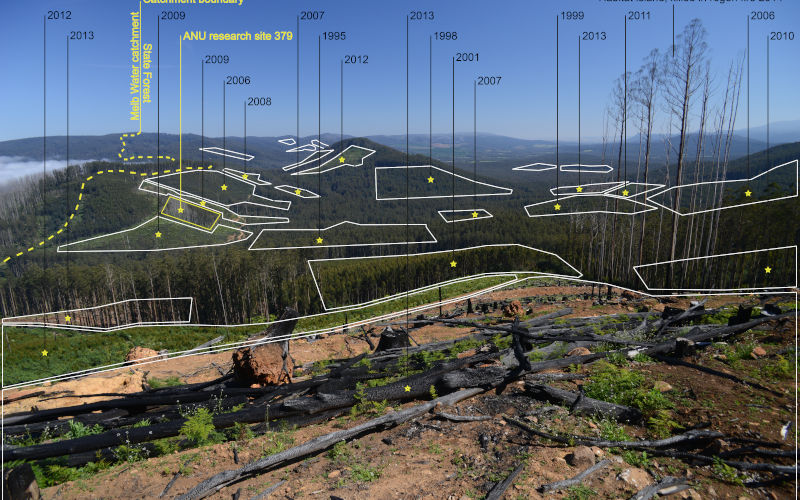
Research across the world shows that logging substantially increases fire risks in Australian native forests.
There has been much controversy over the links between logging and wildfire in Australian forests. Advocates for the native forest logging industry deny that such links exist – yet a significant and increasing body of robust scientific evidence shows that they most definitely do. These demonstrated links have been found from empirical studies in Tasmania, Victoria and New South Wales. They have also been identified from work in western North America and provinces in Canada such as Ontario and Quebec. There is now even a collective term for the elevated fire severity problems caused by logging – it is called Disturbance-Stimulated Flammability.
Other evidence shows the reality that logged and regenerated forests are more flammable than intact (unlogged) forests. This includes studies of fire risks in plantations versus native forests. In Australia, logged and regenerated native forests are four times more likely to burn than plantations.
The stark scientific reality is that the effects of logging on flammability have been identified by different research groups working independently in different places and analysing different datasets. This is what is called triangulation in science – seeing the same problem from different angles. The broad similarity in results underscores the extent and seriousness of the fire problems created by logging. This increase in flammability risks is not trivial; the probability of a high-severity canopy fire in a logged and regenerated forest can be seven times greater than it is in an intact forest. Canopy fires are dangerous – they are the kinds of fires that damage property and kill people.
Some lobbyists for the native forest logging industry have argued that the problem of Disturbance-Stimulated Flammability applies only to tall, wet eucalypt forests and we should not be concerned about them because these represent a relatively small area. Is this correct? The answer is a clear no. Research from New South Wales shows that the flammability problem occurs in a wide range of forest types and not just tall, wet eucalypt forests. For example, logging-associated flammability was observed throughout the entire footprint of the 2019–2020 Black Summer fires – from northeastern Victoria, through southeastern New South Wales, to northern New South Wales. The effect was seen in many kinds of forest and across all fire weather conditions. Importantly, the logging effect on fire severity can sometimes outweigh climatic effects. For instance, a logged and regenerated forest burning under moderate fire weather conditions in the Black Summer fires still burned at higher severity than an intact (unlogged) forest burning under bad conditions.
A key issue is that the pulse of flammability that characterises a logged forest can last for between 40 and 70 years after a stand of trees has been regenerated following previous logging. This means that forests where there are more and more logging coupes added to the landscape in each year of a 40 to 80-year logging rotation are dominated by many stands of trees where fire risks are elevated. That is, almost all the forest in a wood production landscape is in a state where it is significantly more flammable than it would have been if the landscape had remained intact. These risks are locally and even regionally significant.
There are several reasons why logged and regenerated forests are more flammable. First, logging operations leave large amounts of debris after an area is cut – up to 450 tonnes per hectare. This debris can include tree heads, lateral branches and understorey vegetation. Some of this is incinerated in a regeneration burn, but approximately 50 per cent remains in the forest and becomes added fuel that can elevate the severity of subsequent wildfires. Second, logged and regenerated forests have drier soils, and are hotter and windier – all ingredients that can promote fire severity. Third, logging removes moisture-loving plants that can keep forests cool and moist. Tree ferns are a good example – the abundance of tree ferns can be reduced by up to 96 per cent as a result of logging operations. Fourth, logging reduces the abundance of large old trees, which create sheltered conditions that reduce fire risks.
Many fire managers recognise the dangers created by logging. For example, firefighters in the 2019–2020 Black Summer fires warned of the dangers of logging debris/slash in the forest.
The bottom line is there is a rapidly expanding body of scientific knowledge from around the world that shows a strong link between logging and increased fire risk. Given the risks to human communities resulting from wildfires, it is critical to stop managing our native forests in a way that makes them yet more flammable. Native forest logging is one of the ways that does. For safety reasons, Australia’s rural and regional communities, and the nation’s greatly overstretched insurance industry, cannot afford the extra risks resulting from more logging of forests.

David Lindenmayer
Professor David Lindenmayer is a distinguished Australian scientist and academic, specialising in landscape ecology, conservation, and biodiversity. His research focuses on integrating nature conservation with agricultural production, improving biodiversity conservation in forestry and plantations, and enhancing fire management practices. With over 1000 peer-reviewed papers and 50 books, David is one of the most published ecologists globally. He leads large-scale, long-term research programs in south-eastern Australia. A Fellow of the Australian Academy of Science, he has received numerous prestigious awards, including the ESA Whittaker Award, multiple Eureka Prizes, and the Australian Natural History Medal.