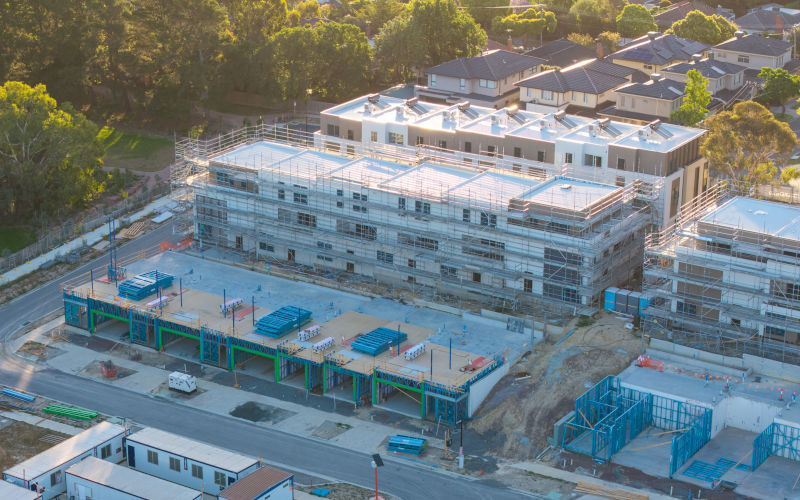
Australia is investing billions in community housing, but smaller regional providers struggle to access funding. Without investment in their capacity, communities risk missing out on desperately needed homes.
Australia has become very good at announcing investment in housing. We have targets, capital programs and investment pipelines, and governments increasingly look to community housing providers (CHPs) to deliver them. Rightly so: community housing has an essential role to play in the housing crisis.
Who is investing in the organisations expected to deliver, manage and sustain these new homes?
A growing responsibility, but not necessarily growing capacity
According to the Australian Institute of Health and Welfare (AIHW), community housing grew from about 30,100 dwellings in 2006 to 118,000 in 2025 and now makes up 26 per cent of social housing. Much of that growth came from transferring existing public housing to providers rather than building new homes. The task now is different: delivering new supply, which demands development capability many providers have not needed until now.
But the sector is far from uniform. Of about 440 CHPs reporting in 2025, 290 (65 per cent) managed fewer than 50 dwellings.
Many of these smaller organisations have deep community connections and experience supporting people with complex housing needs. What they often lack is capital, specialist development teams and the reserves needed to pursue major projects.
More funding does not mean every capable provider can access it. Capital does not create the capacity to use it.
The importance of regional providers
In Central Queensland I have seen how much regional communities rely on locally embedded organisations.
Regional CHPs do much more than manage properties. They understand local housing markets, employment conditions and service availability, and have established relationships with health providers, homelessness services, local governments and community organisations. They know that housing challenges in Rockhampton, Gladstone or Emerald are not those of Brisbane, Sydney or Melbourne. Many also operate alongside other community services, connecting housing with the support people need to sustain it.
Yet housing investment discussions tend to focus on development readiness, financial capacity and delivery at scale. These are legitimate tests; public money must be invested responsibly. But if they become the dominant measures of capability, we overlook what smaller, place-based providers can contribute.
A regional organisation managing 30 homes may not be able to deliver a $50 million development. With the right support, it might deliver another 10, 20 or 30 homes in a community that badly needs them. That is meaningful housing growth.
Funding rounds reward existing capacity
The early evidence points that way. Analysis of Housing Australia data by Kate Raynor, published in The Conversation in July 2025, found that almost all funding in the first round of the $10 billion Housing Australia Future Fund went to Tier 1 CHPs, the largest developers with the most in-house capacity. Only one Aboriginal community housing provider was successful. Raynor also noted that oversubscribed, competitive rounds and the pressure for quick political wins favour bigger players with lower-cost projects.
Consider what a CHP must do to expand. Before a single home is delivered, it may need to identify land, commission feasibility assessments, engage consultants, navigate planning, build financial models and prepare complex funding submissions. It must then demonstrate it can manage those homes and meet long-term regulatory and financial obligations. Larger providers have dedicated teams for this. In smaller organisations it falls to a handful of staff already running day-to-day operations. And the money to build that capacity is often exactly what they lack.
But funding frameworks that primarily reward existing capacity will concentrate funding among organisations already equipped to pursue it.
Capacity building is housing investment
We need to rethink what counts as housing investment. Funding a new development clearly qualifies. So should funding a regional CHP to strengthen its asset management systems, employ a development specialist or improve its financial capability, or helping smaller organisations access shared expertise in planning, procurement, compliance and property management.
These investments do not produce immediate ribbon-cuttings, but they create the conditions for sustainable housing growth.
A new home does not manage itself. It needs maintenance, tenancy management, financial oversight, regulatory compliance and long-term asset planning, long after construction funding has been spent.
Too often, organisational capability is treated as administrative overhead rather than an essential part of housing delivery.
A stronger sector requires deliberate investment
More development funding will not by itself strengthen smaller and regional providers. That takes deliberate policy design.
Some capacity building already exists, and it is worth building on. Queensland’s Community Housing Futures program, run by Q Shelter, Aboriginal and Torres Strait Islander Housing Queensland and CHIA Queensland, funds specialist advice for providers and has been allocated about $8 million in total. The state’s Community Housing Investment Pipeline, by contrast, is backed by $5.6 billion committed in the 2025–26 budget. Capacity support is roughly one-seventh of one per cent of the capital it is meant to help providers use.
Three changes would help. First, tie capacity funding to capital funding. A set-aside of even one per cent of a $5.6 billion pipeline would be about $56 million, seven times what Community Housing Futures has received in total.
Second, regional providers need development assistance, through a shared development service or regional intermediary, that carries projects from concept through feasibility to investment readiness, including the financial modelling that shows whether a modest project stacks up.
Third, funding rounds should assess modest regional developments on their own terms, rather than by metropolitan assumptions about scale, cost per dwelling and balance-sheet size.
Partnerships between larger and smaller CHPs can also combine development expertise and financial strength with local knowledge and relationships.
This is not about protecting every organisation regardless of performance. Providers must remain accountable, financially responsible and capable of delivering quality housing, and some may be better served by consolidation or shared services. Larger providers will, and should, deliver most large projects. The objective is a diverse, capable and sustainable sector, with realistic opportunities for different organisations to contribute.
Building homes means building the sector
Australia needs more social and affordable housing.
But we must resist measuring progress solely by capital committed or homes announced.
Housing is not simply a construction exercise. It is a long-term commitment to secure, affordable and well-managed homes, and the organisations delivering that commitment matter. We need large providers capable of delivering major developments. We also need smaller, locally embedded providers capable of responding to their communities.
Australia needs to invest in more homes. But it must also invest in the community housing sector that will make those homes possible.

Fabian Webber
Fabian Webber is a community-sector leader dedicated to driving systemic change across housing, health, and homelessness in Central Queensland. As Program Development Manager at Roseberry Qld and Project Lead for the region’s CQ Zero initiative, he champions data-driven, person-centred approaches to ending homelessness, integrating Advance to Zero methodology with strong place-based collaboration. Fabian also serves as Chair of the CQ Housing & Homelessness Alliance, working closely with local councils, health services, and government partners to strengthen coordination, influence policy, and expand regional housing solutions.