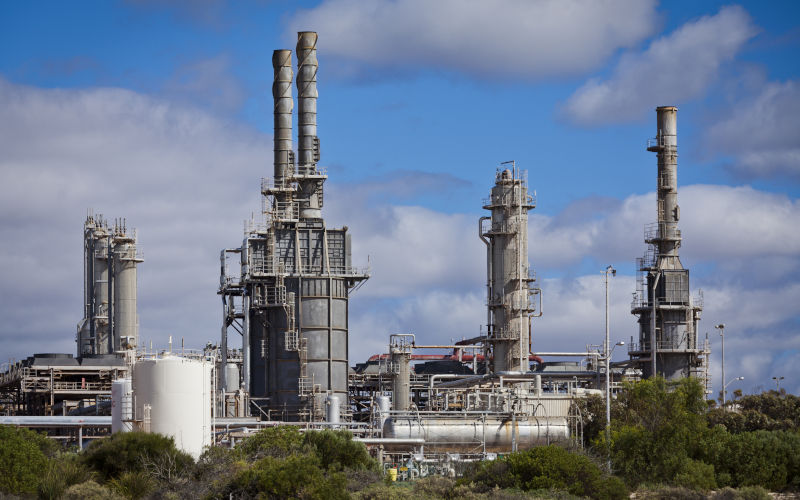
The government’s main policy instrument for reducing greenhouse gases only covers a small proportion of emissions and allows companies to offset these emissions. This is totally inadequate when the climate imperative is to rapidly reduce the use of fossil fuels.
In theory, the Safeguard Mechanism should be reducing greenhouse gas emissions from industrial facilities. It applies to companies across a range of sectors, including mining, oil and gas extraction, manufacturing, transport and waste that emit more than 100,000 tonnes of CO2e each year.
There are two essential requirements to minimise the climate threat. One is to rapidly reduce the use of fossil fuels and the other is to draw down pollution from the atmosphere. Now we face a major problem because drawing down atmospheric pollution is being used as an alternative to stopping using fossil fuels.
The government is planning to review the Safeguard Mechanism sometime in 2026/2027. If the genuine intention of the mechanism is to reduce greenhouse gas emissions, currently it is not fit for purpose. The review should address this. The core problem relates to carbon offsetting.
Carbon offsetting was introduced globally late last century with the objective of accelerating and optimising decarbonisation. It enabled companies that weren’t able, in the short to medium term to reduce their own emissions, to contribute to decarbonisation. Instead, they financed initiatives by others to reduce emissions or increase carbon sequestration.
As offsetting has evolved, it has predominantly been used to fund carbon sequestration. This has mainly been land based, for example planting trees and improving soil so it absorbs more carbon. This is a good initiative; farmers and other landholders improve their practices and receive an income.
Carbon markets have been established to trade carbon credits created from proposed carbon sequestration initiatives. Companies unable to reduce their emissions can procure carbon credits to help them meet climate targets.
Disastrously, this system, which started with good intentions, has been allowed to evolve into a greenwashing operation. Offsetting is enabling companies to meet emissions reduction targets without actually reducing emissions. They can do this because emissions accounting rules class emissions that have been offset as if they were actual emissions reductions. My previous article in Pearls and Irritations explains in detail the problems that have developed with this accounting.
A fundamental weakness with the Safeguard Mechanism is that it only covers emissions created from the extraction and processing of the fuel. It does not cover emissions from the combustion of the fuel by end-users: about 90 per cent of the emissions from gas are created when the gas is burned, and 70 per cent from coal.
The Safeguard Mechanism purports to be a policy instrument to reduce emissions, but it is instead enabling climate targets to be met without companies having to significantly reduce emissions. The review of the policy needs to recognise there was greater justification for offsetting emissions when carbon offsetting commenced several decades ago than there is now. In the years since, there has been a major global failure to phase out fossil fuels. Consequently, the priority now needs to be to stop emissions, not offset them.
For the Safeguard Mechanism to contribute towards the climate imperative to phase out fossil fuels, it should take account of all emissions, not only the domestic emissions from the extraction and processing of the fuel.
Offsetting should not be an easy option for companies to use; it should be a last resort. Companies must prioritise investing in decarbonising their operations ahead of buying carbon credits. Decarbonisation is much more important than meeting net zero targets.
The creation of carbon credits doesn’t have to be dependent on companies offsetting emissions. For example, the billions of dollars being spent annually by Australia (and trillions of dollars globally) on subsidising fossil fuels would be much better spent on funding carbon sequestration initiatives.
The core business of fossil fuel companies creates greenhouse gas emissions, the opposite of decarbonisation. Yet, globally, the major fossil fuel corporations are being allowed to offset emissions to justify continuing to extract fossil fuels. This is an indictment of national governments. The fact that something so patently wrong has become standard practice illustrates the major influence the fossil fuel industry has on governments.
The following are fundamental changes required to the Safeguard Mechanism for it to contribute to the urgent need to rapidly reduce the use of fossil fuels:
- The most important change required to the Safeguard Mechanism is the removal of all fossil fuel facilities from the mechanism. As close to 90 per cent of greenhouse gas emissions come from fossil fuels, clearly these fuels are by far the biggest contributor to the climate crisis. Consequently, a separate set of rules is required that takes into account the need for these fuels to be phased out to the greatest extent possible as quickly as responsibly possible.
- Regarding proposals for new fossil fuel developments, these should be evaluated on the basis that a new project would only be approved if there was no clean energy alternative available. This would be a very rare occurrence because, usually, clean energy can be installed quicker and cheaper than fossil energy.
- In addition to excluding fossil fuel producers from the Safeguard Mechanism, the mechanism’s emissions entry point should be reduced so it covers an increased number of industrial facilities. Companies covered by the mechanism would be allowed to offset emissions, but offsetting would be controlled to ensure it was not being used as an easy option to avoid investing in decarbonisation.
Such changes are not correcting mistakes made in the design of the mechanism: the Safeguard Mechanism has been intentionally designed to enable emissions reductions targets to be met while fossil fuel business continues as usual. This is totally incompatible with minimising the threat from the heating planet.
There is no doubt that the government is giving higher priority to enabling the ongoing production of fossil fuels than complying with climate science, even though it claims it accepts the science.
My previous article makes the case that no amount of scientific information and evidence of a collapsing climate will convince the Albanese government to stop supporting ongoing coal and gas extraction. That change will have to be forced on the government by the community. My previous article proposes a course of action aimed at achieving this.

Ken Russell
Ken Russell spent his working life in the Electricity Supply Industry, initially in England, and subsequently in Queensland, responsible for the supply and spare parts management of large coal-fired power stations. He has been a long-time advocate for rapid climate action.