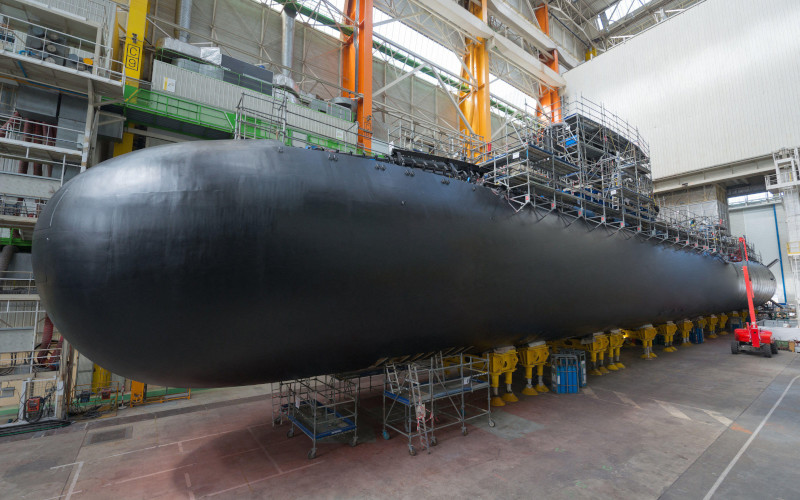
France’s experience with low-enriched uranium submarines challenges claims that Australia would have to send vessels overseas for reactor support, while offering lessons in fleet availability, sovereign maintenance and crewing.
Recent pushback against a low-enriched uranium (LEU) alternative for Australia’s future submarine capability by Minister Pat Conroy reveals a persistent misunderstanding of modern naval reactor architecture and operational sustainment.
His claim that an LEU-powered submarine would force Australia to return vessels to France every decade for reactor support misinterprets modern submarine engineering and ignores decades of proven French Navy (Marine Nationale) operational data.
A modern French major overhaul, termed a full-cycle docking (FCD), takes under 18 months once every decade. This is not a theoretical figure. The Marine Nationale routinely achieved 15-month refuel and refit overhauls on the preceding Rubis-class SSNs and 14-month FCDs on its SSBNs, all using the same, reliable K15 reactor used in the Suffren-class SSN.
During these overhauls, reactor refuelling represents a minor fraction of the work; out of over 60,000 components serviced during a major Rubis refit, less than a quarter related to the nuclear plant. The vast majority of the window is dedicated to deep hull structural inspections, combat management upgrades and overhauling thousands of auxiliary systems.
Crucially, French LEU reactors feature a built-in deck logistics hatch, enabling routine refuelling directly through the casing without cutting open the pressure hull. This process could be executed in Australian shipyards during a standard 10-year overhaul.
By synchronising refuelling with routine platform modernisations, the Marine Nationale sustains an operational fleet availability rate approaching 80 per cent, with Rubis-class hulls historically delivering 240 active days at sea per year.
Contrast this with US and UK nuclear fleets, where roughly 30 to 40 per cent of attack submarines sit sidelined by severe shipyard backlogs.
Beyond hardware, the French model addresses the defining challenge facing modern Western navies: workforce retention. France operates a strict dual-crewing system (Équipages Bleu et Rouge) across its nuclear fleet. While one crew is deployed, the second is ashore undergoing training, on leave, or maintaining work-life balance – a lifestyle necessity for today’s recruits.
Expecting modern sailors to endure relentless, unpredictable sea-shore rotations alongside indefinite shipyard delays is a failed personnel strategy. High fleet availability and predictable dual-crewing go hand in hand.
Pivoting to LEU is not a compromise; it is a proven pathway to secure high fleet readiness, true sovereign maintenance in Australia and a crewing model fit for purpose.
LEU – what is that? That’s a good question, minister – it is time YOU asked it!

Peter Briggs
Peter Briggs retired from the RAN in 2001 after a 40-year career, specialising in submarines. This included two submarine commands, command of the RAN Submarine Squadron, director of Submarine Policy and Warfare and Head of Submarine Capability Team, established to rectify Collins introduction into service issues. He was the president of the Submarine Institute of Australia from 2006-09 and is a frequent contributor to public debate on Australian submarine matters.