The political consensus in America that sustained unconditional US support for Israel was built over decades; it will not be dismantled quickly. But the direction of change is now clear. The shift in public opinion away from supporting Israel reflects generational change. That demographic trajectory will not reverse.
There has been dramatic decline in US public support for Israel. Without the full support of the US Administration and Congress, which have been fully owned subsidiaries of the Israel lobby for decades, Israel will be forced to come to terms with Palestinians and its neighbours and halt large-scale ethnic cleansing and genocide. With US support, Israel has become an abomination. The days of Israel’s endless wars on its neighbours may slowly be coming to an end.
The most recent Pew survey in the US showed that six in ten Americans now have a very or somewhat unfavourable view of Israel — up seven percentage points since last year and nearly 20 points since 2022, with 28 per cent holding a ‘very unfavourable’ view, up nearly threefold from 10 per cent in 2022.
Americans’ sympathies no longer lie more with Israelis than with Palestinians. Gallup has found that among those aged 35 to 54, 46 per cent now sympathise more with Palestinians compared with 28 per cent who sympathise more with Israelis, almost a complete reversal from 2025.
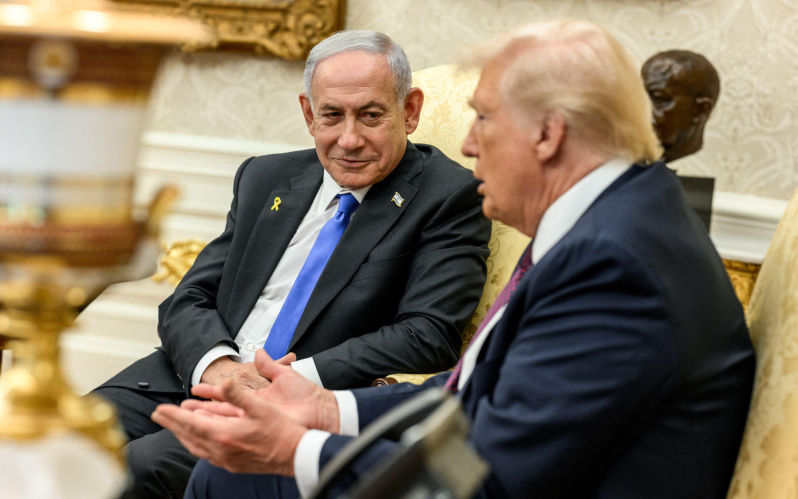
The Iran war has been critical in tipping the scales against Israel. The widespread view is that Netanyahu manipulated Trump into a conflict that serves Israeli interests rather than American ones – and this critique is now being advanced loudly by people who would never have entertained it two years ago, including powerful conservative commentators and MAGA-aligned figures.
Military aid to Israel has become a litmus test in Democratic Party primaries. AIPAC, once considered the most powerful Israeli lobby group, is now a liability in many Democratic races, losing key primaries and watching candidates run against it by name.
A recent Quinnipiac poll found that 60 per cent of Americans Quinnipiac – including three-quarters of Democrats and two-thirds of independents – oppose the US sending arms to Israel. Yet the US House has passed a $3.3 billion military aid package to Israel as part of the 2026 financial year appropriations act.
There is also a generational shift among younger American Jews. Thirty six percent of those aged 18 to 34 are now far less emotionally connected to Israel. Sixty eight percent of those over 65 do feel an emotional connection to Israel.
The attack on Iran by Israel and the US has upset Republican support for Israel. Jeffrey Sachs has pointed out that this war was Netanyahu’s creation. “Trump was suckered.” After getting word from Netanyahu that Iran could be easily crushed, Trump decided: “it all sounds good to me”, so off to war with Iran he went. The widespread perception voiced across the political spectrum is that Netanyahu manipulated the Trump administration into a conflict that serves Israeli strategic interests rather than America’s.
The Iran war has cracked the Republican coalition’s support for Israel. For conservative voters who had remained supportive of Israeli operations in Gaza, the perception that the United States has been drawn into a Middle Eastern war at Israel’s instigation with consequences for gas prices and regional stability has translated into political anger.
Seymour Hersh in Pearls and Irritations on 2 May 2026 noted Trump’s annoyance with Israel. Hersh commented that America’s love affair with Israel has hit an astonishing bump:
…The president, I was told, “no longer trusts Israel. He now believes he was misled” by Israeli Prime Minister Benjamin Netanyahu about the potential for success of the recent joint US-Israeli bombing attack, a goal of which was to trigger an overthrow of the religious leadership in Iran. The president is said not to share Israel’s existential concern about the need to destroy or neutralise the large depot of partially enriched uranium …. “He wants out,” the Israeli insider told me, and the Israeli leadership “is very upset because Trump”– in his fear of the political cost to him of a continuing blockade of the strait “has shown a willingness to ignore Israeli interests and desires.” People in the Israeli leadership “say he’s lost it. He doesn’t think of the consequences. You cannot do negotiations with Iran because every step we make he immediately broadcasts it on his social media posts. He is so obtuse.”
Before the Iran war, more than two years of conflict in Gaza had substantially eroded American public sympathy for Israel. The Gaza conflict forced a generational reckoning that the Iran war has since intensified. Younger Americans, across all ethnicities and both parties, have grown up in a media environment where Palestinian perspectives are far more visible than they had been for earlier generations. The conflict activated and accelerated a demographic shift that had been quietly building for years.
The latent response within the Democratic Party was reflected in the last presidential election when many Palestinian supporters were reluctant to support Kamala Harris in states such as Michigan, a major hub for Arab Americans. Many voters opted for third party candidates or abstained because of Gaza.
Despite the dramatic shift in public opinion, there are several reasons why US government support for Israel will continue for a while. The most important is the military/ industrial/ political complex. Israel is the largest single recipient of US military aid and is required to spend most of its approximately $3.3 billion annual allocation on American-manufactured weapons systems, including F-35 fighters, Hellfire missiles, and artillery munitions. This subsidy for American defence companies is a source of employment in congressional districts across the country. Members of Congress from states with major defence industries have strong domestic political incentives to support Israel aid, regardless of their views on Israeli conduct.
The Murdoch and other media like The New York Times and Washington Post continue to support the genocide. Well-funded think tanks – Brookings, Rand and Hudson – all supporting continual American warfare, influence public opinion in favour of Israel.
But change is coming. In Democratic Party primaries, candidates who would previously have emphasised pro-Israel credentials are now running on opposition to military aid to Israel. Democrat presidential contenders such as Representative Khanna have emerged as strong critics of the genocide in Gaza. The Californian Governor Gavin Newsom is noted for distancing himself from the Israeli lobby. He has referred to Israel as an “apartheid state”.
On the Republican side, the Iran war has produced the first significant rupture in what had been near-monolithic conservative support for Israel. They now see the political cost of being associated with a foreign policy adventure widely perceived as serving another country’s interests.
And Trump now realises that his support for Israel is politically damaging. The 2026 midterm elections will be the first electoral test of whether the shift in public opinion translates into changed congressional membership. If progressive candidates who have run on opposition to Israel win in significant numbers, and if the Republican fracture over the Iran war deepens, the numbers in both chambers will shift.
The question is not whether US government policy toward Israel will change, but when and how. And without unconditional US support, Israel will have to change. Its survival will depend on it.

John Menadue is the Founder of Pearls and Irritations and a board member. He was formerly the Editor-in-Chief. John was the Secretary of the Department of Prime Minister and Cabinet under Gough Whitlam and Malcolm Fraser, Ambassador to Japan, Secretary of the Department of Immigration and CEO of Qantas.