This is a responsible budget that responds sensibly to inflation and weak productivity, but it stops short of the deeper tax and climate reforms needed to reshape the economy.
This budget has had to respond to very challenging times.
Inflation was too high and the Reserve Bank started to lift interest rates in February. That was because, even before the start of the Iran war, the RBA thought that aggregate demand in Australia was already starting to exceed the economy’s productive capacity. But since then, the closure of the Strait of Hormuz has made inflation so much worse.
In March, less than a month after the Iran war started, the annual increase in Australia’s consumer price index was 4.6 per cent, compared to 3.7 per cent in February. This is way outside the Reserve Bank’s inflation target of 2-3 per cent. Furthermore, while the future will be very uncertain as long as the war continues, we can be reasonably certain that inflation will get worse before it gets better.
Equally important, productivity growth has been much lower for the last 15 years or so, and productivity has not risen at all in the 2020s.
As productivity is the main determinant of real wages and living standards, it is therefore not surprising that with no productivity growth the cost of living has become the number one political issue.
But it is difficult for the budget to respond directly to the cost-of-living issue without making inflation worse. That is why the Reserve Bank Governor, Michelle Bullock, warned that any cost-of-living relief in this budget should be tightly targeted to those who are experiencing the greatest cost-of-living pressures.
The economic outlook and budget priorities
The global oil price started the year around $US60 and has now been above $US100 for the bulk of the past two months. Treasury’s central forecast is that headline inflation in Australia will be 5 per cent through the year to the June quarter 2026, and that growth in the economy will slow from 2¼ per cent to 1¾ per cent in 2026-27. Unemployment is expected to stabilise at around 4½ per cent and solid wage growth is expected to continue.
Treasury also presents a more severe scenario where the oil price peaks at $US200 and takes three years to fall back down. We would still avoid a recession, but unemployment would spike to pre-pandemic levels and inflation would peak above 7 per cent.
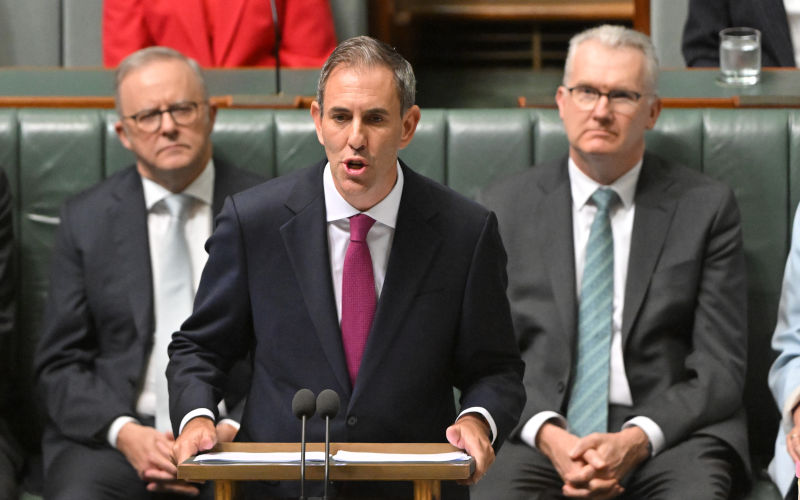
In response the Treasurer, Jim Chalmers, has brought down what he declares is an ambitious budget, with the following major priorities:
- a budget deficit of $31.5 billion next financial year (2026-27), or 1.0 per cent of GDP, a slight reduction of $2.8 billion compared to the deficit projected in the MYEFO last December;
- tax reform with an emphasis on improving inter-generational equity; and
- reforms to improve productivity which is vital to reducing the cost of living and raising living standards.
A better fiscal balance
The Government would like us to believe that it is “returning the budget to balance in a measured way”. The underlying cash balance has improved by $8.5 billion in 2025–26 and by $2.8 billion in 2026–27 since MYEFO, with a cumulative budget improvement of $44.9 billion over the forward estimates for the next four years.
Furthermore, the Government wants us to believe that “The improvement in the budget position is underpinned by savings and reprioritisations, spending restraint, and banking revenue upgrades”.
However, the Government’s projected budget deficit equivalent to 1 per cent of GDP essentially represents a neutral fiscal policy, as it is the same in relation to GDP as last year, and is projected to remain the same over the following two years.
The Treasurer claims that “This budget delivers the largest savings package on record” – $63.8 billion in savings over four years, of which the changes to the NDIS are by far the most important. However, the size of the NDIS savings is somewhat doubtful, as they are still to be negotiated and implemented, and it is uncertain how all the various interested parties will respond.
In addition, there are other new policy decisions that add to expenditure. On a net basis, all policy decisions since the MYEFO was published last December have increased government expenditure for 2026-27 by $6.4 billion and total receipts by $2.2 billion. This in turn means that most of the cumulative improvement in the budget balance over the next four years reflects variations in the parameters underpinning the budget estimates, and not actual government decisions.
In short, this budget will not take much pressure off the Reserve Bank in its fight against inflation. Interest rates are therefore not likely to come down soon, which has significant implications for the cost of living.
The tax reform package
The Treasurer is probably right in claiming that “This budget includes the most significant tax reform package in more than a quarter of a century”. But that tells us how little has happened since the Howard-Costello GST package back in 1999-2000.
There are a number of new tax policies, costing $3.5 billion, to help businesses with lower taxes to encourage investment and innovation. Other policy changes are intended to make the tax system simpler, with a $1000 instant deduction for workers, a permanent instant asset write off for small businesses and more dynamic tax instalments.
However, the tax changes that have received most advance publicity are changes to the taxation of capital gains, negative gearing and trusts, all of which are intended to improve equity, and especially intergenerational equity. In particular, the changes to capital gains and negative gearing are expected to help about 75,000 young Australians gain home ownership.
More generally, the increase in inequality in Australia over the last 20 years, principally reflects the increasing inequality of wealth. At the same time, however, Australia’s tax system presently relies heavily on taxing wages and salaries from work, while having generous concessions for income from wealth and housing speculation and ways to manipulate tax through deductions and trusts. So wealth has been lightly taxed relative to incomes, and these tax changes are not only fair but represent a move towards greater social equality.
Understandably there are grandfathering provisions so that the capital gains tax on existing investments only affects real gains engendered from July next year.
While negative gearing will in future be limited to new builds, it is arguable that it would have been better to adopt the proposal by the independent Member of Parliament, Allegra Spender. Her proposal would have limited all interest deductions to investment income, rather than continue to allow interest deductions on new properties to reduce other non-investment income.
Finally, a really ambitious tax reform package would have increased the taxation on the windfall profits being gained by resource companies who are presently paying very little tax. The simplest way would have been a tax on export revenue, which as I have shown in previous articles (Pearls & Irritations, 29 April and 7 May) would not have affected the volume of exports or their price, and therefore there was no need for our trading partners to complain.
And most importantly, the introduction of a carbon tax would have engendered a very substantial increase in revenue, while helping to reduce carbon emissions and reducing the need for subsidies to achieve the Government’s net zero target.
In sum, this tax reform package, while useful, is not on the scale of its predecessors and represents a missed opportunity.
Productivity reforms
This productivity reform package is based on the Productivity Commission’s five pillar inquiries: creating a more dynamic and resilient economy, building a skilled and adaptable workforce, harnessing data and digital technology, delivering quality care more efficiently, and investing in cheaper, cleaner energy and the net zero transformation.
The reforms announced in the budget will:
- cut red tape and regulatory costs and speed up approvals;
- boost National Competition Policy;
- abolish almost 600 more tariffs;
- improve building efficiency by simplifying building regulations and improving skills recognition and education so that tradies can get their qualifications recognised more readily;
- modernise our energy system with domestic gas reservation and encouraging increased renewable energy use;
- seize the opportunities from AI with grants to commercialise AI innovations; and
- improve infrastructure in regions, towns and cities.
All of these reforms are useful, but they will only have a limited impact on productivity and therefore on the cost of living. The reality is that through history productivity growth has been driven by technological change and that is the obvious reason why productivity growth has been weak over the last 15-20 years, not only in Australia, but also in almost all other developed economies.
Maybe AI will help change that, but it hasn’t so far. In the meantime, the people who are most feeling cost of living pressures are those with a mortgage. Real wages have not really fallen, just not increased, so wage earners who are not paying a mortgage are not really worse off.
But the best way to help households with a mortgage in the short run would be a cut in interest rates, and while this budget does not put any upward pressure on interest rates, neither does it help to bring them down.
This is a responsible budget with some worthwhile reforms. However, if it had been more ambitious and raised extra revenue, it would have charted a path back to budget balance over the next few years. In addition, it could also have implemented a more ambitious Labor agenda by restoring the funding of many government services in health and education and improving the distribution of income and wealth.

Michael Keating is a former Secretary of the Departments of Prime Minister and Cabinet, Finance and Employment, and Industrial Relations. He is presently a visiting fellow at the Australian National University.