
Paul Keating says the Howard-Costello capital gains tax discount distorted the tax system, inflated housing prices and entrenched inequality between wage earners and wealth holders.
Before I began the major reform of the tax system, as Treasurer in 1985, capital profits in this country were completely untaxed.
The takeover merchants were taking-over industrial companies, closing down the businesses, selling off the assets, taking the profits free of any taxation.
Meanwhile, on the income side of the tax system, employees were fully taxed and at the time, under John Howard’s Treasury, at a top marginal rate of 60%.
The issue was simply that income was taxed and at exceptionally high rates while capital profits were completely tax exempt.
In 1985 I addressed this distortion by introducing the Capital Gains Tax, but at the same tax rates that employees paid on ordinary incomes though importantly, washing the inflation from the calculation – taxing only the ‘real’ gain.
This brought the taxation of income and capital to a concomitant point of equality – and for the first time in our history.
But in the face of this achievement, a couple of smarties, John Howard and Peter Costello, thought they could do their used car selling and dodgy accounting mates a favour by jacking a 50 per cent discount on to the taxation of capital profits – destroying the inflation discounting system I had set up to tax the ‘real’ gain only.
The accompanying graph illustrates how housing prices took off dramatically from the moment Howard and Costello introduced the 50 per cent discount in 1999. And not just took off, blasted off.
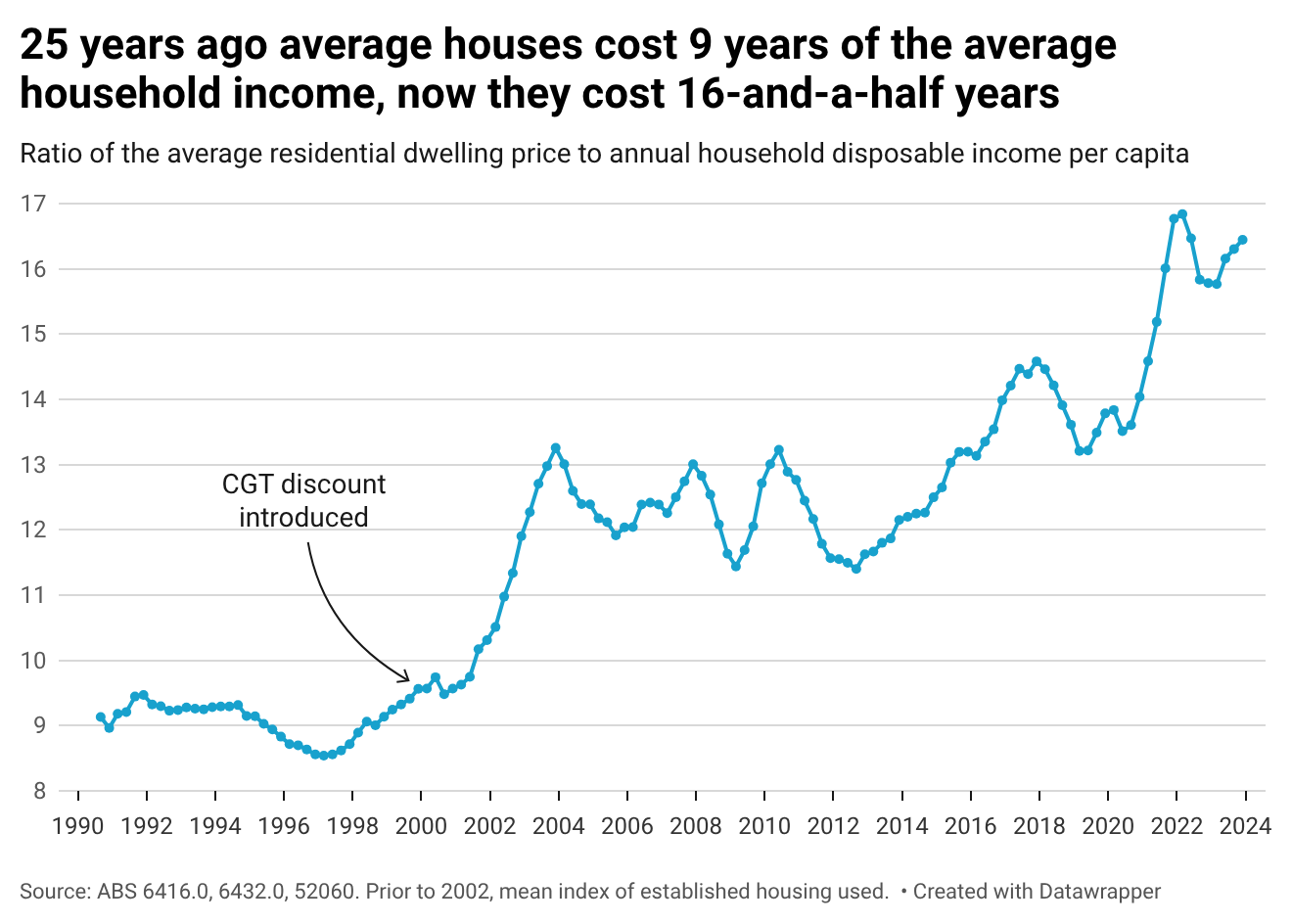
Yet wealthy people are out there now arguing against the government’s change notwithstanding the stark evidence of the price shock Howard and Costello induced. Housing prices rising from nine times income to sixteen·times income over the 25 years.
They scoff at an inflation adjustment to the effective CGT tax rate – because in their heads, they auto-assume inflation at the 2 per cent it has been under the RBA target for decades. But what if inflation hits 5 per cent or 6 per cent? They would then congratulate themselves in the preservation of their ‘real’ gains – which they would not have had under the 50 per cent discount.
And they want to split off startup capital and shares as if the individuals commentating have not made a feast of it already. They want to retain a preference for capital over wage and salary income.
They nominate tech and startups. But if a tech startup fires, like a Canva, the value acceleration and level of wealth makes any discussion of the tax rate absolutely secondary. If it doesn’t fire, the CGT or its discount is of no help to it.
Punters with a big idea won’t be put off by some marginal change to the tax-rate. The rush of entrepreneurial blood to the brain always dominates.
The IMF, for instance, ‘recommends ‘phasing out broad capital gains tax discounts’ in favour of a ‘fairer broadly-based tax system’. That is precisely what the government’s changes will do in returning to a full rate system appropriately discounted for inflation.
Yet when Jim Chalmers announces a policy principle to restore the equity of taxing capital profits on a basis of equality with the taxation of income – we hear the howls for continuing preference.
The simple fact is that income is taxed too heavily while capital is taxed too lightly. That is the fact of it – and has been the fact of it.
And that distortion has made housing unaffordable for a whole generation.
The point is, a society that fails to house its children is a society in decline – this is what Jim Chalmers and his Prime Minister are seeking to arrest.

Paul Keating was the prime minister of Australia from 1991 to 1996.