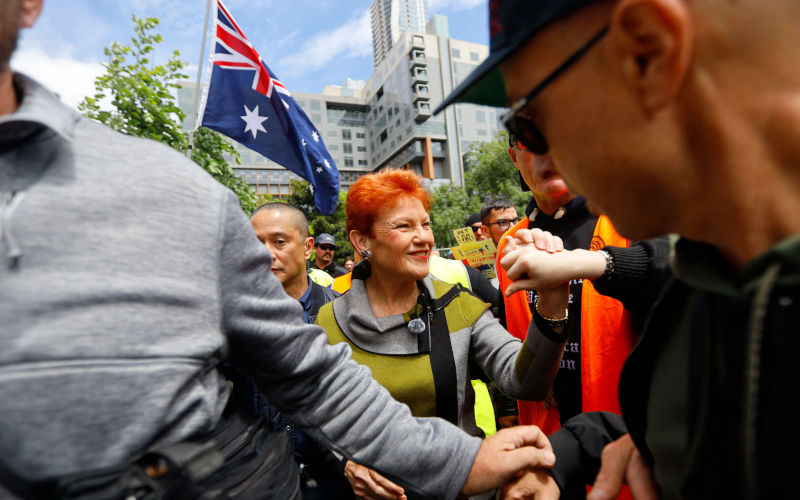
Pauline Hanson’s continuing appeal is less a sudden ideological shift than a symptom of weakening trust, economic frustration and a growing belief that mainstream politics has become distant, managed and closed off.
Why does Pauline Hanson continue to attract support?
If you sit in a café and talk about Australian politics, a question that keeps coming up lately is: Why is Pauline Hanson still a factor in Australian politics and why do more people seem willing to vote for her?
Pauline Hanson has been around for a long time. She comes and goes in terms of seats and numbers, but she never fully disappears, and that alone tells us something important. She’s not simply a passing protest vote, she represents a continuing frustration that neither of the major parties has been able to address.
I think One Nation tends to grow when people believe something is wrong with the political system, not necessarily because they have suddenly changed their core beliefs. At the heart of it is trust.
Many Australians don’t spend much time thinking about whether they’re left wing or right wing. They’re more concerned about everyday life and whether the political system is working for them.
Over many years, several pressures have built up:
- wages have struggled to keep pace with the cost of living
- housing has become increasingly unaffordable, particularly for many young Australians
- governments talk about long-term problems but often seem unable to solve them
- decisions can appear to be made behind closed doors
- and powerful lobby groups often seem to have easier access to politicians than ordinary citizens
When these concerns build up over time, people start looking for someone who sounds different from the political mainstream.
That’s where Hanson fits in. She’s direct and rarely sounds scripted. She doesn’t use the careful language that many politicians prefer and for some people, that comes across as honesty and authenticity, even if they disagree with some of her views.
It’s easy to describe this as a rise of the far right, but that explanation misses part of the picture. Many voters aren’t working through a detailed political ideology. They’re reacting to their experience of everyday life and whether they believe they’re being listened to.
When mainstream politics appears highly managed, cautious and distant, some voters are drawn towards politicians who appear less managed. That doesn’t automatically mean their views have become extreme. Often it means they’re looking for someone they believe is saying what others are unwilling to say.
Most minor parties rise and fall quickly. Many politicians do too. Pauline Hanson hasn’t.
Part of her durability comes from consistency. For decades she has occupied the same political space:
- she speaks in blunt language that many people understand
- she criticises immigration and multicultural policies in strong terms
- she positions herself against political correctness
- she draws on her experience as a small business owner
- and she presents herself as being outside the political establishment.
Whether people agree with her or not, that message has remained remarkably consistent. In politics, consistency matters. It creates recognition and familiarity, even amongst people who disagree with you.
There’s another factor that receives less attention though. Politics still looks and sounds much the same as it did 20 or more years ago.
Suits and ties.
Carefully prepared speeches.
Controlled interviews.
Formal language.
Often, more attention is given to what’s not said than what is.
Meanwhile, much of Australia has changed. Many people work from home. Workplaces are more casual and communication is faster, less formal and more direct.
That gap might seem small, but it sends a message that mainstream politics can appear to belong to a different world.
Not better, not worse – just separate – and when people begin to see politicians as a separate class, trust starts to weaken.
Not everyone who loses trust in the major parties turns to One Nation – some become disengaged altogether while others move towards more extreme or conspiracy-based movements, including fringe nationalist groups.
This doesn’t happen overnight, it usually grows out of a combination of frustration, social media echo chambers and a belief that nobody is listening.
In that environment, more extreme voices can find opportunities they might never have had before.
It’s probably not helpful to think of this as a sudden shift to the far right. It looks more like a gradual drift.
Trust in major parties has weakened.
Politics often appears more distant from everyday life and some voters are choosing whoever seems most direct, most authentic or most willing to challenge the system.
Pauline Hanson is part of that story, but she’s also a symptom of it and that leaves a question for both major Australian parties.
The challenge isn’t simply how to defeat minor parties at the next election but – how do you convince Australians that politics is happening in the open and not in places they can’t see?
Once people start believing that decisions are being shaped behind closed doors, by people they never meet and can’t influence, trust doesn’t simply weaken – it starts to move somewhere else.

Meg Schwarz
Meg Schwarz holds a Postgraduate Diploma in Counselling and Psychotherapy and brings over 35 years of experience championing social justice, advocacy and consumer engagement. Based in South Australia, Meg has dedicated her career to working alongside diverse communities, including refugees, people with disabilities and individuals with complex trauma backgrounds.With a strong passion for equality and human rights, Meg specialises in fostering meaningful communication, empowering voices through advocacy and creating inclusive spaces for dialogue. Her skills in stakeholder engagement, strategic communication and community development have earned her recognition as a trusted and compassionate leader in her field.