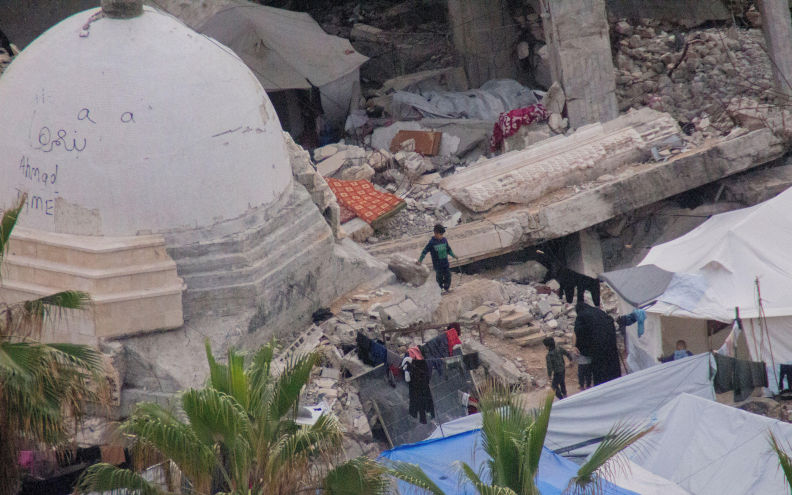
War, displacement and colonisation do not only destroy lives and communities, but also the cultural worlds, histories and shared meanings that give people a sense of continuity and belonging.
When we think about war, genocide or displacement, our attention naturally goes first to human life. And so it should, because the loss of people is immediate, irreversible and deeply personal in a way nothing else can compare to.
However, over time there’s something else that begins to surface in the background of these events, something less visible but equally significant – the loss of the cultural world those people belonged to, the buildings they walked through, the languages they spoke, the stories they inherited and the places that quietly held their sense of belonging in place.
A community is never only a collection of individuals; it’s also a shared environment of meaning, built slowly across generations through architecture, ritual, art, language and memory, so that when we speak of loss in times of conflict, we aren’t only speaking about lives interrupted, but about entire systems of continuity being broken apart.
This is why the destruction of historic buildings and cultural sites carries a significance that transcends their physical form.
A mosque, a church, a statue, an olive grove, an old street, a library, or a family home that has stood for centuries isn’t only stone or timber; it’s a record of presence, a marker that says ‘people lived here, built here, prayed here, created here’ – and when such places are damaged or erased, something much more is also affected, the ability of future generations to see themselves as part of a continuous story.
This isn’t limited to one place or one ‘conflict’. In Palestine, Lebanon, Syria and other regions affected by prolonged instability, there’s been extensive damage to cultural and historic environments that once held centuries of layered history.
In Iran, concerns have been raised about the vulnerability and damage to heritage sites during periods of escalation, while in Israel, cultural landmarks including parts of Tel Aviv’s UNESCO-listed White City have also sustained damage during missile attacks.
These aren’t identical situations, but they share a common consequence, the weakening of physical links to the past.
At the same time, there are other histories that tell us that cultural loss doesn’t only happen in times of war.
In Australia, Aboriginal and Torres Strait Islander peoples have experienced the long-term erosion and denial of language, sacred sites and cultural knowledge systems through colonisation and forced assimilation.
In many cases, languages that once carried deep understandings of land, law and kinship were disrupted or lost and with them, entire ways of understanding the world.
What connects these experiences isn’t that they’re the same, but that they reveal something fundamental – culture isn’t an idea, it’s a living structure that holds people in time and when that structure is damaged, whether suddenly through conflict or gradually through disruption, people are left not only grieving and traumatised by what was lost, but also trying to understand how to locate themselves in relation to what remains.
This becomes especially difficult for children, many of whom come to know their cultural inheritance indirectly, through stories repeated across generations, through faded images, inherited objects, remembered landscapes and the voices of parents or grandparents trying to preserve what can no longer be physically returned to.
This is why it’s not enough to think of loss only in human terms, as important as that is. Human life and cultural life are deeply intertwined with the places people build, the stories they tell, the languages they speak – and the objects they pass down aren’t separate from their humanity, they’re part of how that humanity is expressed across time.
When we lose people, we grieve their absence, but when we lose their cultural world, we also lose part of the map that tells us who they were, how they lived and how they understood themselves in relation to the world around them. That loss is slower, it’s less visible and harder to name, but it does shape the future in ways that are often only understood much later.
Perhaps what’s needed isn’t a ‘hierarchy of grief’, but a broader recognition that human life doesn’t exist in isolation from its cultural environment.
To mourn people fully is also to acknowledge the worlds they created and inhabited, because without those worlds, even memory becomes harder to carry forward.
Meg Schwarz
Meg Schwarz holds a Postgraduate Diploma in Counselling and Psychotherapy and brings over 35 years of experience championing social justice, advocacy and consumer engagement. Based in South Australia, Meg has dedicated her career to working alongside diverse communities, including refugees, people with disabilities and individuals with complex trauma backgrounds.With a strong passion for equality and human rights, Meg specialises in fostering meaningful communication, empowering voices through advocacy and creating inclusive spaces for dialogue. Her skills in stakeholder engagement, strategic communication and community development have earned her recognition as a trusted and compassionate leader in her field.