Nations’ new ways of working together, Xi’s nuclear deterrent display, scandal probe’s link to scandal probe, South China Sea’s geopolitical reality, Korean company’s record market listing, and the region’s shadow baby trade.
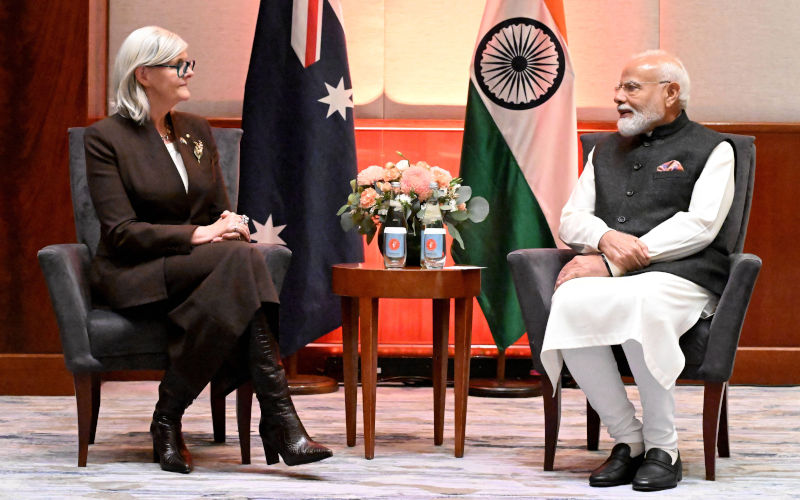
The journey this month by Indian Prime Minister Narendra Modi to Indonesia, Australia and New Zealand marks the consolidation of a new approach to the Indo-Pacific, one that might be called ‘G Minus Two’.
That is the assessment of Indian academic and foreign policy commentator C Raja Mohan, a professor at Delhi’s Council for Strategic and Defence Research.
Mohan says in a commentary in The Indian Express the idea of the US and China dominating Asia has always made Indian strategists uneasy. Donald Trump’s references to a G2, along with his administration’s decision to discard the term Indo-Pacific, have reinforced their anxiety.
“Delhi is responding to the new dynamic between Washington and Beijing by expanding its co-operation with the rest of Asia,” he says.
Recent visits to Delhi by Japanese Prime Minister Sanae Takaichi and South Korea President Lee Jae Myung underline the urgent approach by Tokyo and Seoul to widen their Asian ties, Mohan says. Modi’s eastern journey this month points to the same logic – the importance of increasing room to manoeuvre by strengthening co-operation among themselves.
An analysis in The Diplomat, the Asian online news magazine, says Australia and India are uneasy about relying on the US to resist China and are now seeing how they can gain strength from each other, much as Australia and Japan are increasingly working together.
“Australia and India are framing new minilateral coalitions to maximise their strategic options,” the article says.
The analysis was written by Rajeswari Pillai Rajagopalan, a senior fellow at the Australian Strategic Policy Institute, and reprinted from the institute’s The Strategist. It says a joint declaration on defence, signed during Modi’s visit, has notable aspects, including an intention to increase interoperability between the defence forces and a focus on strengthening regional security.
“Probably the most striking part is the undertaking to ‘consult on defence-related developments in the Indo-Pacific that affect shared interests’,” the commentary says. “This would have been unthinkable… even a few years ago.”
It notes the observation by Griffith University’s Ian Hall that this is almost alliance-like language, similar to the wording of the ANZUS Treaty.
An opinion piece in The Japan Times, written by author Brahma Chellaney, says until recently the Washington consensus on India was that helping the world’s largest democracy to become stronger served US interests by creating a counterweight to China.
“Washington’s India consensus is now quietly unravelling,” he says.
Chellaney says the clearest sign of change came in a March speech in Delhi by US Deputy Secretary of State Christopher Landau, who said Washington would not repeat its China mistake – that would not allow India to ‘develop all these markets’ only to outcompete America.
“These remarks deserve far more attention than they received,” Chellaney says.
Missile test message aimed at US
When China fired a submarine-launched ballistic missile deep into the Pacific this month, Australia’s political class – media and politicians – tried to find a message for Canberra and its links with Pacific Islands nations.
Asian media took a broader geopolitical view.
An analysis in Nikkei Asia, the online politics and business magazine, said that behind the launch was Xi Jinping’s intention to test Donald Trump’s red lines. Xi gave the go ahead after deciding the launch was unlikely to draw Trump’s ire. He got response he expected: the State Department complained but Trump did not make any remarks that would impact the next Sino-American summit.
The analysis, by former China bureau chief Katsuji Nakazawa, said the route of the missile flight was also carefully planned.
The missile was launched from a submarine off Hainan Island, took a southern route over the Philippines and splashed down in the South Pacific, near Tuvalu. If Beijing had chosen a northern route, the missile would have passed near South Korea and Japan. China did not want to give them reason to criticise it.
It was possible, he said, that China wanted to teach Manila a lesson: the launch came just before the 10th anniversary of the law-of-the-sea ruling that rejected Beijing’s South China Sea claims.
The test showed Beijing was willing to demonstrate the growing credibility of its undersea nuclear deterrent, according to an opinion piece in The Diplomat.
Submarine-launched ballistic missiles helped preserve a credible second-strike capability, it said.
The missile tested was likely to have been China’s newest submarine-launched ballistic missile, the JL-3. This weapon had an estimated range of more than 10,000 kilometres, putting most of most of the US within range of patrol areas close to China’s shores.
“Coming just two days after the United States’ 250th Independence Day, the launch carried symbolic weight,” the OpEd said. “If the missile was indeed the JL-3… it underscored China’s increasingly credible sea-based deterrent vis-à-vis the United States…
“The test occurred only hours after Australia and Fiji announced a new mutual defence pact. There is no evidence that the timing was deliberate but the coincidence reinforced the perception that Chinese undersea deterrent patrols are becoming an enduring feature of the wider Pacific security landscape.”
Global Times, an official Communist Party newspaper, said China’s nuclear sword had been forged over several decades – from scratch (the first atomic test, in 1964) to real deterrence now.
China consistently adhered to a policy of no first use of nuclear weapons, it said.
Senior prosecutor caught in graft investigation
Questions are being asked about the handling of an Indonesian corruption scandal, a case that goes to high levels of the country’s law enforcement operations.
National Police disclosed late last week that a former senior prosecutor was a suspect in three graft cases involving state-owned enterprises. The suspect, Febrie Adriansyah, the former assistant attorney general for special crimes, resigned just before the announcement.
Police raided 13 locations in the days before the announcement and seized Rp 476 billion (about A$37.6 million) in various currencies and 74 kilograms of gold bars (worth more than A$13 million), The Jakarta Post said. Febrie admitted his home was one of the places police had raided but denied he was involved in the cases, the paper said.
Police also said the cases had been handed over to the Attorney General’s Office. They would be handled by Febrie’s acting successor, Rudi Margono.
The Post said in a separate story the handover raised concerns about due process and accountability. The decision to let the office investigate its own former senior prosecutor fuelled concerns about potential conflicts of interest.
It said anti-corruption academic Zaenur Rohman had questioned whether the investigation could remain independent. “If the AGO solely handled the investigation, the public will surely question whether it will stop at Febrie or whether it will go after other AGO officials who may also be involved,” Zaenur said.
Reports emerged of a standoff between the police and the Attorney General’s Office, triggered by the police investigation of the top prosecutor, the Post said. This led to an extraordinary public appearance by Attorney General Sanitiar Burhanuddin and National Police Chief General Listyo Sigit Prabowo.
The display of unity came shortly after the AGO ordered prosecutors nationwide to stop collecting field data as part of an investigation into alleged corruption in President Prabowo Subianto’s free meals programme, the paper said.
The investigation had so far named seven suspects, including Brigadier General Lalu Muhammad Irwan Mahardan, a serving police officer and a senior official in the National Nutrition Agency, which oversaw the programme.
AGO spokesman Anang Supriatna denied the investigation had been scaled back.
But Zaenur, the anti-corruption academic, said the decision created the impression the AGO and the police had reached a behind-the-scenes settlement, particularly since the police had handed the Febrie case files to the prosecutors.
Battle to control historical narratives
This week marked the 10th anniversary of The Hague’s declaration that China’s claims to most of the South China Sea had no legal basis and 14 countries issued a statement calling on the parties to the case – Beijing and Manila – to abide by the ruling.
They said the ruling was final and legally binding, The Japan Times reported. The countries were: the US, the Philippines, Japan, Australia, New Zealand, Canada, Britain, Germany, Italy, Estonia, Latvia, Lithuania, Romania and Slovenia.
China hit back, asserting its historic rights, Hong Kong’s South China Morning Post said. Beijing said the primary threat to peace in the South China Sea was US-led military activity.
Such is the political and legal toing and froing over claims within the sea. But there are two other battlegrounds between claimant nations: occupying and building on the sea’s islets, rocks and atolls; and establishing a dominant historical narrative.
The gap between international law and geopolitical reality had never been wider, said a detailed SCMP feature article. Laura Zhou, a senior Beijing-based reporter, went on a tour of Tree Island (known as Zhaoshu), in the Paracels – along with more than 100 tourists.
They saw a sprawling array of modern infrastructure: not just military buildings but gardens, two-storey houses and air-conditioned government offices, supermarkets, a helicopter pad, paved roads power stations, a waste-water plants and even a prison, all built on reclaimed land. Some 90 per cent of the island is covered in vegetation.
Zhou said: “[Tree Island] is a microcosm of Beijing’s more-than-a-decade-long campaign to cement its sovereignty and de facto over the disputed waters through island-building – a strategy that observers say has effectively eclipsed [the] 2016 legal ruling that denied China’s expansive maritime claims.”
Controlling the narrative is also seen as important. In an elaborate online essay, Singapore’s The Straits Times reported that in the southern Chinese fishing town of Tanmen a museum shaped like a fishing boat housed Han Dynasty records asserting a millennia-old hold over ancestral seas. The Han Dynasty ruled from 206 BCE to 220 CE.
In Vietnam, a scenic coastal highway and a replica of a French colonial-era marker are monuments to the Paracels (which South Vietnam lost to China in a 1974 naval battle).
And in Manila, the National Library holds a 1734 map that shows, in detail, the disputed Scarborough Shoal as Philippine territory (long before Beijing drew its nine-dash-line staking its claim to the sea).
The front lines of the overlapping claims are being reinforced by competing historical narratives, disseminated by institutions from state-run museums to primary school classrooms, the story said.
“[T]hese narratives appear to be taking root not just among local communities but also at the national level,” the story said.
Lee to use AI boom taxes to build the future
The strength of the AI boom was underlined late last week when South Korea’s SK hynix debuted on New York’s Nasdaq and set a new record for the largest share offering by a foreign company.
SK hynix, the world’s biggest supplier high bandwidth memory (HBM) chips, completed a US$26.5 billion (about A$37.8 billion) IPO, edging out the US$25 billion offering by China’s Alibaba in 2014.
The chipmaker’s shares, known as American depositary receipts, opened at $170, 14 per cent above their $149 offer price, The Korea Herald reported. SK hynix CEO Kwak Noh-jung said HBM was at the heart of the AI revolution.
But The Korea Times said this week the enthusiasm had faded, with the ADRs losing about 9 per cent in Monday’s trading.
The boom is also contributing to Korea’s economic problems. The country’s central bank on Thursday raised its key interest rate for the first time in more than three years, Nikkei Asia said.
The bank was grappling with inflation at least partly flowing from rapid growth.
“In recent months, South Korea’s booming exports have set records, with semiconductors and other components in particularly high demand as companies invest in artificial intelligence,” Nikkei said. “In June, outbound shipments exceeded US$100 billion for the first time.”
President Lee Jae Myung, however, is adopting a full-steam-ahead approach, pledging on Monday to put the full resources of government behind planned new semiconductor and AI megaprojects, the Herald said.
He also proposed setting up a future response fund, to channel excess tax revenue from the boom into strategic investments in such areas as youth, regional development and education.
Korea is not the only country experiencing an AI boom. South China Morning Post said China’s chip exports almost doubled in the first half of the year. The global AI boom cemented computing hardware’s place as a key economic growth engine..
Surrogacy is illegal but the money is too good
A Thai woman given the pseudonym of Nicha has borne three babies for other parents, even though commercial surrogacy is illegal in Thailand. She is about to hand the third child to his father, to be raised in China. It will be the last time she hires out her womb.
“It’s a deep bond, just like raising your own child,” Nicha says. “My whole family has fallen in love. It will be so hard to give up this baby.”
Thailand banned commercial surrogacy for foreign parents in 2015, after a Thai woman bore twins for an Australian couple but one, named Gammy, was born with Down syndrome and the couple refused to accept the baby. Laos and Cambodia also imposed bans.
Yet, says a South China Morning Post feature article, a shadow economy is thriving and women like Nicha are paid US$10,000-to-15,000 (about A$14,000-to-21,000) for each pregnancy.
The UN estimated the global market to be worth almost US$15 billion in 2023, the story says and China drives a large share of global demand. Nicha’s baby will be raised by a couple who are grandparents whose hopes for a larger family were blocked by the one-child policy.
China punishes medical professionals who push the trade. But surrogacy is not specifically outlawed, creating a legal grey area, the story says, that lets the children become Chinese citizens.
Thailand continues to crack down. Bangkok Post reported earlier this month that the Criminal Court sentenced four obstetricians and four brokers to prison terms of up to 15 years for their roles in an international surrogacy network.
The court said they treated the human body as a commodity.
Two days later, a Chinese couple from Hangzhou, named as Mr Yan, 43, and Ms Mi, 33, were arrested in Pattaya, east of Bangkok. The Post said they were wanted by the Hangzhou Public Security Bureau on a charge of operating a commercial surrogacy service. Police said they would be deported.
The SCMP story says that when Thailand banned commercial surrogacy, Russia and Ukraine became baby-trade hubs. After Putin invaded Ukraine, Georgia and Armenia took over, with clients coming from the US, China, Israel and India.
But still the sad Asian trade continues. “The ones who do it, do it again and again,” says Nicha. “We have no choice. There is nothing better we can do for money.”

David Armstrong is the Editor-in-Chief of Pearls and Irritations. David is one of Australia’s best respected reporters, editors and media executives, with more than five decades of experience in Australia and Asia. A contributor for more than 10 years, David writes a regular column on Asian media.