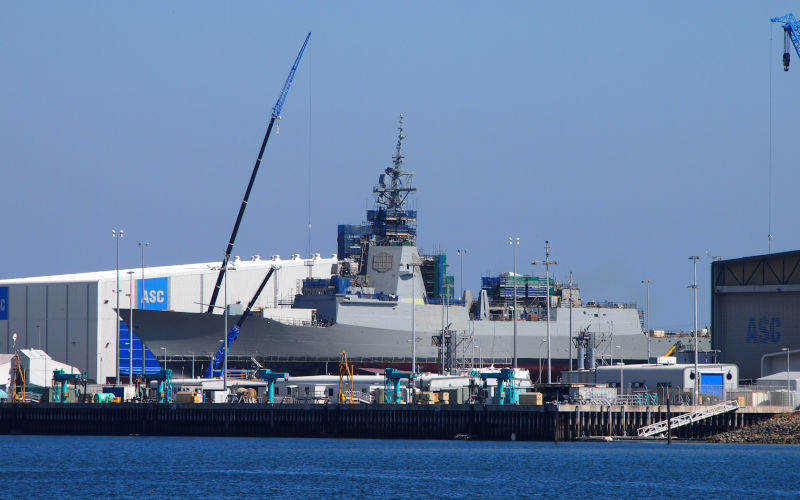
In the third of a six-part series on AUKUS infrastructure, Osborne’s submarine yard is making visible progress, but unfunded stages, nuclear licensing, supply-chain dependence and the absence of an embedded graving dock pose major risks.
While Part 1 evaluated the technical docking constraints of nuclear submarine sustainment and Part 2 examined the land-tenure logjam at Henderson, a parallel but distinct challenge exists in South Australia. To fulfill the AUKUS Pillar 1 Optimal Pathway, Australia has committed to building its future fleet of UK-designed SSN-AUKUS attack submarines at the Osborne Naval Shipyard on the Lefevre Peninsula. Managed by Australian Naval Infrastructure (ANI) on behalf of the Australian Submarine Agency, the new Submarine Construction Yard is projected to cost over $30 billion and cover more than 100 hectares.
Credit must be given where it is due: unlike the administrative stagnation at Henderson, South Australia is making tangible physical progress. Following early land exchange agreements between the Commonwealth and South Australian Governments, ANI has established clear title over a greenfield site. Dirt is moving. Works are actively progressing on heavy soil-piling campaigns, utility realignments, Pelican Point access bridges and civil construction of the $500 million Naval Shipbuilding Skills and Training Academy.
However, translating successful civil earthworks and training halls into a certified, sovereign nuclear submarine construction yard introduces severe long-lead bottlenecks, technical dependencies and live-reactor testing risks that threaten the planned delivery of Australia’s first home-built nuclear submarine in the 2040s.
Osborne’s capital down payment and unfunded horizon
Building a nuclear-powered submarine requires precision civil engineering to tolerances far beyond conventional naval shipbuilding. The proposed master plan at Osborne requires over 50 new structures, including a 420-metre-long fabrication hall, heavy module outfitting facilities, specialised plate-rolling shops and an expansive consolidation and launch berth.
The Albanese Government’s $8.5 billion total commitment to ANI, combining the initial $3.9 billion down payment in February 2026 with the subsequent $4.6 billion funding injection in July 2026, supports active civil works, land acquisitions, utility relocations and early fabrication halls in Area 1. However, these direct commitments are strictly absorbed by preliminary site enabling works, heavy civil piling, road access and initial fabrication facilities.
With total projected shipyard costs exceeding $30 billion, the remaining heavy capital outlays remain uncommitted and pushed into future budget cycles, specifically: Area 2 ($8 billion for outfitting) and Area 3 (more than $15 billion for consolidation, launch and nuclear commissioning).
Furthermore, these deferred outlays are locked behind step-by-step regulatory checkpoints. Capital cannot legally be spent until statutory nuclear safety authorities, the Australian Naval Nuclear Power Safety Regulator (ANNPSR) and ARPANSA, formally approve the safety case for each successive phase of construction. Concentrating capital exclusively at Osborne also doubles down on an “all in Adelaide” strategy. By failing to distribute subassembly work to broader East Coast industrial hubs like Geelong Port, Newcastle or Williamstown, the government risks compounding local site congestion and accelerating regional trade deficits rather than building a resilient, distributed sovereign supply chain.
Co-location congestion and physical constraints
Despite its greenfield advantage, Osborne is a congested maritime industrial node. The new nuclear submarine yard must sit directly alongside active, high-priority naval programs:
- Surface Fleet and Sustainment Programs: The existing Osborne South facility is dedicated to constructing the Royal Australian Navy’s Hunter-class frigates, occupying substantial quay line, laydown acreage and heavy lifting infrastructure. Meanwhile, Osborne North remains the primary sustainment hub for the existing Collins-class conventional submarine fleet, where Life-of-Type Extension (LOTE) maintenance activities cannot be disrupted while adjacent nuclear construction halls are excavated and built.
Reactor integration and the trapped submarine scenario
A critical distinction in naval nuclear shipbuilding lies between the cold structural assembly phase and the post-fuelling commissioning sequence. Under standard UK manufacturing protocols, the Rolls-Royce PWR3+ reactor will arrive at Osborne as a fully sealed, factory-fuelled module encased in a heavy transportation cask. Prior to initial criticality, un-irradiated fuel generates no decay heat and produces no fission-product radiation, making it radiologically benign during initial module insertion and pressure-hull closure. At this point security is all about protecting the weapons grade uranium against theft or sabotage.
Once hull closure is complete and the vessel is moved to the waterfront fitting-out berth, the project reaches its highest-risk milestone: initial reactor criticality, steam-plant commissioning and full power range testing, typically starting 18 months before delivery. Bringing a naval reactor to power transforms the waterfront into an active nuclear site requiring continuous, redundantly powered shore-based backup cooling feeds and high-capacity electrical grids to guarantee uninterrupted decay heat removal if onboard systems fail.
The most severe technical risk occurs if a major defect, hull-seal anomaly or steam-plant failure is detected requiring out-of-water access after the reactor has gone live. The master plan for Osborne prioritises fabrication halls, outfitting bays and a launch transfer system (such as a shiplift or transfer quay), but omits an embedded, nuclear-certified concrete graving dock for deep post-criticality repairs. Taking a live-reactor submarine out of the water on a mechanical shiplift or rolling rail-car system violates core naval nuclear safety standards. Moving a live vessel dynamically across a landward transfer grid creates concentrated point-load stresses on the hull, introduces seismic risks and requires disconnecting primary shore cooling lines while decay heat remains active.
If a live-reactor submarine suffers a primary system defect during waterfront trials at Osborne, it becomes a trapped asset. It cannot be safely lifted onto an open land hardstand, nor can it be towed across the Great Australian Bight to a dock in Henderson or across international oceans with a compromised primary loop. Without a dedicated, nuclear-certified concrete graving dock embedded at the build site, any post-criticality structural or propulsion defect threatens to freeze the construction line indefinitely.
Foreign supply chain reliance
The assumption that Australia can independently build an SSN-AUKUS hull by the 2040s overlooks reliance on overseas industrial partners for core nuclear and combat components. The SSN-AUKUS design relies on Rolls-Royce PWR3+ reactors, manufactured at Raynesway in Derby, alongside US-supplied propulsion components and vertical launch systems. Australia possesses no domestic capacity to manufacture naval nuclear reactor cores or primary steam plant machinery.
Uniquely, the UK Ministry of Defence elected not to build a land-based prototype for the PWR3 reactor, relying instead on computer simulations. Importing an un-prototyped reactor design means any generic design or fabrication flaw discovered during initial criticality at Osborne will have no established shore-based test site fix, amplifying local schedule delays. Furthermore, Australia’s construction timeline relies on the UK’s BAE Systems shipyard at Barrow-in-Furness delivering reactor plants and components on schedule. Barrow-in-Furness is already severely constrained by its commitments for the UK Royal Navy’s Dreadnought-class ballistic missile submarines and initial UK SSN-AUKUS hulls. Any schedule slip at Barrow or Raynesway directly impacts assembly at Osborne.
An ambitious build on fragile foundations
While South Australia is successfully advancing civil land site preparation, domestic submarine construction faces a severe post-criticality safety question. The $8.5 billion commitment remains an early down payment for Area 1, with over $20 billion in future funding (for Areas 2 and 3) remaining uncommitted and subject to step-by-step nuclear licensing.
As recent ASPI analysis on AUKUS infrastructure governance highlights, routing these vast capital outlays through a Government Business Enterprise shields true through-life costs and project risks from parliamentary scrutiny. Failing to co-locate a nuclear-certified graving dock at the build site leaves Osborne without certified out-of-water infrastructure required to safely inspect or repair a submarine with a live-reactor, while establishing an assembly plant heavily dependent on overburdened US and UK supply chains facing acute maintenance backlogs and equipment constraints.
Read Part 1:
Read Part 2:

Peter Briggs
Peter Briggs retired from the RAN in 2001 after a 40-year career, specialising in submarines. This included two submarine commands, command of the RAN Submarine Squadron, director of Submarine Policy and Warfare and Head of Submarine Capability Team, established to rectify Collins introduction into service issues. He was the president of the Submarine Institute of Australia from 2006-09 and is a frequent contributor to public debate on Australian submarine matters.