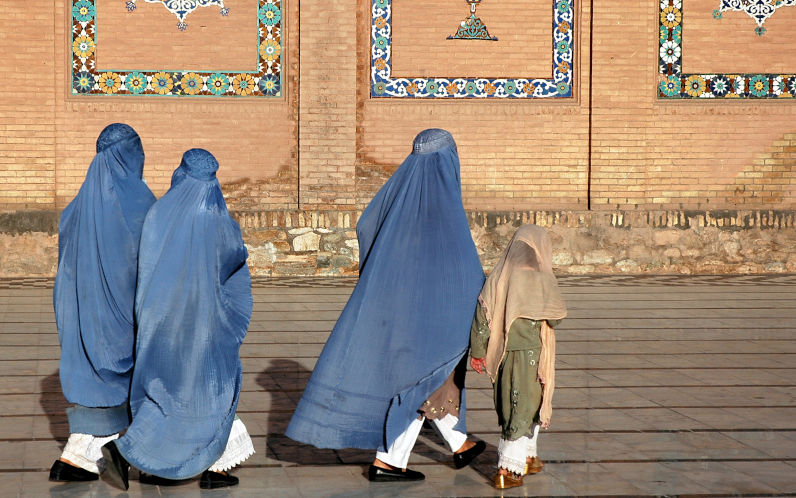
Afghanistan’s battlefields are quieter, but millions of girls remain excluded from education. The consequences will emerge slowly – in missing doctors, teachers, midwives and skills.
Afghanistan has stopped fighting. It has also stopped producing the doctors, teachers and midwives it will need in 10 years. Only one of those facts shows up in the data.
UNICEF projects that Afghanistan could lose 5,400 female health workers by 2030 and as many as 9,600 by 2035 if current restrictions on girls’ education and women’s employment continue, roughly a quarter of the 2021 workforce. Female representation in the civil service has already fallen from 21 per cent in 2023 to 17.7 per cent in 2025. In a country where female health professionals are indispensable to maternal and child care, the damage reaches well past the women prevented from working, arriving eventually at patients who will find the professionals they need no longer exist.
This deterioration is unfolding alongside an apparently contradictory story. By the most conventional measure of war, Afghanistan has become dramatically less violent. Battle-related deaths recorded by the Uppsala Conflict Data Program fell by more than two orders of magnitude after 2021 and have remained in the low hundreds since. The end of nationwide territorial warfare has delivered a genuine security dividend to Afghans who spent decades living around insurgency, airstrikes, checkpoints and shifting front lines. That improvement should neither be denied nor diminished. The difficulty lies in what gets inferred from it.
Economic indicators reinforce the impression of recovery. Afghanistan has returned to aggregate growth, with real GDP expanding an estimated 4.8 per cent and domestic revenue collection reaching 19.8 per cent of GDP in 2025. Yet the World Bank warns that the return of some 3.7 million Afghans from Iran and Pakistan has outpaced that expansion, producing a 5.6 per cent fall in GDP per capita, while inflation climbed from an average of 3.6 per cent to 7.6 per cent by March 2026. The country therefore presents a more complicated picture than either collapse or recovery captures, in which territorial control and low battlefield violence coexist with falling living standards.
Those vulnerabilities come into focus once another ledger is opened. UNESCO reported this week that an estimated 2.4 million Afghan girls remain excluded from secondary education, making Afghanistan the only country in the world where girls and women are formally prohibited from study beyond primary level. Schools closed to girls in March 2022 and universities followed that December, and five years after the Taliban returned to power the exclusion has ceased to look temporary.
More than 100,000 women were unable to resume university study after the higher-education ban, creating the risk that Afghanistan will have no replacements for around 600,000 skilled women expected to leave the workforce by 2066. By 2030 the country could be short more than 11,000 female teachers.
UNESCO puts the cumulative cost of suspending women’s higher education alone at US$9.6 billion by 2066, equivalent to about two-thirds of Afghanistan’s current GDP, and nearly eight in 10 young Afghan women are now outside education, employment and training entirely.
Here is the problem with how Afghanistan’s peace is increasingly understood: the indicators are running on different clocks. Battle deaths respond almost immediately to the end of war, falling within months once armies stop fighting. Educational exclusion works differently, because its consequences accumulate across years. A girl prevented from entering secondary school today does not appear in any statistic as a missing midwife, doctor, teacher or civil servant. Her absence becomes visible much later, when the health centre cannot recruit her and the economy cannot draw on skills she was never permitted to acquire.
Afghanistan therefore exposes a temporal weakness in how post-war stability is assessed, since the benefits of reduced violence are visible immediately while the institutional costs of exclusion arrive gradually. The peace dividend is counted in the present and part of the bill is transferred to the future. Call the resulting effect a pacification premium: a regime that establishes order by removing half its population from public life earns credit in peace measurement for the quiet that removal produces, while the removal itself sits outside the frame.
This matters politically because stability carries diplomatic value. Russia became the first state to formally recognise the Taliban government in July 2025, citing security, counter-terrorism and economic cooperation as areas for expanded ties, and at least 17 countries now maintain embassies in Kabul. Other governments have stopped short of recognition, with women’s rights the central obstacle, yet Afghanistan’s improved security environment increasingly sits alongside the case for pragmatic engagement. The danger is not engagement itself, since diplomacy with the authorities controlling a country of more than 40 million people may be necessary for humanitarian access and regional security. The danger arrives when territorial control and falling battlefield deaths begin to substitute for a judgment about whether Afghanistan is becoming sustainably peaceful.
Correcting that begins with measurement. Educational access belongs inside assessments of post-conflict stability as a constitutive element rather than a separate human rights annex, so that improvement on one clock cannot mask deterioration on the other. A durable peace requires more than the absence of organised warfare, because states must also reproduce the human capabilities their institutions depend upon. A political order that systematically interrupts that reproduction can hold for years while hollowing out the foundations it needs to survive.
Afghanistan’s quieter battlefields are real, and Afghans no longer living beside an active front line have gained something profoundly valuable. The same country is preventing millions of girls from acquiring the education its schools, hospitals and economy require. Both realities belong in any serious assessment of what this peace has produced.
The most revealing statistic about Afghanistan in 2035 may concern someone absent from today’s conflict data entirely: the health worker who should have been standing in a maternity ward, but never reached the classroom that would have let her become one.
Afghanistan has become quieter. Whether that silence can sustain a society is a different measure of peace.
Muhammad Amir
Muhammad Amir is a PhD researcher in International Relations at Deakin University, focusing on conflict resolution and regional politics.