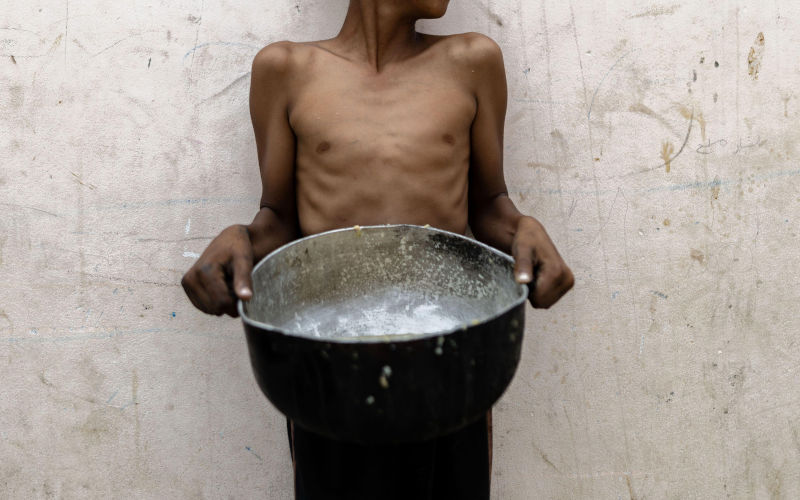
Climate change, war and fragile supply chains are driving a growing global food crisis, with hunger rising and the world’s food systems under increasing strain.
Hunger, the ‘Second Horseman of the Apocalypse’, is riding down modern humanity in ever-increasing swathes as world leaders compete to see who can make matters worse.
While famine spreads through the developing world – Africa especially – the thunder of his iron hooves is echoing even in the supermarket aisles of the affluent West as world food prices ratchet to their second-highest point in history, driven by fears of disruption to the global grain trade caused by a searing climate and savage politics.
Driving the emerging global food insecurity are vast, intractable factors:
- A world climate heating four times faster than it was a decade or so ago, threatening harvests in all continents and regions. The stable climate in which agriculture, cities and modern civilisation arose has now ended.
- A global water crisis, in which humans have outrun the Earth’s ability to supply fresh, clean water – and farmers no longer have sufficient water to irrigate their crops.
- A global soils crisis, in which humans are destroying the very soils that grow our food and spreading deserts at unprecedented rates.
- An agro-ecological disaster, slowly killing the world’s food-producing regions, through hundreds of millions of tonnes of highly toxic chemicals spread over many decades, accompanied by the rising spread of microplastics, ‘forever chemicals’ and endocrine disruptors, all of which attack our children and their brains.
- A pandemic of food ignorance among an urban populace of 4.75 billion, heedless of the fact that it now costs 12 kilos of topsoil, 950 litres of water, 1.6 litres of fuel, 1g of pesticide and 4.9 kilos of carbon emissions to feed one person for one day.
- A human population four times larger than the planet can carry, which is the chief engine of the above.
- Pointless wars in West Asia, Eastern Europe and central/east Africa disrupting grain supply to local and world markets, driving up bread prices for everyone.
- Booming world oil prices and tightening supplies, also war-driven, creating shortages and fuel emergencies in 27 countries. Diesel scarcity, in particular, will hit farming, transport and the cost of food.
- A warning of a global food crisis in 2027 by banker JP Morgan due to world fertiliser scarcity and lack of reserves.
- Increased fragility of world food chains and food prices due to trade and tariff wars, instituted by thoughtless politicians.
- The hottest summer on record has cut 9 million tonnes off the Western European grain crop, sending vegetable prices spiralling and alarming policymakers across the EC.
- Few natural events shape global food output more profoundly than the El Niño/Southern Oscillation (ENSO). The event forecast for 2026/27 could be the worst in living memory, according to the UK Met Office. El Niño’s impact will compound the dire effects on food output arising from global heating.
- The rising danger of a limited nuclear war in West Asia. This could kill up to 2 billion people worldwide through crop failures and famine.
In the current world food crisis, 266 million people face acute hunger, and another 45 million are at direct risk due to war in West Asia, according to the World Food Program. The highest deaths from starvation are in India, Nigeria and Myanmar, but there are widespread problems across central and eastern Africa and in Central America. Worst-affected countries include Sudan, South Sudan, Ethiopia, Somalia, Kenya, Guatemala, Haiti and a growing list of Middle Eastern states.
Even in developed countries the challenge of ‘hidden hunger’ due to a poor-quality industrial diet is growing. In the US, for example, 4.3 million children suffer ‘very low food security’, while in Europe 9 per cent of people cannot afford a quality meal every other day. On top of this, an estimated 2.5 billion humans now suffer from malnutrition due to the oversupply of rubbish food, causing obesity. This is expected to increase to 3.3 billion by 2030.
The emerging food crisis falls most heavily on children. The Trump regime, stained by its support for child mass murder in Iran and Gaza, has committed its most egregious act of pedocide yet, by cancelling funds for the World Food Program, which delivers vital food aid to regions facing disaster. Millions could die of starvation as a consequence, the WFP has warned. Additionally, US sanctions are driving hunger in Cuba.
Meanwhile Trump’s fellow tyrant, Putin, has helped shut down 97 per cent of grain exports from the Black Sea region. The last time Black Sea exports fell sharply it led to regime failures in Egypt, Tunisia and Syria, and the refugee crisis in Europe. High bread prices were a significant driver in the 2011 ‘Arab Spring’ of protest against repressive governance, highlighting the domino impact of local grain trade and harvest failures on wider global geopolitics.
These two individuals epitomise how the might of the world’s two largest military powers is now being deployed in ways that kill people all around the planet – with famine as their deadliest weapon. To gratify their psychotic egos and power hunger, these dictators have unleashed the Second Horseman.
Equally to blame for the rising death toll are the oil, petrochemical and fossil fuel corporates, whose profits depend on continued fossil fuel production despite its contribution to climate change. Oil companies have known about global heating since before the 1970s, through their own scientists. They have proceeded, clear-eyed, with the destruction of the only climate the Earth has ever had that favours farming, and the urban civilisation that depends on it.
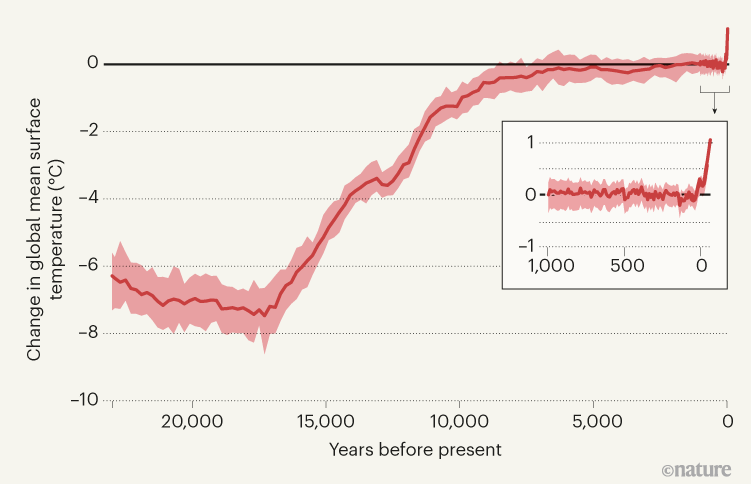
Fig 1. The average temperature of the Earth over the last 20,000 years. 9,000 years ago, after the Ice Age, it achieved a level of stability that enabled grain farming and grazing to emerge, and this led to the rise of cities, industry and technology. That stability is now ended, with the sharp increase in temperature of the past 150 years (see inset). Source: Nature, 2024.
It’s an established fact that no large city on Earth can feed itself. All cities draw their food from farming systems, often thousands of kilometres distant. Without this vital food chain, they can starve within days. And without cities there would, of course, be no industry, advanced technology – or billionaires.
The world food supply is hedged with all these intractable threats, almost all of them the result of government or corporate action or carelessness. It is doubtful whether their citizens, political leaders or corporate bosses understand just how perilous is the sword that hangs over global civilisation. The belief that food, like the planet, is endless is seductive, but delusional.
Because it is not possible to forecast the behaviour of unhinged rulers, it is not possible to predict the onset of global and regional famines with any great precision. We only have the weather as a guide. However, it is possible to predict – with high confidence – that they will occur, on an increasing trajectory, starting well before 2050.
Is there anything to be done? Certainly. Renewable food could solve the problem with ease, and in good time. It could also re-green the planet, massively reducing CO2 levels, and end about two-thirds of modern wars, while creating millions of sustainable new jobs, enterprises and prosperity. (See Food or War.)
But introducing renewable food will be no easier than introducing renewable energy – though both make perfect sense – because national leaders and corporates will oppose it with every breath in their bodies, for the same senseless and selfish motives that have governed their foot-dragging and sabotage on climate change.
So humanity now faces a global food crisis, plain as day and beyond denial, yet seems powerless to do anything to prevent it.
Is collapse truly the only alternative left to us?

Julian Cribb AM is an Australian science writer and author of six books on the human existential emergency. His latest book is “How to Fix a Broken Planet” (Cambridge University Press, 2023)