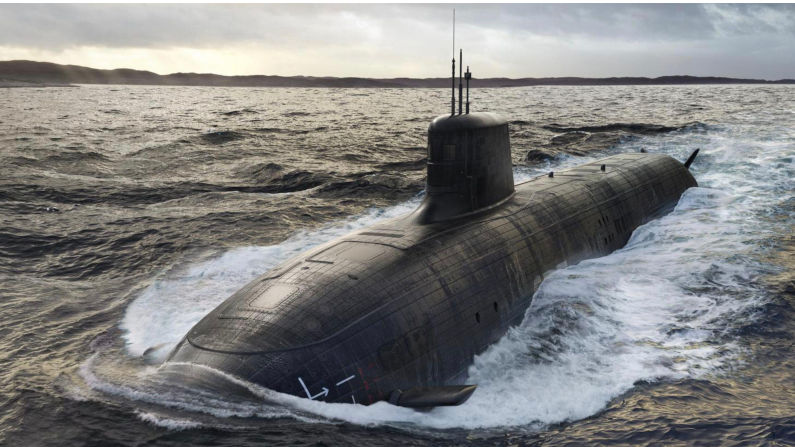
SSN-AUKUS is heading towards steel-cutting in 2027. The real test is whether design maturity, workforce capacity and engineering readiness support the milestones being celebrated.
In Lewis Carroll’s Through the Looking-Glass, Humpty Dumpty famously declares in a rather scornful tone: “When I use a word, it means just what I choose it to mean – neither more nor less.” When Alice questions whether one can make words mean so many different things, Humpty Dumpty delivers the realpolitik punchline: “The question is, which is to be master – that’s all.”
This exchange provides an apt framework for understanding the official public relations surrounding the SSN-AUKUS program. In the realm of defence procurement, public relations spin has become the master, while engineering reality, milestone integrity and standard acquisition governance are relegated to inconvenient details.
Faux serenity v waterfront reality
This “faux serenity” routine is not new; it mirrors the public relations management of the Royal Navy’s frontline fleet.
On 22 September 2025, HMS Agamemnon (S124), the sixth Astute-class hull, was “commissioned” at BAE Systems’ Barrow-in-Furness shipyard with full regal fanfare and media celebration – conveniently ahead of subsequent high-level visits by President Trump and Prime Minister Albanese. Yet she sat alongside in Barrow for over a full year before finally sailing for HM Naval Base Clyde (Faslane) on 24 September 2026 to commence her sea trials.
Allowing for the standard 12-to-15-month contractor trial and work-up pipeline, Agamemnon will not enter operational service until mid-2028, 15 years after her keel was laid down in July 2013, likely setting the record as the longest build duration of the Astute class. It seems reasonable to conclude that the ceremonial 2025 commissioning was a pure public relations event, completely decoupled from waterfront reality.
We are now seeing the same playbook applied to SSN-AUKUS. Management appears ready to stage ceremonial steel-cutting in 2027 to claim symbolic progress, regardless of whether the engineering data packages are mature or the Critical Design Review is really locked down.
In early September 2026, Major General Mark Totten, UK director SSN capability in the Defence Nuclear Organisation, visited Canberra. During his tour, he offered reassuring words regarding the state of the British submarine enterprise and the SSN-AUKUS design schedule. Addressing criticisms over shipyard bottlenecks and schedule slippage, Major General Totten reframed delays, saying: “We’re being very careful to spend the right amount of time to design the right submarine that both our nations will use.”
It was a masterclass in public relations reframing, converting a missed engineering gateway into a deliberate, quality-assurance virtue.
Yet, barely six weeks later, public narratives took an even more bizarre turn. Luke Pollard, the minister of state for defence, said in response to a parliamentary question: “The SSN-AUKUS Preliminary Design Review was conducted in June 2026 and concluded on 1 July as part of the ongoing Detailed Design and Long Lead (D2L2) phase of the program.”
Ahead of schedule!
BAE Systems obviously forgot to tell the general, creating an extraordinary contradiction. If the Preliminary Design Review had indeed been achieved on 1 July, why was the UK’s senior responsible owner for SSN-AUKUS entirely unaware of it in Canberra two months later when explaining why the team was taking extra time on the design? The champagne was apparently popped in secret, leaving even the program leadership out of the loop.
An alternative view is sustainable, that is, BAE Systems and the MoD have redefined ‘Preliminary Design Review completion’ to mean something entirely decoupled from engineering ground truth. (As a consequence, the minister may have inadvertently misled parliament.) An external review to confirm the situation is probably the only way to resolve the actual situation.
Subverting the CADMID gateway
In naval architecture and established UK Ministry of Defence acquisition policy, specifically the CADMID (Concept, Assessment, Demonstration, Manufacture, In-Service, Disposal) framework, the Preliminary Design Review is not an optional checkbox or a floating administrative construct.
Preliminary Design Review marks the formal boundary ending the Concept/Assessment phase. Its objective is to freeze macro hull dimensions, compartment boundaries, weight distribution and core system interfaces before committing detailed engineering resources and ordering long-lead items.
We look forward to hearing more of the details – what are the designed surface displacement, major systems and macro dimensions of our new SSN? And some calendar dates for the key design milestones ahead – notably the Critical Design Review, to freeze the detailed manufacturing drawings and structural data packages before major physical construction or steel-cutting begins.
Rushing to cut steel, slated for 2027, on an un-frozen design directly repeats the disastrous 1997–2001 Astute procurement blunder, where cutting steel prior to finishing detailed design caused a multi-year collapse, massive cost overruns and required an emergency influx of American designers from General Dynamics Electric Boat to rescue the 3D CAD modelling.
The cost of deluding ourselves
The British submarine enterprise is operating under immense structural strain. All five operational Astute-class SSNs have experienced severe availability bottlenecks, tied up alongside while an ageing Vanguard-class deterrence fleet consumes available maintenance bandwidth. Barrow-in-Furness faces acute labour shortages, adding barely 500 workers against a required 2,500 to support parallel Dreadnought and SSN-AUKUS build lines.
Substituting public relations narrative for engineering ground truth does not build submarines. As former UK director of nuclear policy Rear Admiral Philip Mathias bluntly observed: “Policy and money don’t build nuclear submarines – people do that, and there are not enough of them with the right level of skills and experience.”
Until defence leadership in London and Canberra abandons the Humpty Dumpty approach to terminology, where “on track” means whatever is politically expedient, the SSN-AUKUS program will remain trapped in a cycle of symbolic milestones, unacknowledged delays and escalating risk.

Peter Briggs
Peter Briggs retired from the RAN in 2001 after a 40-year career, specialising in submarines. This included two submarine commands, command of the RAN Submarine Squadron, director of Submarine Policy and Warfare and Head of Submarine Capability Team, established to rectify Collins introduction into service issues. He was the president of the Submarine Institute of Australia from 2006-09 and is a frequent contributor to public debate on Australian submarine matters.