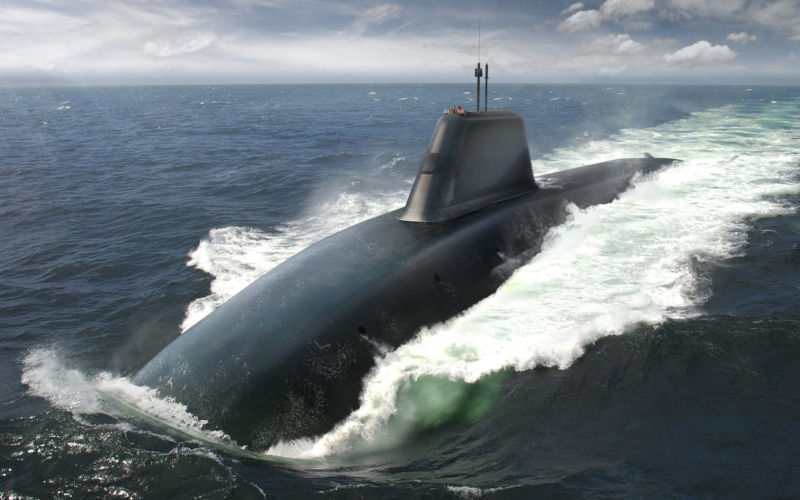
Britain says SSN-AUKUS remains on track. But its shipyards are already stretched while new reactor and workforce capacity is still being built. Australia is betting heavily on that gap being closed in time.
The public relations narrative of AUKUS Pillar 1 rests on a singular, untested premise: that the United Kingdom can seamlessly transition from its current Astute and Dreadnought submarine programs to deliver a brand-new, complex, 10,000-tonne nuclear-powered attack submarine, SSN-AUKUS, on schedule.
Recent developments in the UK demonstrate that this political optimism is fundamentally disconnected from the physical, contractual, financial and industrial realities on the ground at BAE Systems’ shipyard in Barrow-in-Furness.
In September 2025, King Charles formally commissioned HMS Agamemnon, the sixth Astute-class submarine, into the Royal Navy. Press releases heralded a major defence milestone. Yet, far from entering active service, Agamemnon remained tied up inside the Devonshire Dock Basin at Barrow for another full year, only departing for initial contractor sea trials on 24 September 2026.
The early commissioning reverses standard Royal Navy procurement. Laid down in July 2013, Agamemnon took 13 years and two months simply to leave the dock. Her actual entry into service will not occur until mid-to-late 2027 – a 14-year construction timeline.
This ceremonial exercise illustrates a broader pattern of political messaging substituting for industrial output. Claims that steel will be cut for the first SSN-AUKUS hull at Barrow in 2027 follow the same pattern. Embarking on physical hull fabrication before completing a preliminary design review (PDR) and freezing the 3D spatial design model risks severe engineering setbacks. For SSN-AUKUS, detailed design funded under a £3.95 billion development contract running through 2028 remains under way. Without a stable PDR baseline, internal layouts, reactor integration and pipework remain in flux. ‘Cutting steel’ in 2027 will merely involve cutting test rings or material qualification modules rather than assembling an operational warship.
Yard saturation and uncontracted infrastructure
The physical state of Barrow shipyard exposes the impossibility of fast-tracking SSN-AUKUS.
The heart of Barrow’s manufacturing capability is the Devonshire Dock Hall (DDH). Currently, the DDH is full. It houses the first three Dreadnought-class ballistic missile submarines (Dreadnought, Valiant and Warspite) alongside the final Astute hull, HMS Achilles (Boat 7), while initial fabrication for the fourth SSBN (HMS King George VI) proceeds off-site. There is no physical bay space inside the primary hall to establish an SSN-AUKUS production line.
The severity of this spatial bottleneck was underlined in a recent planning application submitted by BAE Systems Marine Ltd for its North Quay site, immediately adjacent to the DDH. BAE sought municipal approval to erect a 125-metre-long temporary enclosed scaffold structure on the open quay to house overflowing component manufacturing and outfitting. In its official filing, BAE acknowledged the improvised structure was explicitly required “as a result of capacity constraints within the Devonshire Dock Hall (DDH)”.
When a major nuclear shipyard must resort to 125-metre fabric sheds on quayside aprons to handle current workloads, absorbing a new 10,000-tonne attack submarine line strains credibility.
To bypass this bottleneck, BAE Systems purchased an 18-acre former gas site at Ramsden Dock. The plan is to manufacture hull cylinders on this port land and barge them via a roll-on/roll-off (Ro-Ro) quay to the main dock basin. However, the site requires extensive clearing, re-grading and deep piling before shed construction can begin.
Crucially, while the initial £3.95 billion contract covers preliminary 3D design and basic enabling works, primary contract packages required to build these sheds and construct the Ro-Ro wharf remain unexecuted or fragmented across future budget cycles. Furthermore, in July 2026, the UK MoD awarded a £5.9 billion delivery contract strictly prioritised for the Dreadnought-class SSBN. Because Britain’s continuous at-sea deterrent takes total strategic precedence, primary nuclear engineers, dry docks and yard resources at Barrow are contractually locked into Dreadnought through to the delivery of the fourth boat in the late 2030s.
Reactor supply and logistics bottlenecks
The industrial choke point extends beyond Barrow to the nuclear supply chain at Raynesway in Derby, where Rolls-Royce Submarines manufactures all Royal Navy reactor cores.
To support both Dreadnought and SSN-AUKUS, Rolls-Royce began work to double the footprint of its Raynesway site in July 2026. Once assembled, complete PWR3 reactor modules must be transported over 150 miles by road in heavy-duty, radiation-shielded containers under armed police escort along the M6 and A590 corridors directly into the Barrow yard.
While the PWR3 reactor has been lowered into lead boat HMS Dreadnought inside DDH, manufacturing and delivering reactors for follow-on SSBN hulls alongside initial SSN-AUKUS units creates a severe industrial queue. Raynesway remains constrained by strict nuclear licensing oversight and an acute shortage of specialised nuclear-certified welding technicians.
The human and civil bottleneck
The physical sheds at Barrow may eventually be erected; however, the civil infrastructure required to support the workforce does not exist in the numbers required.
BAE Systems has expanded its Barrow workforce from 11,000 to approximately 16,000, aiming for over 18,000. In 2026, the UK House of Commons Defence Committee warned that infrastructure investment at Barrow “has already faltered”. BAE Systems formally advised local government that the shipyard requires 900 new homes to be built annually in Barrow to house incoming technicians. Current local construction struggles to deliver 200 units per year. Thousands of contractors commute daily along the single-carriageway A590, creating severe transport gridlock.
In response, the UK Government established ‘Team Barrow’ with a £200 million regeneration fund. However, Team Barrow leadership has publicly acknowledged that this seed allocation falls far short, stating that £400 million to £800 million in combined investment will be required to tackle the town’s infrastructure deficit. Furthermore, this funding is designated for general municipal upgrades – schools, healthcare and roads – rather than industrial shipyard tooling.
Britain lacks the localised housing, transport capacity and specialised nuclear-certified trade workforce to operate two concurrent submarine construction lines.
Strategic imperatives: NATO vs Indo-Pacific overreach
This industrial overstretch must be viewed through the unforgiving lens of Britain’s fiscal deficit and shifting strategic priorities.
Under mounting financial pressure, the UK Ministry of Defence faces a multibillion-pound structural budget shortfall. The UK Strategic Defence Review has formalised a mandatory ‘NATO-first’ posture, directing military resources, capital investment and force readiness primarily toward European defence and deterrence against Russian aggression. Facing a security crisis on its continental doorstep, Whitehall cannot afford to bankroll massive, long-horizon industrial expansions designed to project power into the Indo-Pacific.
Sustaining Britain’s continuous at-sea deterrent via Dreadnought consumes the lion’s share of UK capital expenditure. Coupled with urgent demands to re-arm land and air forces in Europe, attempting to design and build a bespoke 10,000-tonne attack submarine for Australia would appear to be a lower priority.
Industry is striving to recover from decades of systemic neglect that has left operational SSN capability immobilised and the continuous at-sea deterrent under strain. Political ambition cannot overrule the laws of industrial capacity, national economics and engineering physics.
Australia is pinning its strategic future to an overburdened, fiscally constrained UK industrial baseline. The physical and financial evidence at Barrow – an unbuilt off-site facility, a saturated main assembly hall requiring temporary outdoor work space, unfinalised contracts for primary manufacturing sheds, acute housing deficits, severe reactor supply chain queues, and a UK defence budget deficit whilst pivoting back to Europe – demonstrates that Britain cannot deliver SSN-AUKUS on the promised timeline.
Relying on ‘schedule-free’ assurances while ignoring these constraints guarantees a severe capability gap for Australia. It is time for Washington, London and Canberra to acknowledge these ground realities and undertake a fundamental reappraisal before industrial overreach turns into operational and political catastrophe.

Peter Briggs
Peter Briggs retired from the RAN in 2001 after a 40-year career, specialising in submarines. This included two submarine commands, command of the RAN Submarine Squadron, director of Submarine Policy and Warfare and Head of Submarine Capability Team, established to rectify Collins introduction into service issues. He was the president of the Submarine Institute of Australia from 2006-09 and is a frequent contributor to public debate on Australian submarine matters.