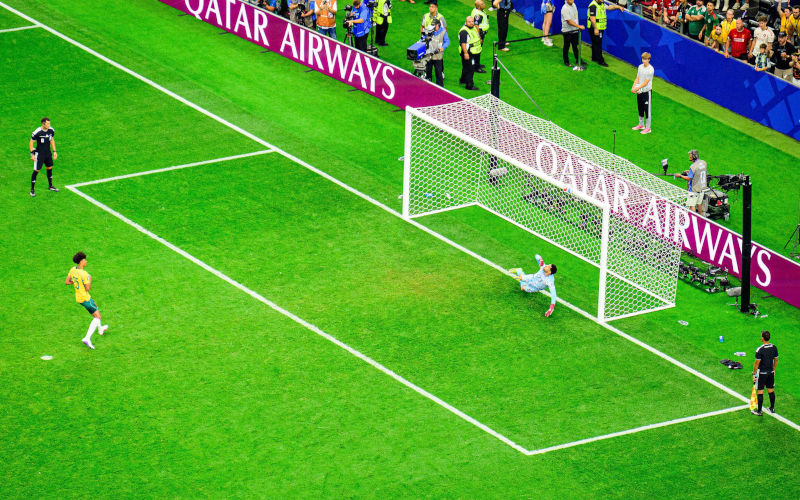
After the Socceroos’ World Cup heartbreak, the penalty kick offers a brutal lesson in pressure, failure and courage – especially when an 18-year-old is willing to step forward.
Invented in 1891 to make football fairer by punishing deliberate fouls near goal, the penalty was born from an idea of justice. Yet over the following century it became something much larger. It became a test of character.
Every penalty distils life into its simplest form. Preparation meets pressure. Skill meets psychology. Hope meets fear. There are no teammates to hide behind, no tactics to disguise responsibility and no second chances once the whistle blows.
Perhaps that is why the world’s most celebrated players are remembered not only for their brilliant goals but also for their misses. Roberto Baggio’s penalty over the bar in the 1994 World Cup final remains one of football’s defining images. Yet it diminished neither his greatness nor his humanity. If anything, it reminded us that excellence and vulnerability can exist in the same person.
The penalty kick teaches an uncomfortable truth. Most of life is lived collectively, but some moments must be faced alone.
Leadership is like that. Parenthood is like that. Medicine, politics, teaching, business and public service all have their own penalty spots—those moments when the decision cannot be deferred, the responsibility cannot be shared and the outcome may define how others remember us.
Ironically, the goalkeeper often plays with greater freedom than the kicker. Expectations are lower. Success is celebrated; failure is forgiven. The penalty taker carries the burden of expectation. That, too, reflects life. It is often those entrusted with responsibility who carry the greatest psychological weight.
The penalty also reminds us that fairness is never the same as certainty. It was introduced to create justice, yet it frequently leaves millions feeling that justice has not been served. That paradox extends far beyond football. Our courts, elections and public institutions all strive for fairness while knowing perfection is impossible.
Perhaps the greatest lesson is that pressure rarely creates character. It reveals it. When the crowd falls silent and the world narrows to twelve yards, there is no time to invent courage or discipline. What emerges is the product of years of preparation, practice and resilience.
In an age increasingly obsessed with instant success and curated perfection, the penalty kick offers a healthier perspective. Failure is not the opposite of greatness; it is often one of its companions. The greatest players have all missed. What distinguished them was not perfection but the willingness to walk back to the penalty spot the next time.
That lonely walk from halfway may be football’s most profound image. Every one of us eventually faces moments when responsibility cannot be outsourced and outcomes cannot be guaranteed. At those times, we discover what the penalty kick has always taught: courage is not knowing you will succeed. Courage is stepping forward anyway.
Perhaps that is why the penalty remains football’s most compelling ritual. It compresses the human experience into a single moment. Justice and chance. Skill and nerve. Triumph and regret. Hope and fear.
All within twelve yards.

Stewart Sweeney
Stewart Sweeney is a writer and public policy advocate with a longstanding interest in the evolution and future of capitalism. He migrated from Scotland to Adelaide in 1975 to work with Premier Don Dunstan on industrial democracy. A former academic and trade unionist, he continues to contribute to public debate on economic justice, democratic reform, and sustainable development. His work reflects a deep commitment to the common good and the role of public purpose in shaping Australia’s future.