In the final part of a six-part series on AUKUS infrastructure, Peter Briggs argues that Pillar 1 cannot deliver on schedule or budget, and that Australia should pause its HEU pathway and assess proven LEU alternatives.
A central question now confronts Australian defence policymakers and the public alike: Is it too late to change course?
When pressed on whether AUKUS Pillar 1 can realistically deliver an operational, nuclear-powered Australian submarine capability, official commentary routinely sidesteps compounding engineering, industrial and financial barriers. This was vividly illustrated on ABC TV’s 7.30, where Assistant Minister for Defence Pat Conroy introduced a new narrative twist, asserting that the foreign Submarine Rotational Force–West (SRF-W) presence at HMAS Stirling will strictly conclude in 2032 as the first Australian Virginia-class hull arrives. This tight “2032 departure” sunset clause is not reflected in the AUKUS Joint Leaders’ Statement or other official announcements. Nor does it reflect the reality of the US Navy establishing Naval Support Activity Stirling, to manage logistic support, including for USN families living locally. The Commander, Submarine Forces Pacific’s announcement on 10 June 2026, re-establishing US Submarine Squadron 3 at HMAS Stirling, leaves little doubt as to their intentions:
“Adding an additional forward-positioned submarine squadron in the Indo-Pacific … CSS-3 enables our submarines and crews to respond rapidly in support of the US joint force mission of regional deterrence.”
Political tap dancing aside, the fundamental question remains unanswered: what happens to Australian maritime posture when that US Virginia is simply not available for delivery? Judging by his failure to answer many of the questions put to him on the ABC’s 7.30, this is a hypothetical scenario and therefore not worthy of considering or answering. A refreshing if not heroic take on risk management indeed!
Every objective metric confirms that Pillar 1 cannot deliver its promised outcomes on schedule or within budget. Pausing this trajectory is not an admission of failure; it is an urgent strategic necessity. Every day Australia continues down this unworkable path wastes billions of dollars and precious time that should be allocated to securing a viable, sovereign undersea capability.
The anatomy of a systemic failure
To understand why changing course is imperative, one must evaluate the individual component assumptions underpinning Pillar 1. None withstand critical scrutiny:
- US industrial reality: The United States Navy (USN) cannot deliver three additional Virginia-class submarines to replace those slated for Australia, starting in 2032. No extra hulls have been ordered to offset the transfer, no additional reactors are under construction and the USN leadership never organically sought this politically inspired arrangement. US shipyards are fully committed; construction rates remain stuck below 1.1 hulls per year as shipyards struggle under the heavier workload of Block V/VI Virginias and top-priority Columbia-class SSBNs. Furthermore, the service-life extension (SLEP) for aging Los Angeles-class boats is languishing, only one has been completed, taking twice as long as planned, while 37 per cent of the US attack submarine fleet sits non-operational, tied up awaiting depot maintenance against a standard target of under 20 per cent.
- US supply chain breakdown: The US submarine supply chain is failing its own fleet. Active USN attack submarines are routinely cannibalised for spare parts to keep deployable hulls at sea.
- Domestic infrastructure and workforce deficits: Australia cannot construct the requisite nuclear shipyard facilities at Henderson and Osborne to support US and Australian Virginias by 2032. Assembling the certified nuclear workforce alongside concurrent builds of Hunter-class frigates, landing craft, Mogami-class frigates and the booming North West Shelf oil and gas sector is highly improbable. Even if three Virginias were delivered three years apart, it is likely that Australia could neither crew nor sustain them.
- The failed UK submarine enterprise: Australia cannot deliver its first SSN-AUKUS in the early 2040s, nor commence construction by 2030. The UK submarine enterprise we are relying on to deliver this is in a state of collapse, the industrial base is staggering under backlogs on the Astute and Dreadnought programs, leaving no capacity to deliver a debugged SSN-AUKUS design by the late 2020s. Furthermore, the un-prototyped PWR3+ reactor core has yet to go to sea. While UK shipbuilders will undoubtedly cut steel with undue pomp in 2027, Osborne cannot simultaneously manage the ongoing Collins-class LOTE, build six Hunter frigates and construct an advanced nuclear facility on the same site.
- The mixed-fleet nightmare: Australia cannot achieve operational deterrence with a small, split force of three Virginias and five SSN-AUKUS hulls. Neither type reaches a sustainable minimum mass and both remain tethered to separate, overstretched overseas supply chains.
The social license and budget realities
Beyond industrial limits, Pillar 1 lacks a durable public license. Managing the onerous, highly intrusive safety and non-proliferation mandates of weapons-grade Highly Enriched Uranium (HEU) near civilian populations has not been explained to the Australian public. It will legitimately trigger widespread concern once the full radiological, regulatory and waste-disposal burdens are understood.
Moreover, executing this unviable plan is impossible on the current defence budget. Persisting with a plan that cannot be funded, built, crewed or sustained risks leaving Australia without a functioning submarine force in the 2030s.
Evaluating LEU: ROK developments and France’s Suffren
Australia does not have to take the HEU path; there is a valid alternative. Pivoting to a Low-Enriched Uranium (LEU) propulsion framework resolves these structural logjams. Operating on commercial-grade fuel enriched to under 6 per cent U-235 removes weapons-grade hazards, avoids reliance on the US as a sole source supplier of HEU, eliminates non-proliferation liabilities and provides a forgiving 5-to-6-hour thermal safety window during a reactor cooling failure. Synchronising LEU refuelling with mandatory 10-year structural overhauls aligns nuclear physics with standard naval maintenance cycles.
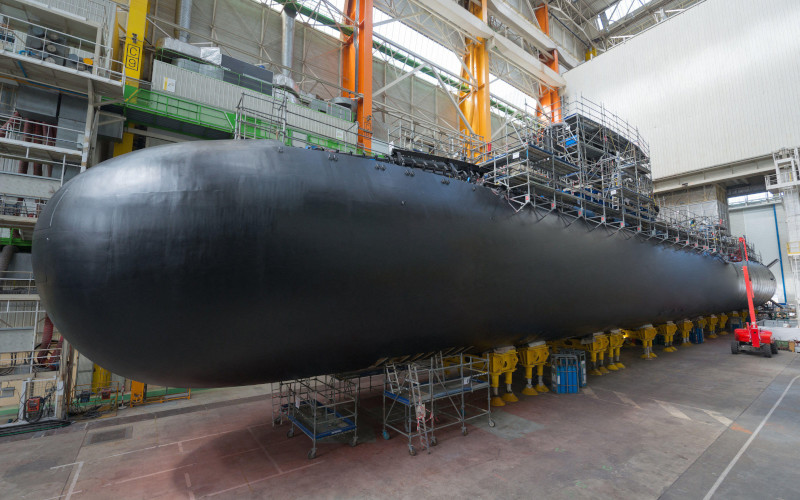
In evaluating international options, South Korea’s recent announcement of its Jangbogo-N program to develop an 8,000-tonne LEU-powered submarine underscores the broader global momentum shifting toward low-enriched naval propulsion. Whilst it opens up the possibility of collaboration in the future, the Jangbogo-N design remains an unbuilt concept. Given the late hour and the state of our submarine capability, we must look to platforms already operational at sea. France’s Suffren-class SSN stands out with the immense advantage of being fully debugged and active today. Utilising standard torpedo tubes to deploy heavyweight torpedoes, anti-ship missiles and land-attack cruise missiles, the Suffren could give Australia sovereign munitions access independent of congested US production lines.
If at all possible, we should transition directly to Suffren, but if an interim conventional submarine is required to bridge the 2030s gap while nuclear waterfronts are certified, platform selection must be dictated by Australian transit geography. Conventional submarine designs using Air-Independent Propulsion (AIP) are unlikely to be suitable. While AIP suits low-speed, littoral operations over short ranges, it adds deadweight during the long, high-speed transits Australia demands. Once its reactants are exhausted, an AIP submarine is burdened by empty tankage during long snorkelling transits. To meet Australian requirements, this space is better filled by more powerful diesel generators, paired with higher capacity battery banks.
In this context, the French-designed Orka class, derived from the Suffren hull, probably represents a suitably balanced conventional platform for Australia’s needs. It replaces AIP complexity with a high-output generator and modern battery combination. Transitioning from there to a Suffren derivative would create a harmonised, single-family design with shared hydrodynamics, matching combat systems and similar platform maintenance procedures to the Suffren SSN.
A pragmatic roadmap for strategic realignment
To restore sovereign agility, escape the infrastructure swamp and avoid a catastrophic undersea capability gap, Australia should adopt a conservative, sequential approach:
- Halt Pillar 1 HEU commitments: Immediately suspend capital expenditure on un-prototyped HEU infrastructure at Osborne and Henderson until nuclear safety cases, dry dock logistics and delivery realities are independently audited and established.
- Evaluate operational LEU platforms: Conduct a formal technical evaluation of mature LEU attack submarine designs, prioritising platforms like the French Suffren class that are already operational at sea and debugged.
- Assess high-capacity conventional options: If a capability bridge is required, evaluate long-range conventional platforms like the Orka class, rejecting low-speed AIP systems in favour of high-capacity generator and battery combinations suited to Australia’s transit requirements.
- Monitor regional LEU developments: Consider collaboration with emerging international LEU programs, perhaps joining the recent France–South Korea agreement cooperating on South Korea’s Jangbogo-N, while focusing near-term procurement on proven, sea-going hulls.
- Reconfigure waterfront infrastructure: Refocus domestic shipyard construction on certified conventional graving docks capable of supporting surface warships and LEU submarines, ensuring any HEU containment costs for visiting foreign vessels are borne by those nations.
Stopping the waste of time and money
It is not too late to change course, but the hour is late and the clock is ticking. Continuing to pour public funds into an unbuilt HEU infrastructure line, dependent on failing overseas shipyards and supply chains, an overburdened domestic workforce and an unachievable 2032 delivery timeline, is a dangerous gamble with national security.
By pausing the current Pillar 1 trajectory, pivoting to a sea-proven LEU propulsion framework and evaluating realistic platform options, Australia can build a formidable, affordable and truly sovereign undersea force, large enough to make a difference. Every day spent ignoring these industrial and personnel realities wastes money and compromises national defence; changing course now is the only responsible way forward.
Read the 6-part series and more on AUKUS from the author here

Peter Briggs
Peter Briggs retired from the RAN in 2001 after a 40-year career, specialising in submarines. This included two submarine commands, command of the RAN Submarine Squadron, director of Submarine Policy and Warfare and Head of Submarine Capability Team, established to rectify Collins introduction into service issues. He was the president of the Submarine Institute of Australia from 2006-09 and is a frequent contributor to public debate on Australian submarine matters.