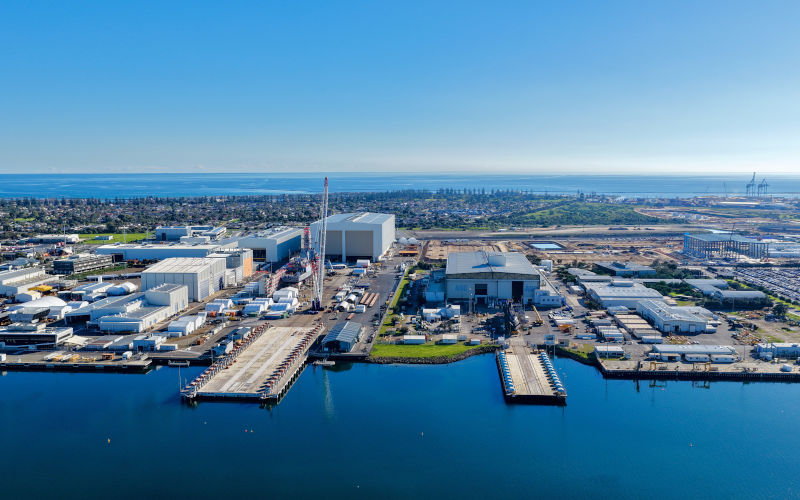
In part seven of the AUKUS infrastructure series, the focus turns to Henderson, where fragmented planning risks locking Australia into costly nuclear bottlenecks before construction has properly begun.
The establishment of the consolidated Henderson Defence Precinct in Western Australia, under design leadership from Bechtel Infrastructure Australia, represents a generational investment in Australia’s naval infrastructure. However, Commonwealth planning displays a profound lack of strategic forethought. By committing to fragmented shipbuilding contracts ahead of a finalised master plan, Defence has created severe spatial, regulatory and workforce gridlock at Henderson and Osborne before heavy civil construction has even begun.
This piece examines the maintenance workloads generated by an eight-hull Australian nuclear submarine fleet operating alongside four forward-deployed US Navy SSNs and demonstrates Henderson’s incapacity, under the current program, to deliver.
For starters, a single graving dock as currently envisaged creates an inherent single point of failure. For a force of four USN and eight RAN HEU-fuelled SSNs, incorporating two graving docks and one nuclear-certified floating dock into Bechtel’s baseline design is essential to prevent the severe dockyard congestion currently crippling US and UK fleet availability.
To provide national redundancy for the 80-year-old Captain Cook Graving Dock in Sydney without freezing nuclear maintenance, Henderson’s Dock 1 must be constructed as a ~300-metre x 45-metre dual-chamber facility. Equipped with an intermediate caisson, its two sections can then handle short planned and/or unscheduled emergency submarine dockings and be cleared to dock Australia’s 27,500-tonne Canberra-class Landing Helicopter Docks (LHDs) when needed.
Dock 2 (~180 metres x 25 metres) can then be dedicated to continuous, two-year SSN refits that physically lock out the facility from unscheduled emergency submarine dockings. Across an eight-hull RAN submarine force as planned under AUKUS, one to two submarines will be permanently in two-year refits (occupying Dock 2), while the in-service submarines will generate three to five shorter docking events annually (occupying Dock 1).
Rationalising Henderson requires relocating surface warship construction to free up waterfront real estate for SSN laydown areas and deep-water access. Co-locating nuclear docks with Collins submarine maintenance, surface ship sustainment, landing craft builds and Mogami-class frigate construction within a shared footprint creates unmanageable conflicts.
Moving the landing craft and 6,200-tonne Mogami frigate construction to an east coast yard, such as reactivating the Williamstown shipyard in Victoria, could offer an immediate, cost-effective solution. Applying US Navy dimensional standards (such as Dry Dock #5 at Pearl Harbor, costing over A$5 billion) demonstrates that an SSN dock requires a direct waterfront footprint of 2.5 hectares, which is currently unavailable within the Henderson facility plan.
Infrastructure at Henderson is further complicated by depth constraints. While Cockburn Sound features a naturally deep central basin, immediate precinct berths operate at depths of only eight to 10 metres. Supporting deep-draft SSNs, large surface ships and floating docks requires capital dredging to 18 metres. The low-enriched uranium policy pivot
A profoundly more significant step to resolve AUKUS program risk, cost, quality and schedule is pivoting to low-enriched uranium (LEU) fuelled reactors, such as the K15 reactor used in the French Suffren-class SSN. LEU is commercially available fuel and used in nuclear power stations. LEU submarines, by design, require and enable reactor access for maintenance and refuelling at or about the 10-year docking cycle schedule. Virginia-class SSNs and AUKUS-SSNs using high-enriched uranium (HEU) (ie weapons-grade uranium, only available from US stockpiles), being sealed units, do not offer access for maintenance or refuelling, hence rendering severe operational, technical and regulatory limitations to an Australian industry that never intends, and therefore is not equipped, to open up the reactor in the event of an emergency radiation or coolant leak.
As I have argued earlier, an LEU architecture could resolve this fundamental infrastructure dilemma at both Henderson and Osborne by eliminating the domestic requirement for submarine graving docks, provided a statutory safety case for cold-reactor landside transit, leveraging LEU decay-heat margins, is approved by ANNPSR/ARPANSA regulators for these sites.
Selecting Osborne, South Australia, introduces compounding geotechnical risks. Building heavy nuclear facilities on reclaimed estuarine soils in Australia’s most seismically active capital city exposes transfer grids to soil liquefaction during ground motion. Both Adelaide and Henderson will require heavy, seismically resilient civil structures to withstand design-basis ground motion without compromising nuclear containment. HEU reactors require high-heat, active emergency cooling that can survive extreme earthquakes, imposing severe civil engineering costs. Pivoting to LEU does not remove the need for seismic-resilient piling, but its lower energy content requires much less cooling; a shut-down, ie ‘cold-reactor’, eliminates the need for high-heat, emergency cooling requirements and shrinks landside safety zones.
The Commonwealth has yet to achieve a social licence for handling nuclear fuel of either low or high levels of enrichment, nor for its implications for civil infrastructure, community safety and end-of-life waste management in the regions surrounding naval bases and shipyards.
Stalemate unlocked – LEU pivot conclusions:
- If approved for use at Henderson, transferring an LEU submarine ashore via a nuclear-certified shiplift or floating dock transfer system (the shiplift, floating dock and transfer system should all be nuclear certified for flexibility and redundancy) could eliminate the graving dock requirement for RAN hulls.
- If approved for use at Osborne, cold LEU reactor transfers ashore via a shiplift and rail system would remove the requirement for complex, high-heat HEU emergency graving docks for RAN submarines.
- The ~300m graving dock provides the needed redundancy for Sydney’s Captain Cook Graving Dock.
- For Henderson and Osborne, the LEU pivot would shrink the Reactor Maintenance Facility Emergency Planning Zone (EPZ) entirely within Defence-controlled land.
- The issues surrounding disposal of HEU fuel at end of life, while not addressed here, conclude that the obvious advantages of ‘removable’ LEU alongside the disadvantages of ‘non-removable’ HEU for transport and disposal remain significant obstacles for public acceptance, social licence and Commonwealth regulatory resolution. Pivoting to an LEU platform, such as a 12-hull Suffren-class derivative (4,700 tonnes, crew of 60) utilising the French LEU naval reactor model, could offer a major opportunity to optimise civil infrastructure. Master planning recommendations:
- HEU baseline requirements: Incorporate Dock 1 (~300m x 45m dual-chamber), Dock 2 (~180m x 25m) and one nuclear-certified floating dock into the Henderson master plan, paired with capital dredging to 18 metres.
- Relocate surface construction: Move Mogami frigate construction to the east coast (eg Williamstown/Geelong) and move LAND 8710 Phase 2 landing craft builds off the Henderson footprint.
- Approve the LEU safety case: Evaluate the LEU option to eliminate domestic submarine graving docks in WA and SA, restricting Henderson graving infrastructure to a single large dock for fleet redundancy and visiting HEU submarines. Structure three distinct precincts at Henderson:
- North precinct: Zoned 100 per cent as a consolidated nuclear facility. This precinct brings together the graving dock, floating dock and its mating slot to the transfer system, LEU covered maintenance halls and a dedicated Reactor Maintenance Facility (RMF).
-
- Situated at the northernmost point of the Henderson footprint to maximise buffer distances from civilian suburbs and conventional surface berths, the RMF would be a heavy, lead-shielded landside facility designed for core refuelling/monitoring and component servicing.
- Under an LEU architecture, safe core refuelling operations could be conducted within a tightly controlled radiological perimeter, while containing all active safety boundaries within Defence land.
- Central precinct: Conventional surface fleet hub (nuclear-certified shiplift, shared nuclear-certified transfer grid, berths and workshops) free from nuclear regulatory friction.
- South precinct (ASC): Dedicated to Collins ILM and mid-cycle docking support.
As I have argued earlier, continuing with the current, flawed AUKUS plan will not result in a sustainable, operational Australian submarine capability. If the Commonwealth is unwilling to evaluate this LEU submarine safety case now while master plans remain fluid, then I conclude that the only viable alternative is to abandon the HEU AUKUS-SSN path, revert to a new-build conventional submarine force of at least 12 new submarines and accept a reduced strategic capability.
Read the full series from Peter Briggs.

Peter Briggs
Peter Briggs retired from the RAN in 2001 after a 40-year career, specialising in submarines. This included two submarine commands, command of the RAN Submarine Squadron, director of Submarine Policy and Warfare and Head of Submarine Capability Team, established to rectify Collins introduction into service issues. He was the president of the Submarine Institute of Australia from 2006-09 and is a frequent contributor to public debate on Australian submarine matters.