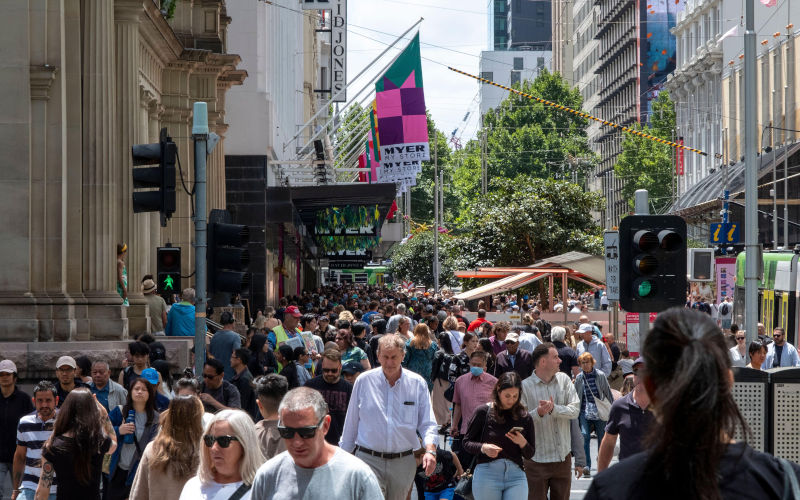
Australia’s population debate should move beyond arguments over growth and migration to a larger question: what population can a capable, inclusive and ecologically sustainable country support?
Australia’s population debate is trapped between two inadequate positions. On one side are governments, business organisations, property interests and universities accustomed to the economic activity generated by population growth. On the other are organisations such as Sustainable Population Australia (SPA), which correctly insists that endless population growth cannot be reconciled with finite land, water, infrastructure and ecological systems.
SPA’s latest newsletter makes the second case forcefully, sometimes too forcefully. Its dismissal in advance of the ABC’s immigration forum as a “sham” and its description of opposing voices as “zealots” producing “garbage” risk obscuring an argument that deserves serious consideration.
The central point is difficult to dispute. Australia cannot sensibly debate housing, water, transport, energy, biodiversity, hospitals or schools while treating population growth as though it were simply something that happens. Population is substantially shaped by government policy, particularly migration policy. Demand matters as well as supply.
Housing makes this obvious. It is simplistic to claim immigration “caused” the housing crisis. Australia has constructed a housing system distorted by tax concessions, financialisation, land speculation, inadequate social housing, infrastructure shortages and low construction productivity. But the opposite proposition, that rapid population growth has little effect on housing affordability, is equally implausible. When hundreds of thousands of additional people require somewhere to live while supply responds slowly, rents and prices come under additional pressure.
Yet Australia’s deeper problem is not simply that its population has grown rapidly. It is that population growth has too often substituted for something much harder: building national capability.
For decades Australia has been able to make its economy bigger by adding people, houses, consumption and debt. More people require more apartments, roads, supermarkets, universities and services. Aggregate GDP rises. Property values rise. Governments collect more revenue. Businesses acquire more customers.
But a bigger economy is not necessarily a more capable economy.
The important question is what Australians can collectively do: what we can manufacture, invent, maintain and build; whether we can provide affordable housing; whether our universities generate knowledge and skills rather than merely sell degrees; whether our electricity, transport and water systems are resilient; whether governments retain the expertise to plan for the future; and whether all this can occur within ecological limits.
One of the most revealing items in SPA’s newsletter, therefore, is not directly about population. Rex Patrick draws attention to Australia’s dependence on imported chemicals essential for treating drinking water. That is an extraordinary vulnerability for a wealthy continent facing increasing climate and geopolitical uncertainty. Reducing population growth would not manufacture those chemicals. Australia still needs the industrial, scientific and governmental capability to secure essential supplies.
The same applies to medicines, fertilisers, machinery, renewable-energy technology and defence supplies. Australia exports enormous quantities of minerals and energy while depending on complicated international supply chains for many sophisticated products essential to modern life. That is not primarily a population failure. It is a capability failure.
Nor should population decline become another simplistic objective. SPA is right to challenge claims that falling populations must produce economic disaster. Japan demonstrates that population decline can coexist with high living standards, sophisticated infrastructure and advanced technological capability. Automation and productivity can offset some reduction in labour supply.
But Japan also demonstrates the difficulties of ageing: healthcare pressures, regional decline, labour shortages and changing dependency ratios. Neither population growth nor population decline should therefore be the objective. Human wellbeing within ecological limits should be.
That leads to a better migration debate. Instead of asking whether we are “for” or “against” immigration, Australia should ask what migration program is compatible with the country we are deliberately trying to create.
What skills do we genuinely need? Which shortages should instead be addressed by training Australians, raising wages, improving working conditions or investing in technology? How much population growth can our housing and infrastructure systems accommodate without reducing living standards? What are the consequences for water, biodiversity and emissions? And should universities, property developers and other industries dependent on expanding markets exercise such influence over population policy?
One principle must remain non-negotiable. Australia is already one of the world’s great migrant societies. Questioning the future rate of migration must never become questioning the belonging, equality or dignity of Australians who have come here from elsewhere.
That is another reason SPA should temper its rhetoric. Population policy is too important to be surrendered either to business interests demanding endless expansion or to populists searching for people to blame. A democratic population policy can favour lower migration while remaining resolutely opposed to xenophobia.
The larger question is the one Australia rarely asks: what kind of country do we want to be in 2050 – or 2088 – and what population is compatible with it?
That reverses the conventional sequence. Instead of continually increasing population and then scrambling to provide enough housing, roads, electricity, hospitals and water, Australia should establish ecological constraints, infrastructure capacity and social objectives and determine a population trajectory consistent with them.
This also takes us beyond the sterile choice between growth and degrowth, or between a Big Australia and a Small Australia. The more important choice is between development largely driven by markets and vested interests, and deliberate development directed towards expanding national and social capability.
Australia has become extraordinarily wealthy without becoming correspondingly capable. We possess minerals, land, accumulated capital, educated people and formidable scientific institutions, yet remain dependent on other countries for technologies and industrial systems we could develop ourselves. Meanwhile housing costs, environmental degradation and infrastructure pressures consume some of the benefits economic growth supposedly delivers.
SPA is right: population belongs at the centre of national debate. But population cannot become the explanation for everything.
The ambition should be greater than either a bigger or smaller Australia.
It should be a deliberately capable Australia. An Australia that is productive, democratic, socially inclusive and ecologically sustainable. Once we decide what that Australia should be, we can finally have an intelligent debate about how many people it can sustainably support.

Stewart Sweeney
Stewart Sweeney is a writer and public policy advocate with a longstanding interest in the evolution and future of capitalism. He migrated from Scotland to Adelaide in 1975 to work with Premier Don Dunstan on industrial democracy. A former academic and trade unionist, he continues to contribute to public debate on economic justice, democratic reform, and sustainable development. His work reflects a deep commitment to the common good and the role of public purpose in shaping Australia’s future.