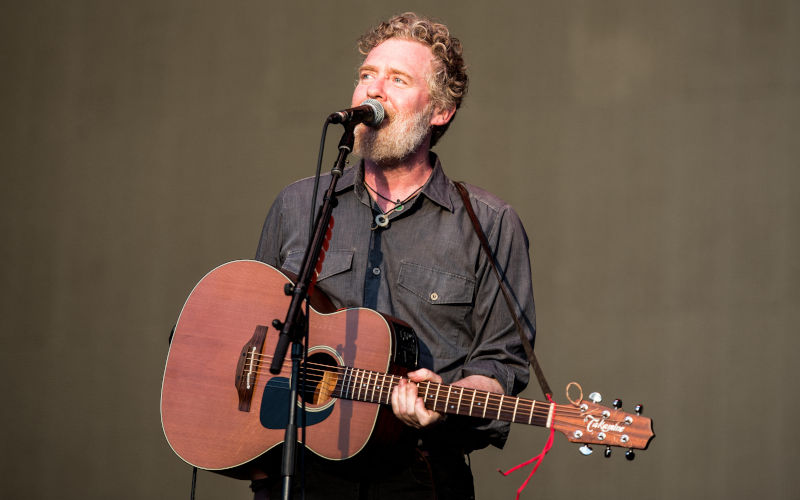
Glen Hansard’s life traced Ireland’s journey from poverty and emigration to global confidence, while never losing sight of those excluded from its prosperity.
Glen Hansard’s journey from the streets of Dublin to the world’s great concert halls was often presented as an Irish success story: the teenage busker from Ballymun, the struggling bandleader, the accidental actor, the small independent film and, finally, the Academy Award.
But Hansard’s life was more than individual ascent. It ran alongside Ireland’s passage over the past half-century from poverty, emigration and cultural deference to European integration, economic transformation and international confidence, followed by financial collapse, housing crisis and renewed uncertainty.
Born in 1970, three years before Ireland joined the European Economic Community, Hansard belonged to the first Irish generation to grow up fully inside Europe. Yet the Ireland of his childhood remained far from today’s multinational economy. Ballymun, where he grew up, embodied both the ambitions and failures of the post-independence state. Its high-rise public housing was meant as modern social progress, but poor planning, weak services and unemployment turned it into a symbol of neglect.
Hansard left school at 13 and educated himself on Dublin’s streets. His real academy was Grafton Street: the guitar case, the passing crowd, the need to persuade strangers to stop and listen. Busking gave him not only musical technique but a democratic instinct. The street performer has no authority. They cannot command an audience. They must earn attention, create a temporary community, and accept that people can simply walk away. Much of Hansard’s later work retained that structure. His concerts were enlarged street performances of stories, songs, interruptions, invitations, other musicians brought forward, audiences encouraged to sing.
Hansard formed The Frames in 1990 as another era was ending. Ireland in the 1980s had again become a country of unemployment, debt and emigration. A generation left for London, New York, Boston and Sydney. For those who stayed, music, theatre and literature became alternative worlds and ways of imagining an Ireland more open than the official one.
The Frames emerged from that independent culture. Their development was slow and precarious, largely outside international pop machinery. Hansard appeared in The Commitments (1991), but resisted letting it define him. The film captured a transitional Dublin: poor, young, funny, frustrated and culturally colonised, but eager to remake American soul through Irish experience. Its claim that the Irish were “the Blacks of Europe” was clumsy, but expressed a desire to turn marginality into cultural force.
Hansard absorbed Dylan, Cohen, Van Morrison, soul and folk, yet remained unmistakably Irish. His achievement was translation rather than purity. He belonged to a generation of Irish artists who stopped asking permission to enter the wider world. They did not abandon Ireland but made it legible beyond it.
European Community membership loosened Ireland’s dependence on Britain, modernised infrastructure and widened cultural horizons. A country defined by departure became a destination for migrants. By the 1990s, the Celtic Tiger had arrived. Foreign investment, education, low corporate tax and global markets produced rapid growth. Dublin became younger, wealthier and more cosmopolitan. The psychological shift mattered as much as the economic one: a society long shaped by emigration began to imagine itself at the centre.
The Frames rose within this confidence but never fully belonged to its glossy surface. Their songs carried melancholy, emotional incompleteness and fragile belonging. Hansard’s voice moving from murmur to cracked roar held the older Ireland inside the new.
Then came Once. Released in 2007, it showed a Dublin unlike the property-driven fantasy of the boom. Its protagonists were a busker and a Czech immigrant making music in streets, flats and borrowed spaces. This was globalised Ireland from below. The immigrant was not a problem or statistic but a creative equal. Dublin appeared through encounters and improvisation rather than corporate skylines. The film became an international success, and Falling Slowly won the 2008 Academy Award. Hansard moved from Ballymun to Hollywood still looking like a man who had arrived with a guitar from Grafton Street. But history had already turned.
Within months, Ireland’s property and banking system collapsed. The Celtic Tiger’s later phase had become dependent on credit and speculation. When it failed, losses were socialised, austerity followed, and emigration returned. Ireland had escaped the old cycle only to reproduce it in financial form.
Hansard’s public role deepened. He became associated with homelessness activism, the Christmas Eve busk, and the 2016 occupation of Apollo House, where activists turned an empty building into emergency shelter. He described it as civil disobedience and a challenge to a system where buildings stood vacant while people slept outside.
That contradiction has only sharpened. Ireland is now highly globalised and statistically wealthy, hosting major tech and pharmaceutical firms. Yet housing remains inaccessible for many, especially the young and working poor. Hansard thus embodied both success and the unfinished business of global recognition paired with a return to those excluded from its benefits.
Hansard’s music reflects Ireland’s position between Europe and the English-speaking Atlantic world. Politically and economically, Ireland is European. Culturally, it remains tied to Britain and the United States through language, migration and music. Hansard lived in that triangle. His songwriting draws from American folk and rock; his stage presence recalls Springsteen; his seriousness echoes Cohen and Dylan. Yet his emotional grammar is Irish: departure, longing, exile, return. He did not resolve these tensions. He turned them into art.
His collaboration with Czech-born Markéta Irglová in Once suggested a new European Ireland, shaped not by institutions but by shared listening and creative exchange. Their work offered a modest vision of belonging: not political union, but human connection across borders. Hansard’s Europe was creative, collaborative and acoustic rather than financial or bureaucratic.
Hansard represented a form of Irish patriotism distinct from both old nationalism and newer identity politics. He loved Ireland without idealising it. His attachment was to its people, humour, music and streets, but also to its failures of homelessness, exclusion and indifference. His patriotism was not about admiration but responsibility.
Ireland has changed dramatically. It was wealthier, more secular, socially liberal. It legalised same-sex marriage in 2015 and repealed the abortion ban in 2018. But moral liberalisation has not resolved economic inequality. Ireland may be progressive in values while remaining harsh in housing and distribution. It may welcome global capital more easily than it houses its citizens. Hansard stood within that contradiction as a global cultural success whose most consistent act was returning to the street.
The grief following his sudden death in a road accident at 56 reflects more than admiration for a musician. Hansard embodied a public role that modern societies struggle to sustain: the accessible, rooted artist. He won an Oscar, toured widely and collaborated internationally, but repeatedly turned celebrity back into community through busking, benefit work and solidarity.
The Christmas Eve gathering in the streets of Dublin became a civic ritual, formed not by institutions but by shared songs and attention to those excluded from prosperity. After his death, his family requested donations to the Dublin Simon Community and Ukrainian Action Ireland, linking local homelessness with European conflict.
Hansard’s career shows that culture is not decoration after development. It is how societies understand what development has done to them. Ireland’s official story is one of modernisation and success. Hansard’s songs tell a more complicated one of migration, love, exclusion, improvisation and fragile community.
Ireland moved from periphery to global centre. Hansard carried the memory of the periphery with him. That may be his deepest significance. He showed that Ireland could speak without imitation, become modern without forgetting the street, and enter Europe without losing its human scale.
His death leaves a painful silence. But his life leaves a question. What is the value of global success if the people who make a city cannot afford to live in it? Hansard offered no policy answers. He offered something simpler: attention, solidarity and the creation of shared space. One person begins a song. Others stop. A crowd forms. Strangers listen.
For a few minutes, another Ireland becomes possible.

Stewart Sweeney
Stewart Sweeney is a writer and public policy advocate with a longstanding interest in the evolution and future of capitalism. He migrated from Scotland to Adelaide in 1975 to work with Premier Don Dunstan on industrial democracy. A former academic and trade unionist, he continues to contribute to public debate on economic justice, democratic reform, and sustainable development. His work reflects a deep commitment to the common good and the role of public purpose in shaping Australia’s future.