Labor’s promise to ease living costs and cut taxes may offer relief, but it avoids the deeper question of who owns, controls and profits from the systems making life insecure.
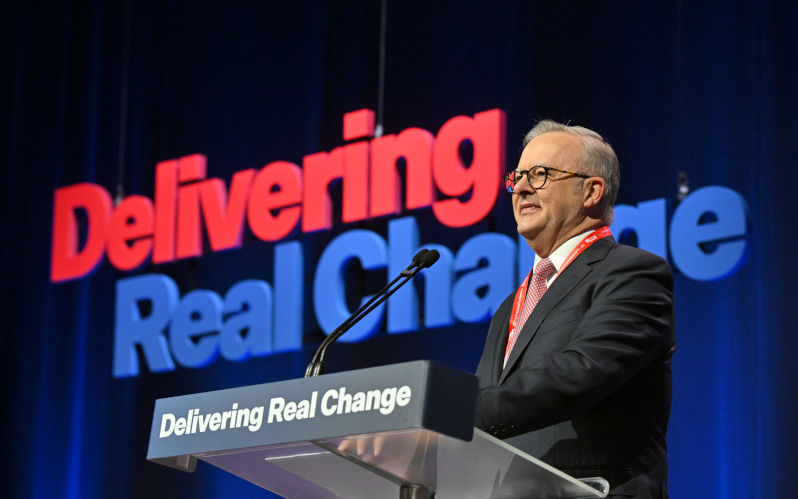
Last week Anthony Albanese opened Labor’s fiftieth National Conference with two promises that now sit at the centre of the party’s electoral offer: Labor will ease the cost of living, and Labor will cut taxes again.
Both propositions sound attractive. Both respond to genuine pressures. Neither is remotely adequate to the conditions confronting Australia.
Together, they reveal how far Labor’s political ambition has contracted. A movement created to change the distribution of economic power now offers to compensate people for its consequences. A party that once built public institutions now increasingly promises to leave a little more money in private pockets so households can struggle through increasingly expensive private markets.
Labor’s cost-of-living politics begins from the wrong question.
It asks how government can help people pay their electricity bill, rent, mortgage, childcare fees, insurance premiums, medical costs and transport expenses. It does not ask why so many essentials have become vehicles for profit extraction, speculation and corporate power.
“Cost of living” is therefore not merely an innocent description of hardship. It is a politically convenient way of depoliticising it.
Housing becomes a cost-of-living problem rather than the consequence of treating land and shelter as financial assets. Energy becomes a bill problem rather than the outcome of privatisation, market design and fossil-fuel power. Food prices become an inflation problem rather than a question of supermarket concentration. Insecure employment becomes household stress rather than a shift of risk from corporations to workers.
Labor acknowledges the pain while leaving largely undisturbed the structures producing it.
Its relief measures are real enough. The government points to tax reductions, wage increases, Medicare measures, cheaper medicines and assistance with education and care. Albanese used the conference to announce further support for students undertaking compulsory health placements and a new Fair Work Court. These are worthwhile reforms.
But they remain fragments within an economy whose commanding institutions Labor is unwilling to challenge.
The second pillar of repeated tax cuts deepens the problem.
The government has already announced a permanent $250 tax offset and says its combined tax changes could provide an average worker with benefits of up to $2,816 from 2027–28. Yet every tax cut reduces the public revenue available for housing, hospitals, schools, aged care, public transport, climate adaptation and the reconstruction of government capability.
Tax cuts are presented as money returned to the people. But taxes are also the means by which people create things they cannot purchase individually: universal healthcare, secure housing systems, clean energy networks, functioning cities, environmental restoration and dignified care.
A household may receive several hundred dollars in tax relief and lose much more through higher rent, private health costs, childcare fees, insurance premiums and inadequate public services. The tax cut arrives with a ministerial announcement. The erosion of collective provision occurs quietly, bill by bill.
Labor has accepted the conservative assumption that taxation is fundamentally a burden rather than the price of civilisation and the instrument of democratic power.
This traps the party in a competition it cannot win. Conservatives can almost always promise larger tax cuts, fewer regulations and weaker public institutions. A Labor Party competing on that terrain becomes a more cautious manager of the same settlement.
The alternative is not to dismiss immediate hardship. People need relief now. But relief should be the bridge to structural change, not a substitute for it.
Labor should replace “cost of living” with a politics of the cost of capitalism.
That means naming the institutions that determine whether Australians can live securely: banks, landlords, property developers, energy corporations, supermarket chains, insurers, mining companies and digital monopolies. It means recognising that many households are not simply suffering from higher prices. They are being subjected to organised systems of rent extraction.
The answer is not merely larger subsidies that eventually flow to private providers. It is to expand the public, cooperative and non-profit alternatives that reduce dependence on those providers.
A renewed Labor platform would commit to building public and community housing at a scale capable of changing the market, not merely assisting selected buyers to enter it. It would create a publicly owned energy retailer and strengthen public ownership across generation, storage and distribution. It would restore universal bulk billing and include dental rather than repeatedly patching a deteriorating Medicare system. It would move towards free early childhood education, properly funded public schools, genuinely free TAFE and substantially reduced university debt.
It would regulate rents, tax land and property wealth more effectively, confront supermarket concentration, strengthen collective bargaining and guarantee minimum hours as well as minimum wages.
Above all, Labor should abandon the presumption that lower taxation is necessarily progressive.
Australia needs tax reform, but its objective should be a fairer and stronger public realm. Taxes should be reduced for the lowest-paid where necessary, while wealth, economic rents, inheritances, speculative land gains, superannuation concessions, fossil-fuel profits and monopoly income are taxed more effectively.
The choice is not between helping households and raising revenue. A progressive government raises revenue from concentrated wealth to reduce the costs imposed on ordinary households.
This would offer Australians something more substantial than another rebate, offset or temporary concession. It would offer greater freedom from the market itself: freedom from ruinous rent, medical debt, insecure work, predatory energy pricing and the fear that old age, disability or unemployment will produce destitution.
Labor’s historic purpose was not to make an unequal system slightly more affordable. It was to democratise economic life.
Cost-of-living relief can ease the symptoms. Tax cuts can purchase temporary approval. Neither can rebuild social democracy.
Labor needs to tell Australians that their insecurity is not a personal failure, an unfortunate price cycle or an economic weather event. It has been produced by political decisions about ownership, taxation, wages, public services and power.
Those decisions can be changed.
The better Labor offer is not: we will help you pay the bills and reduce your taxes.
It is: we will change the system that keeps raising the bills, rebuild the services that make life secure, and require those who have accumulated the most from Australia to contribute more to its future.

Stewart Sweeney
Stewart Sweeney is a writer and public policy advocate with a longstanding interest in the evolution and future of capitalism. He migrated from Scotland to Adelaide in 1975 to work with Premier Don Dunstan on industrial democracy. A former academic and trade unionist, he continues to contribute to public debate on economic justice, democratic reform, and sustainable development. His work reflects a deep commitment to the common good and the role of public purpose in shaping Australia’s future.