While China builds influence through BRICS, the SCO and economic ties across the Global South, Australia is pouring almost $1 billion into Solomon Islands amid fears of a Chinese military presence. Australia’s China policy risks being overtaken by the regional order taking shape around it.
Increasingly, Australian foreign policy seems to exist in a parallel universe to the rest of the world. This past weekend saw the biggest ever BRICS summit which was held in New Delhi. This was preceded by the biggest ever summit of the Shanghai Cooperation Organisation (SCO), marking its 25th anniversary. Leaders from China, Russia, India and across the breadth of the Global South met in plenary sessions and, most importantly, in bilateral and plurilateral meetings.
Australia, of course, as a developed country was not there. Two weeks ago, the Australian Prime Minister was in Palau, a US client state, for the Pacific Island Forum, where, for a variety of pretexts, five leaders stayed away. Their absence was the main story. Did China coerce them to stay away? Certainly, the backgrounding from the Australian and New Zealand sides drew that conclusion.
It then transpired that Australia had agreed to what had been a ‘secret’ additional aid package to the Solomon Islands of $980 million. The sordid story of Australia’s attempt to settle a security agreement with the Solomons is becoming a recurring nightmare.
Caught in the volatile domestic politics of Honiara, Australia has now launched into full-scale dollar diplomacy. Nearly a billion dollars is a lot of money, especially at a time of straightened domestic budget pressures at home. It is also more than $1.1 million per Solomon Islander. Lucky them!
Dollar diplomacy is a game Australia can ill afford to play and one which it cannot win. Twenty years ago, the Australian government used to berate the Taiwanese government for doing the same thing. Foreign Minister Alexander Downer was known to give furious lectures to Taiwanese officials, accusing them of undermining Australia’s own efforts in the region to build good governance and address corruption.
The ostensible purpose of Australia’s policy is to prevent China establishing a military base or bases in the Pacific. But as Jessica Sier wrote last week, China doesn’t need a military base. It has enormous influence through trade, investment and tourist flows, as well as its aid and training programs.
And in any event, the case has not been made why a Chinese military presence would present such a dire threat to Australia’s security. Apart from being a very long way away from Australia, the technology of modern warfare has changed massively since the Second World War. Presumably, that is one reason why the Australian government is so hell bent on AUKUS. We are unlikely to see another Guadalcanal campaign.
Despite the fear-mongering, China in fact doesn’t seem particularly interested in overseas bases. As far as we know it has two: a prominent one in Djibouti which was established only in 2017 against the background of elevated piracy against commercial shipping in the area; and one in Tajikistan close to the Pakistan/Afghanistan border to help check militant Islamic insurgencies. It also has some militarised islands in the South China Sea.
The US has somewhat more than 500 bases globally. The point is not about equivalence, or lack there-of, but that China just doesn’t seem particularly interested. It is not necessary to assert that China is a benign actor, rather China seeks security through other forms of influence. If the justification for the exorbitant aid package to the Solomons was to prevent China establishing a military presence, then the government is doing foreign and security policy in the rear-vision mirror.
The summit meetings of the SCO and BRICS last week and the divisive PIF meeting are in stark contrast to each other. China has constructed an entire suite of interlocking initiatives: SCO (together with Russia), BRICS, New Development Bank, Asia Infrastructure Investment Bank, and most influential of all the Belt and Road Initiative. China is effectively the leader of much of the Global South.
Prime Minister Modi’s participation in these meetings and the improving India/China bilateral relationship should send a powerful message to Canberra. It has been a long and misguided hope in Canberra (and Washington) that India could be drawn into a relationship with western powers to balance an ever more powerful China.
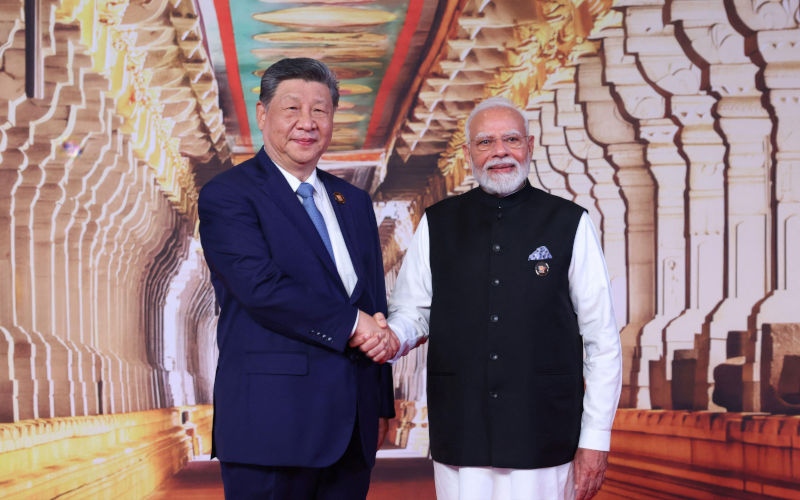
Instead, India, like China, has ignored western sanctions on Russia over its invasion of Ukraine and is the world’s biggest importer of Russian crude oil. Xi Jinping attended the just-completed BRICS summit in Delhi and held bilateral meetings with Modi. They have agreed to try to sort out the remaining divisive border issues. Whether they can remains to be seen, but a cornerstone of Australia’s policy in dealing with China is crumbling.
Historian Neville Meany’s observation on the early twentieth century debate in Australia over the militarisation of Japan captures well the state of discussion today, “Most held rigid views with which the geo-strategic situation might occasionally collide.” Future historians may well say the same of our age.
As China constructs the architecture to advance its interests in the multipolar world, Australia needs to think hard about what a forward-looking constructive agenda with China might look like. Perhaps we’ll get some guidance when Xi Jinping visits Trump in Washington later this month and then Trump attends the APEC Leaders meeting in Shenzhen in November.

Geoff Raby: Ambassador to China, 2007-11; 2nd edn. of China’s Grand Strategy and Australia’s Future in the New Global Order was published in May 2025 and Great Game On, November 2024, both by Melbourne UP.