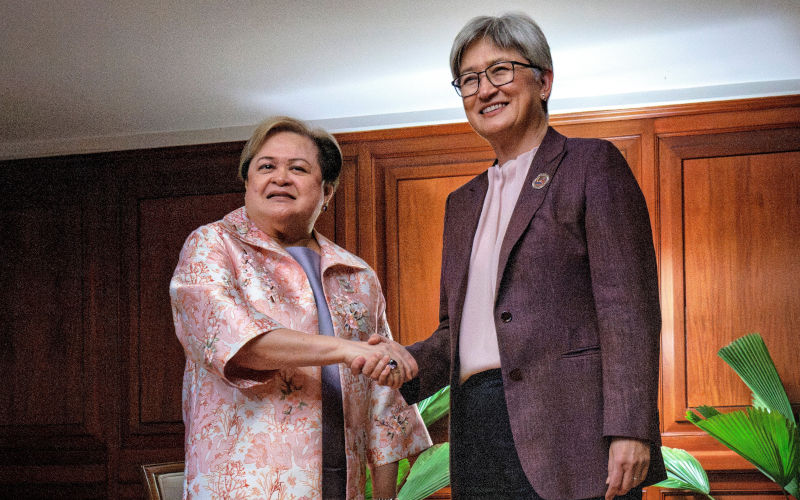
The weakly supported anniversary statement on the Hague ruling showed how isolated the US and Australia have become on the South China Sea, with ASEAN preferring diplomacy over confrontation.
Distinguished former senior Singaporean diplomat and strategic analyst, Kishore Mhabubani, asked in his 2020 book, whether China has won the geopolitical contest between the US and China.
Judging by the embarrassing lack of support for the recent US and Australian push to mark the tenth anniversary of the Hague Judgement on the Philippines-China dispute on the South China Sea (SCS), the answer must surely be a resounding ‘yes’.
The Judgement under Article VII of the United Nations Convention on the Law of the Sea (UNCLOS) of 12 July 2016 was a landmark event. It unanimously found in favour of the Philippines and rejected outright China’s claims of SCS ‘historic rights’. China opted out of the proceedings – as is the right of UNCLOS members – and has refused to accept the Judgement. Beijing has continued to rail against it. It is still disputed among international legal experts.
The Judgement, however, has been used by the US and Australia to justify frequent, in China’s view, incursions into waters and airspaces in the SCS which China claims belong to its territory. These Freedom of Navigation Operations (FNOPs) challenge China’s claims. They have been an ongoing source of tension in the region with considerable risk of miscalculation and escalation on both sides.
Far from contributing to greater security in the region, FNOPs add to regional instability. The US and Australia have made the SCS a major front in their geopolitical contest with China.
Rightly or wrongly – and from the Hague Judgement, in China’s case wrongly – competing claims between China and several Southeast Asian states exist over a handful of atolls, shoals and reefs in the huge area which is the South China Sea. The two most contentious are between the Philippines and China (Scarborough Shoal) and Vietnam and China (Paracel Islands). SCS states also have competing claims against each other.
The reality is that despite the 2016 ruling and years of potentially hazardous FNOPs provocations, nothing has changed other than from time-to-time China has continued to reinforce the geographical features it occupies.
Instead, ASEAN has searched for a diplomatic solution and may finally be close to agreeing on a Code of Conduct between ASEAN members and China for managing the resources of the SCS. This would build on the 2002 ASEAN Declaration of Conduct in the SCS. Neither the US nor Australia are parties to this ASEAN-centred process involving China.
Far from contributing to the search for a diplomatic and hence peaceful resolution of issue, the joint statement sponsored by the US on the 10th Anniversary of the Hague Judgement only served to highlight how little international support there is for it.
The tenth anniversary statement managed to attract only 14 countries. One of which was the Philippines. That’s half the number that supported the Judgement ten years ago: so the argument is going backwards.
But far more significant for Australia’s regional diplomacy, the Philippines was the only ASEAN member to sign on. How far Australian policy is out of step with the region, which we are constantly reminded by the Australian Foreign Minister is the most important for our security, is underscored by the fact that Japan was the only other Asian state to sign on. Conspicuously, India and South Korea did not.
The other signatories were, apart from Germany, Italy and the UK, a grab bag of minor European states. The US, of course, and NZ also signed. No country from Latin America, Africa, or the Middle East, including Israel, signed.
It should also be noted that the US is not a member of UNCLOS but is seeking to hold China accountable to rules to which it is not a party.
And Taiwan has opposed the Hague Judgement all along because it shares exactly the same view as the mainland concerning historical claims to the region.
In short, the anniversary statement by the 14, accounting for just 7 per cent of the UN’s 193 members, was a diplomatic own-goal. In diplomacy it is not a good idea to highlight your weaknesses.
Instead of showing international solidarity against China, it has put up in headlights the isolation of Australia and the other signatories on this issue.
In the circumstances, no statement would have been better than such a weakly supported one. This is not to say that issues of territorial integrity as embodied in the UN Charter are not vitally important. It is to say, as ASEAN does, that where a dispute exists quiet diplomacy and negotiation are preferable to grandstanding.
Australia again finds itself out of step with our immediate region, despite the Foreign Minister’s endless incantations about ‘ASEAN centrality’. It would be interesting to know how much diplomatic capital was spent trying unsuccessfully to get ASEAN on board with the statement.
The oft repeated assertion that China has to be resisted in the SCS because it seeks to control shipping there – when its economic well-being depends crucially on free movement through the region in both directions – is one of the great furphies in geopolitics today.
Instead of recognising the geopolitical realities of the matter, the Australian Foreign Minister has doubled down on what is patently a losing strategy. In her speech at the Philippine Coastguard Headquarters of 21 July she announced a $10m military aid package directed at Australia’s largest trading partner.
It is as if the Foreign Minister is suffering from cognitive dissonance, proclaiming that Australia stands with ASEAN to uphold the Hague Judgement. The Philippines is not ASEAN and ASEAN and much of the rest of the world is not with Australia. China has won.

Geoff Raby: Ambassador to China, 2007-11; 2nd edn. of China’s Grand Strategy and Australia’s Future in the New Global Order was published in May 2025 and Great Game On, November 2024, both by Melbourne UP.