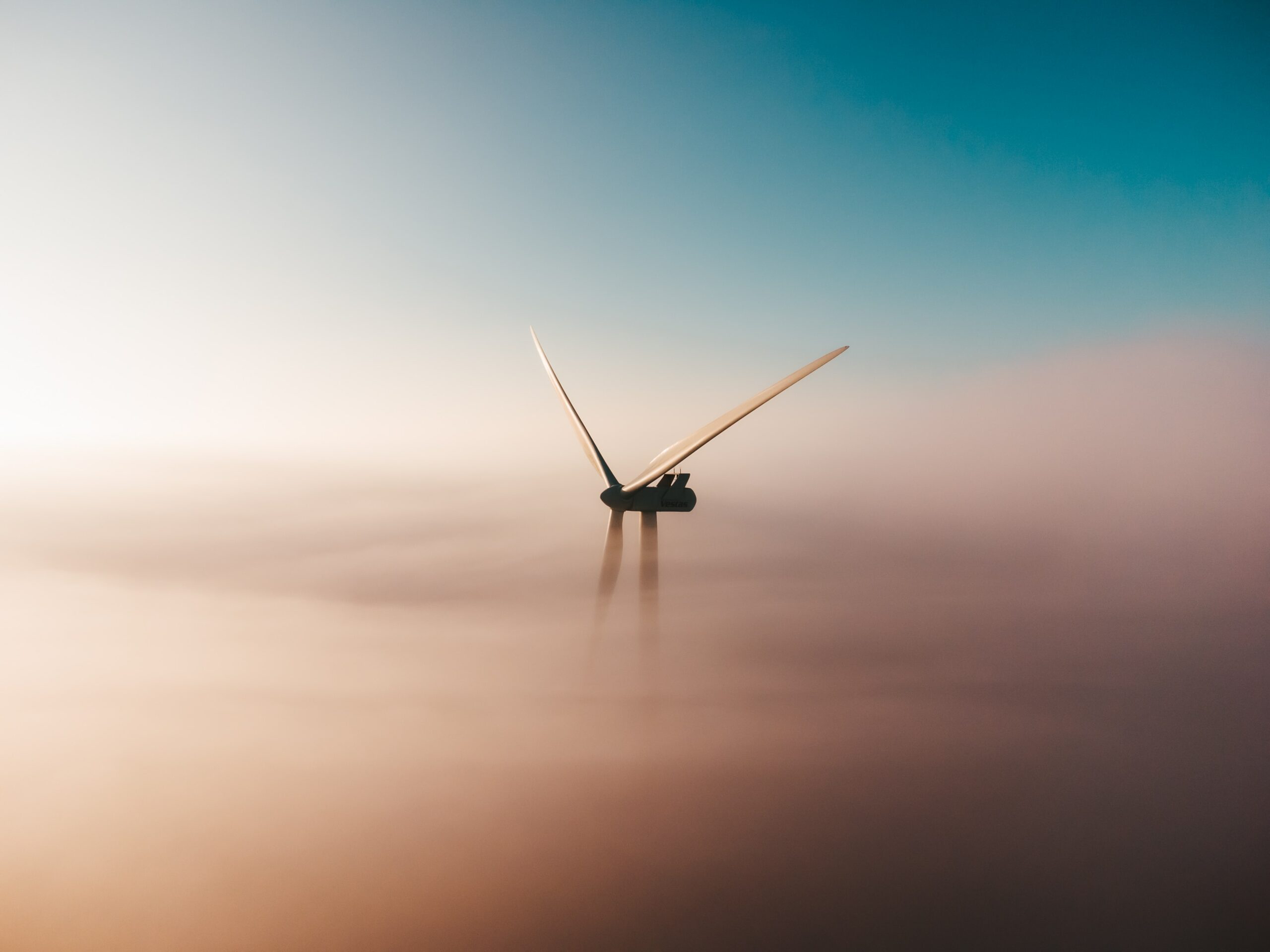
We can have economic growth without wrecking the planet, says economist Per Espen Stoknes.
A clear path exists for the world to reach zero greenhouse gas emissions by 2050. We in the West would become vegetarian (preferably vegan), stop travelling by air (and preferably stop travelling altogether), sell our cars (preferably for scrap), turn our thermostats down to twelve degrees in the winter (and preferably turn them off and rug up) and endure the sacrifice for the sake of the planet. People who haven’t reached our consumption levels can stop where they are. They shouldn’t miss what they have never had.
Wherever they live, these sacrifices would be easier for the well-off. They may even enjoy the challenge of building a house and going off-grid. Getting around in electric cars should be easier because there would be so much less traffic, and although carbon credits would be expensive the wealthy few would be able to enjoy Paris and Venice as they used to be enjoyed, without having to rub shoulders with the hoi polloi.
That’s one of four paths to 2050 that Per Espen Stoknes describes in his new book, Tomorrow’s Economy. But there’s a problem with that scenario: green de-growth might appeal to environmental purists, but if humanity set out on such a path it would prove to be unsustainable, because it involves a significant rise in unemployment and worsening inequality.
Stoknes wants us to understand that the choice between fulfilling our economic aspirations and preventing destructive climate change is a false dichotomy. Worse: it’s a dichotomy that reinforces political polarisation and therefore stymies meaningful action on greenhouse gas emissions and other serious environmental problems.
We don’t have to choose between the two, he argues: we can enjoy economic growth while dealing with climate change. In fact, the industrial transformation involved in reducing greenhouse gas emissions will itself be a source of growth. What counts is the type of growth. But we’ve been conditioned, whether we’re on the “left” or the “right,” to associate economic growth with the destruction of natural resources.
Stoknes’s argument is hardly radical. The big financial services company Goldman Sachs, for example, points out that limiting global warming will require up to US$30 trillion in green energy infrastructure over the next 20 years, all of it boosting GDP, and this investment is already under way. We might observe that it is only in politically backward countries like Australia that the dichotomy still holds strong sway.
But Stoknes contributes more to our understanding than simply advocating green growth. He shows how our accounting systems — particularly our national accounting systems, with their emphasis on GDP growth — hold back our thinking and creativity.
Again, this is hardly radical. Anyone who has studied basic macroeconomics knows the shortcomings of GDP as an indicator of wellbeing. It measures only monetised transactions; it fails to take account of natural resource depletion; and many things that are detrimental to human wellbeing show up as contributors to GDP growth. Pollution-induced illness, for example, does wonders for stimulating activity in healthcare, thus boosting GDP.
But the kind of economic activity captured by GDP has assumed primacy in government policy. To confirm that, we need only consider the hoopla around Australia’s twenty “recession free” years until the coronavirus spoiled the game. (Note that even a recession is framed in the positive language of growth, as two quarters of “negative growth.”)
A Marxist would attribute the focus on GDP to the power of those who profit from financialisation, but Stoknes looks at it from a psychological perspective, drawing on his experience as a psychotherapist before he moved into business and economics. Put simply, we are creatures who find growth fulfilling: growth is good, and the idea of living in a world without growth is unappealing to us. As he explained in a 2017 Ted Talk on apocalypse fatigue, we’re not going to be persuaded to adopt the ascetic “de-growth” lifestyle by warnings of disaster.
“Is a healthy type of growth possible,” he asks, “and if so, what kind of therapy will it take to lure our economic minds away from destructive growth and toward healthy growth?” His case for green growth is couched in conservative language: it’s a matter of avoiding waste while still providing for life’s comforts in ways that don’t have a negative environmental footprint.
More specifically, Stoknes asks how we can think about growth without assuming it involves the depletion of natural resources and damage to life-support systems. To do this, he takes the reader on a short historical tour of economic ideas.
For a long time, he says, humans were concerned about how to allocate physical capital and labour efficiently, with natural resources considered plentiful enough not to worry about — until we realised that they too were limited. Here, he is mainly updating the Club of Rome’s 1972 work on limits to growth, using recent data collected by ANU’s Will Steffen and his colleagues tracking twenty-four indicators of unsustainable demand for natural resources — in primary energy use, tourism, tropical forest loss and ocean acidification, to name a few. In 1972 the world population was 3.9 billion; now it is 7.8 billion; and almost every human on the planet, in rich or poor countries, is demanding more natural resources than he or she did in 1972.
Although we are aware of it, we still aren’t accounting for that depletion of resources. As the economist Partha Dasgupta points out in a report on the economics of biodiversity released last month by the British government, even though we now recognise our negative impact on ecosystems, we tend to believe that human ingenuity can overcome nature’s scarcity. We are very concerned to see our human-made capital allocated efficiently, and we take great care to keep track of labour productivity. But where do we account for natural resource productivity?
This is where Stoknes gets into the economics of decoupling growth from natural resource depletion. Put simply — as he does on a two-by-two matrix — we can have “growth” or “de-growth,” and our path can be “green” (with a shrinking environmental footprint) or “grey” (a growing environmental footprint). Most countries are on a grey growth path, but if a country can improve its GDP while using fewer natural resources then it can get itself on a path of green growth.
Importantly, green growth isn’t confined to the realm of theoretical models: Stoknes reports that Sweden — measured by its carbon footprint, at least — has been on a green growth path for all of the twenty-first century. (When a Norwegian compliments a Swedish achievement it must be credible!)
In what he acknowledges to be a recontextualisation of Thomas Piketty’s famous formula showing how the return on assets (r) is greater than economic growth (g), and hence that inequality will grow unless other action is taken, Stoknes introduces the symbol rp for the change in resource productivity. According to his simple formula, if rp > g then green growth is happening.
It’s a neat presentation, but how can resource productivity be improved? If the world is to enjoy real economic growth of at least 2 to 3 per cent a year, and if we are to meet zero emissions by 2050, the annual rate of resource-productivity improvement has to be very high — in the order of 5 to 6 per cent. Resource productivity is certainly improving, but for most technologies — fuel use in internal combustion engines, for instance — we are in the zone of diminishing returns, at nothing like the rate necessary to meet 2050 greenhouse gas targets.
On top of that, as Stoknes points out, technologies that improve resource use have rebound effects. If we get better at squeezing more useful energy out of gas or coal, demand will rise, partially or wholly offsetting any improvement in resource productivity.
At this point some would say there is no way out while we stick with capitalism, a system that valorises growth based on resource exploitation. But Stoknes believes capitalism is redeemable. Like Dasgupta, he wants us to change our focus from labour productivity to resource productivity. This, he writes, is the necessary “paradigm shift toward a better version of capitalism.”
The term “paradigm shift” has been grossly overused in recent times: the philosopher Thomas Kuhn would turn in his grave if he knew how it has been misunderstood. But Stoknes is indeed calling for a fundamental change in the way we think about economics, and that is because we have still not integrated natural resources into our economic models. He sees the transition to an economy based on resource productivity as yet another wave of innovation — a Kondratieff wave “riding on top of digitalisation” — that is qualitatively different from simply applying digital technologies to existing business models.
His focus is on meeting greenhouse gas targets. Indeed, a shortcoming in his work is that he doesn’t give much attention to difficult trade-offs within resource use. Sometimes, for instance, the green benefits of hydro power will have to be traded off against the green benefits of farmers and fishers engaged in sustainable food production. Elsewhere, we need to take account of the stress imposed on the environment by mining lithium for batteries for electric vehicles.
This kind of trade-off is complex unless some common metric can be found. While some environmental costs and benefits can be translated into monetary terms, analytical methods such as contingent valuation and discounting are based on arbitrary assumptions about people’s trade-offs across time. But Stoknes gives plenty of examples of where resource-productivity considerations have brought extraordinary results, in projects ranging from breweries to buildings.
One firm he mentions, a carpet manufacturer, managed to achieve more than 100 per cent resource productivity (at least as far as CO2 is concerned) by sequestering more carbon than it uses in its supply chain. “Why aim for just zero emissions,” he asks, “when we could aim for a climate-positive impact instead?”
Stoknes goes further than most of its advocates in recognising that green growth is not necessarily equitable growth. Widening inequality in income and wealth is already fuelling resistance to structural adjustment; and unless it is handled well it can indeed worsen inequality. So he develops another two-by-two matrix with growth–de-growth on one axis and fairness–unfairness on another axis, and even a three-dimensional two-by-two chart bringing in his green–grey dimension.
His approach to growth is in favour of what economists would call a Pareto improvement: for green growth to be politically acceptable there must be no losers. To avoid anyone going backwards in absolute terms, income must be redistributed within a growing pie.
Stoknes’s 3D model deals with each of the dimensions. In tackling climate change, the green dimension will be achieved by fundamental changes in energy production and in food production and distribution. Growth will come about through new governance and economic models in “developing” countries, and equity will be achieved through Pareto redistributions and investment in education, gender equality and health. These ideas about equitable growth align closely with the work of scholars including Thomas Piketty and Robert Putnam.
Although Stoknes wants innovation to be supported by appropriate pricing — the case for a carbon price is such a no-brainer that he hardly mentions it — he also calls for a strong role for government. The private sector can’t do it on its own: “Just imagine what might happen if the broad majority viewed government as being more entrepreneurial than bureaucratic, more stimulating than stifling, and more guardian of your personal freedom and safety rather than overreaching invader.”
In his optimism and practicality his views could hardly be further from those of Australia’s federal government, immobilised by its inability to think beyond the economy–environment dichotomy.
This was first published on Inside Story on 9 March.

Ian McAuley is a retired lecturer in public finance at the University of Canberra. He can be contacted at “ian” at the domain “ianmcauley.com” .
Comments
7 responses to “Beyond apocalypse fatigue”
I tend to agree we can have “green growth”. It might be slower than “dirty growth”, but it’s still growth nevertheless. I don’t think addressing climate change entails negative growth.
Similarly, we can have “inclusive growth”. Whereas “green growth” might be lower than “dirty growth”, I firmly believe “inclusive growth” significantly exceeds “non-inclusive growth”. This is clearly the case if we give greater weight to growing the income of low-income households (vs high-income households), in accordance with standard utility functions. But even if we weight every household the same, I’m sure inclusive growth will still be higher than growth that exacerbates inequality.
Economists only get careers if they stick to the agenda. Economic history might be much more helpful. Trust breaking, stopped Rockefeller, but then he branched out in pharmacy, petroleum jelly etc. We now have Microsoft…. a huge monopoly. Branching out into …. ?
Demographics are already set in concrete: populations are falling!
We can still have great lives, but we do need to root out the false doctrines and those who fear their loss of power…
Putting a ceiling on corporations, which can be owned or controlled by unknown persons, will mean more local businesses.
Globalization seems to have run its course?
Thanks Ian.
It’s easy to mock “greenie” views re reducing consumption, becoming vegetarian, etc (which is one of the reasons The Greens’ vote is stuck at 10% – who’d want to be a ‘do-gooder’ – strange that is a pejorative term). And I realise, Ian, you are simply paraphrasing Stoknes’s views.
But I reckon there is much to be gained, for both humanity and the planet, by limiting the extravagant consumption of the world’s wealthy. No-one needs to fly an entire wedding party to an overseas resort – etc, etc. And as for vegetarianism, I’ve yet to meet an animal who is against it.
The challenges of creating a fairer world with less overall consumption are of course enormous, but I’m reluctant to let an economist tell us that we don’t need to try. Economists haven’t been a great help on climate change so far! – see e.g. Steve Keen’s excoriation of the economists who have advised the IPCC – Nordhaus in particular.
Great wisdom in your saying “And as for vegetarianism, I’ve yet to meet an animal who is against it.”
If humans can be convinced that we are also animals, perhaps we will have more compassion. One slight problem- all 3 desert religions say it is ok to slaughter animals for consumption- even if 2 of the 3 have an aversion to pork.
Thanks Ian. Ian Angus says that ‘there’s no such thing as a win-win revolution’. Sainsbury’s corollary is that ‘there’s no such thing as a win-win status quo’. Sainsbury’s second corollary is that ‘economics is not the only dimension of winning and losing’. So I’m not sure that I’m fully convinced by Stoknes’s confidence that losers will be avoided and equity will be achieved through Pareto redistributions of a growing economic pie and investment in education, gender equality and health. Even if economic losers could be avoided through this approach, what about the power and influence losers (mostly all the same people, of course)? The people at the top of the social hierarchy are not going to relinquish their position easily. Social equity is much broader than economic equity. And while Stoknes’s 2X2 grids may be useful aids to understanding, again I’m not convinced that they actually provide us with a path to deliver environmental sustainability, let alone green growth, or true equity. Economic growth without wrecking the planet?? – possible but I’m not convinced and it’s a big risk to take.
Greener growth is possible and we need to talk more about it. if you want people to change we have to show them an opportunity for a better life. People get sick of all the doom and gloom from environmentalists and just turn off.
The EROI of wind turbines is around 50-100 now, solar not far behind, i.e. more energy for less use of resources.
Electrified transport requires about half the resources of FF powered transport and if properly managed autonomous ground transport will halve the resources used for roads and parking.
We don’t all have to go vegan, managed grazing can be a key part of building soil carbon. In fact modern farming practices can sequester carbon faster than reforestation
We may have to limit air travel but even there, Journeys like Melbourne-Sydney, New York- Chicago, Frankfurt to London, Shanghai to Beijing can probably be electrified in the next 15 years
Localising energy and food production can do a lot to revitalise rural towns and cities and if small scale ownership models are encouraged also reduce inequality. Medicine Law and education can also be more decentralised and brought closer to the people, further weakening the role of the high priests at the top of academia and the professions