Reducing dependence on China in the world’s critical mineral supply chain doesn’t require building a separate market. The trading system must find a balance between defence interests and the push for decarbonisation.
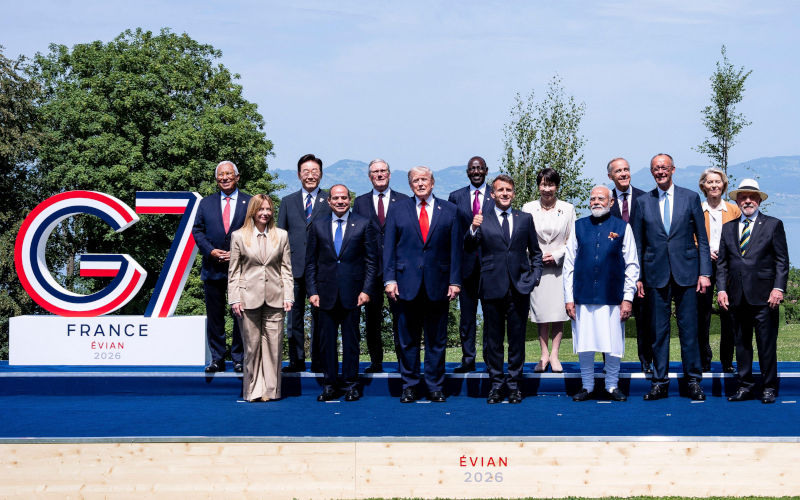
The G7’s latest critical minerals declaration sets an ambitious target: to reduce dependence on any single supplier outside the G7 and partner countries for rare earths and permanent magnets to below 60 per cent by 2030, and to 50 per cent thereafter.
On paper, this is a supply-chain resilience measure. In practice, it recognises that critical minerals are no longer ordinary commodities but instruments of national security, industrial policy, alliance management and geopolitical leverage. The target matters because it translates strategy into collective procurement, co-financing, standards and investment decisions.
Only a few years ago, price floors, stockpiling, demand aggregation and price-gap subsidies would have been dismissed as market interventions. China’s export controls have done what years of western policy papers could not: they have made interventionist industrial policy politically legitimate across the world’s most advanced economies.
That is the paradox Beijing now faces. Export controls strengthen China’s short-term bargaining power but also give the G7 the crisis narrative it needs to coordinate more seriously. The more China tightens the controls, the easier it becomes for western governments to justify the collective action Beijing hopes to deter.
The G7 target is a dependency-management strategy, not a realistic near-term pathway to a China-free supply chain. China’s advantage lies not simply in mining, but in the industrial ecosystem around critical minerals: separation, refining, magnet-making, specialist equipment, solvents, reagents, waste treatment and downstream manufacturing.
A target measured only by supplier share can mislead. Supply chains may diversify mining and some processing while remaining dependent on China for chemicals, magnet makers, machinery or qualification pathways. Without the conversion layer, they are far from resilient.
Japan shows the difficulty. After more than a decade of investment in Lynas Rare Earths Limited, overseas projects, recycling and alternative-source R&D, Tokyo has reduced its dependence on China for light rare earths. Heavy rare earths diversification remains far harder.
China built this ecosystem over decades through cheap energy, engineering talent, industrial clusters, patient capital and domestic demand. It also includes inputs and by-products that receive little attention until they become scarce: germanium, antimony, and tungsten and sulfuric acid. China can restrict such exports at relatively low domestic cost, while exploiting chokepoints across global production networks.
That is why minimum-price guarantees for non-Chinese projects are subsidies in disguise – and may be necessary. China-shaped prices do not capture concentration risk, coercive leverage, environmental externalities or the cost of sustaining capacity outside China. Without price floors and other targeted intervention, alternative supply chains are unlikely to compete with a lower-cost incumbent.
Beijing has given no indication that it will dismantle its export-control regime. It presents controls as sovereign measures tied to national security, export compliance, and nonproliferation, while accusing the G7 of using exclusive blocs to disrupt trade.
Its response extends beyond rhetoric. China’s placement of MP Materials and USA Rare Earth on its export-control list illustrates the vulnerability of emerging alternatives at difficult midstream nodes. Such measures can delay rival projects but they are double-edged: by imposing leverage, they also strengthen the political case for G7 price support, stockpiles, and allied investment.
The G7 presents a united front but countries within it, and others, have differing perspectives. Japan faces the sharpest pressure to import rare earths. European industry, already burdened by high energy costs, has little appetite for higher raw-material prices. The United States wants allies to co-fund resilience, while pursuing its own industrial policy. Australia and Canada are potential beneficiaries, but neither wants to become merely a secure quarry for US industry.
The same applies to resource states beyond the G7. Vietnam, Indonesia and Malaysia will bargain over infrastructure, processing, jobs, technology transfer, environmental standards and market access. Without credible alternatives, China will remain attractive because it offers capital, speed, technical know-how, processing capacity and downstream demand.
The G7 should not treat every mineral input as though it were a defence asset. While that would make supply chains politically cleaner, it could also slow decarbonisation by raising costs and delaying deployment. The energy transition needs more rare earths, lithium, copper, nickel and graphite – quickly and at competitive prices. Blanket decoupling from China risks making EVs, wind turbines, batteries and grid infrastructure more expensive and slower to implement.
Supply chains serving defence and other security-sensitive uses should become increasingly China-light and, where feasible, China-free. Governments and defence buyers should bear the resilience premium associated with strict, verifiable chain-of-custody standards, strategic stockpiles and government-backed offtakes.
That premium is not only financial. Building non-Chinese processing capacity requires dealing with its by-products: acid leaching, solvent extraction, tailings, wastewater, toxic residues, and, in some cases, radioactive materials. But it should not be allowed to burden the broader decarbonisation effort. Defence and other security-sensitive supply chains should therefore bear the financial, social, and environmental costs of building alternative capacity.
By contrast, clean-energy supply chains should become more diversified, transparent, and environmentally responsible, but not necessarily China-free. China will remain a major supplier because scale, cost and manufacturing capacity still matter – especially across the Global South, where affordable access to clean-energy technologies is central to decarbonisation.
The question is no longer whether the west needs resilient critical-minerals supply chains. It is how to build a system that distinguishes between supply chains requiring China-free sourcing and those that can remain globally integrated, while accommodating the divergent interests of allies, resource states, industry and the Global South.
To balance resilience in the critical minerals supply chain and decarbonisation, diversification is only the beginning. The real challenge is to build an end-use-based traceability system that can make those distinctions credible, enforceable and commercially workable.

Marina Yue Zhang
Dr Marina Yue Zhang is an academic, author, and commentator whose work examines how technology and geopolitics shape one another. Her research and public engagement focus on how AI, biotechnology, and critical minerals are recasting global power—and how Australia can navigate these shifts with foresight and purpose.
Her recent book, Demystifying China’s Innovation Machine: Chaotic Order (Oxford University Press, 2022; with Mark Dodgson and David Gann), frames China’s innovation system as a natural ecosystem—combining bottom-up entrepreneurship with adaptive, pragmatic top-down policy. Her earlier book, China 2.0: The Transformation of an Emerging Superpower… and the New Opportunities (John Wiley & Sons, 2010), was listed by Booz & Company’s strategy+business among the best business books on China in 2010.