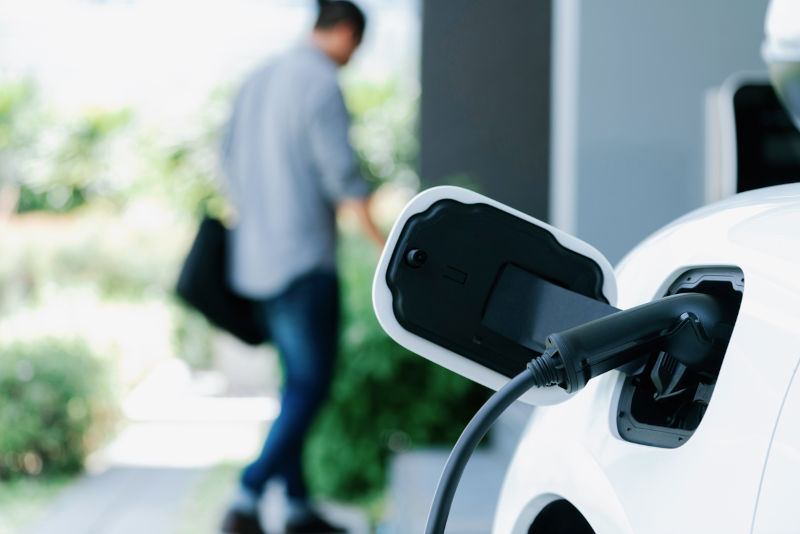
A road user charge should not be used to punish electric vehicle drivers, but to fairly price all motoring by distance, vehicle mass and pollution – with fossil-fuel vehicles still paying for the harm they cause.
Calls are being made to levy EV drivers a flat, per-kilometre rate for driving on our roads, ostensibly to make up for the revenue lost by virtue of them not buying the thing that attracts excise: fuel.
Australia spends an absolute fortune on roads and motorways: $44 billion last year, $36 billion the year before. For a population of 28 million, we spend $1,500 for every man, woman and child on roads. Most of this is directed towards brand new motorways and tunnels, while some goes towards maintaining the roads we already have. All levels of government spend money on roads but the majority is spent by state and territory governments, as they are responsible for managing road transport. All Australians benefit from safe, well-engineered roads even if they don’t drive a vehicle. So, it makes sense that a large portion of the funding comes from general revenue.
General revenue is sourced from income tax, resource royalties, duties, levies, excises and charges. We can parse out ‘road-related revenue’, which is made up of vehicle registration fees, licence fees, stamp duties, parking fees and fuel excise. That last one, fuel excise, is collected by the Commonwealth on all fuel sold at the refinery gate. Everyone who buys fuel to be burned in Australia pays this excise; however, some special customers get a tax credit paid back to them – namely miners, farmers, and heavy freight logistics firms. Needless to say, the vast majority of fuel excise is paid by motorists who drive petrol or diesel cars.
Excise collected from petrol sales has dropped by about $200 million per year for the last 15 years. This is in part due to more efficient vehicles, hybrids and, most recently, EVs but is largely due to a shift towards diesel vehicles. Excise collected on diesel has grown by $170 million per year over the same period but the generous fuel tax credit scheme has largely neutralised this difference.
Road-related revenue collected by the Commonwealth, primarily as fuel excise, has decreased by $71 million per year. Not much in the grand scheme of things, but enough to motivate Treasury to look for alternative revenue options.
Tied up in this discussion is the personal economics of motoring. There is a discretionary cost to motoring. You probably wouldn’t drive your car 500 metres to the shops, if you could walk there. You might also carefully consider where and how you work, particularly if your commute adds two hours a day, along with fuel and maintenance costs. The very act of driving somewhere will cost you, and the more it costs you, the more judicious you are with the decision to hop in the car. This becomes particularly acute when a large dual cab ute costs over 20c/km. But when your EV costs anywhere from zero to not much per kilometre, the decision to drive somewhere is less crucial. Moreover, there is no incentive to choose a lighter, more efficient EV when the fuel is practically free.
This creates a dilemma. While the EV has fewer externalised costs, particularly in regard to air pollution and CO2 emissions, it still has many of the same social costs as vehicles with internal fuel combustion engines, including traffic congestion, parking demands, infrastructure wear, road crashes and fatalities.
If the marginal cost of motoring is low, people will simply drive more. More people driving means fewer people seeking alternatives like walking, biking or taking public transport. This also reduces the pressure on city planners to develop higher density suburbs with full amenities and building more liveable cities.
Motoring should cost enough that people will think twice before taking a drive that could have been a bus ride. Roads and traffic have incredibly elastic demand, and alternatives are easily sought if the convenient option is withheld. William Stanley Jevons worked out that when a cheaper, easier or more efficient process comes along, we tend to consume more of the product, not less. Roads and motoring are no different.
There is an equity layer to all of this. It seems entirely fair that everyone who chooses to own a vehicle, park it in public spaces and drive it on public roads, should contribute to funding the upkeep of this infrastructure.
Vehicle registration and licensing is the cost of owning a roadworthy and safe motor vehicle, and grants access to safe, well-engineered public roads, all before you back out the driveway. The systems that ensure compliance and safety are not cheap.
Then there is an immediate and present operational cost to the driver who travels down the road to their destinations: petrol, diesel, LPG or electricity. Fuel consumption was once the most convenient metric of how much one used the road, but nowadays that correlation no longer holds. Some element of ‘user-pays’ is a reasonable condition of motoring, regardless of what powers the vehicle. All vehicles contribute to wear and tear, to traffic congestion and road crashes. Thus it is fair that all drivers pay for this as and when they drive.
Federal Treasurer Jim Chalmers has made it clear that some form of road user charge specific to EVs will be developed in consultation with the states and territories, and implemented soon after. The Australian Electric Vehicle Association has long held the view that if a road user charge were to be implemented, it should be done as part of a broader reform of how we cost roads and motoring. We have made the case that, if two vehicles of the same mass, drive the same distance every year, they will cause the same wear and tear to infrastructure and contribute equally to traffic congestion, they should pay the same amount for their road use. However, if one of those vehicles burns fossil fuels, producing toxic air pollution and planet-warming emissions, then its driver should pay in addition to the road use for the harm caused. We already have a very efficient mechanism for this – fuel excise!
The fairest way to achieve this is through a universal, mass × distance road user charge, set to a rate comparable to fuel excise and introduced gradually as people make the switch to electric. This means an eventual rate of 3 c/t•km for light vehicles, and 0.5 c/t•km for heavy vehicles, in addition to fuel excise. Factoring in the mass of the vehicle means lighter, more efficient vehicles are encouraged, and heavier ones discouraged. The motivation to go electric is obvious, but the staged introduction gives people time to prepare.
EV drivers are happy to pay something for road use, along with all the other fixed costs associated with vehicle ownership we already pay. Just make it fair.

Chris Jones
Chris Jones convenes the Australian Electric Vehicle Association (AEVA) policy working group, and is the past national president of the Association. The AEVA is a volunteer-run transport electrification organisation with a half-century of advocacy for cleaner transport. Chris lectures in Applied Engineering at South Metropolitan TAFE, Perth.