The solution to the desertification of the planet may well rest with women – since it is men who do most of the destroying.
In a hundred million years or so, when all our cities, buildings and bones are ground back into bedrock, the sole monument to humanity will be a thin, yellow stratum containing the vast deserts we created. How apposite that our only memorial should be one bearing witness to the most destructive deed of the most destructive animal ever to inhabit the Earth!
Drylands presently cover nearly half of Earth’s available land area and are home to 2.3 billion people, a quarter of the human population. Deserts are now spreading 30-35 times faster than their historical rates. Between 2001–2018, the global desert grew by 5,400 sq kms a year, an area the size of Brunei. Each year, 127,000 more people find themselves living in a desert. The impacts of desertification include sand and dust storms, food and water scarcity, extinctions, wars both local and international, species loss, disease spread, increased poverty and floods of refugees.
The simple definition of a desert is an area that receives less than 250 millimetres of rain or snowfall a year. This makes it unusually poor in vegetation and hard for both animals and humans to survive in. As deserts spread, the rainfall on their outer fringes dwindles, creating new desert.
Without humans, the Earth’s deserts would be shrinking, thanks to all the extra liquid water released into the global water cycle with the ending of the last Ice Age. But instead, deserts are spreading at geologically record rates – and there is no doubt who is responsible.
Humans have mismanaged the Earth into a drought state resembling that of the Younger Dryas, 12,900-11,700 years ago. The big difference is that the Younger Dryas was driven by an intense cold snap – and our desert spread is caused, in part, by man-made overheating of the planet.
We spread deserts in many ways. For example, three civilisations that destroyed themselves by spreading deserts through over-grazing and over-farming were the Mesopotamian (West Asia), the Garamantean (Sahara) and the Khorezmian (Central Asia). Many experts now warn that their fate may be shared by modern civilisation if we continue to ignore the warning signs and turn too much of the Earth to desert, igniting global famines.
“Most of the world’s land – more than three-quarters – has become permanently dryer in recent decades. A combined global area equal to half the size of Australia (4.3m sq kms) has transformed from humid lands to drylands with less rain for crops, pastures, nature and people,” states the United Nations Convention to Combat Desertification (UNCCD) in its hard-hitting 2024 report The Global Threat of Drying Lands. The drying of these lands has revealed “a global existential peril”, says UNCCD executive secretary Ibrahim Thiaw.
You read that right: a danger to the very existence of humanity. A danger far too few of us can see or understand.
Man makes deserts in several ways: directly, by over-clearing land, and then by over-farming and overgrazing it, by pumping out the groundwater which sustains landscapes to supply heedless cities, by harvesting vegetation for fuel, construction and animal feed, by spreading toxic chemicals. All these set up cascading impacts that strip dry landscapes of their life, plants and soils.
Humans also have a huge indirect impact on the march of deserts – by heating the Earth’s climate at record rates with land clearing, fossil fuels and the melting of glacial and polar ice. “More than three-quarters of all land on Earth experienced a drier climate during the three decades leading up to 2020, compared to the previous 30-year period, and global drylands expanded by about 4.3 million kms,” says the UNCCD.
All these activities are chiefly the handiwork of men, not women. Men wield the axes and chainsaws, drive the bulldozers, light the fires, mine, farm and graze the soil too hard. Men dominate the carbon-based industries that ruin the climate. Men spread the chemical poisons. Men are the prime movers in the march of deserts.
Here are some scientific facts about desertification that not many people know:
- Almost 60 per cent of the Earth’s land area is severely degraded, rising to 90 per cent by 2050.
- Desertification contributes 12 per cent to global carbon emissions and accelerates global warming by >0.3°C annually by creating landscapes that absorb more of the sun’s heat.
- 10 per cent of global food price inflation is due to desertification, which cuts food output by <12 mt a year. Its total annual costs exceed $75 billion.
- 60 per cent of all wars are linked to desertification and the resulting disputes over shrinking soil, water and food resources.
- The world loses more than 24 billion tons of topsoil every year due to spreading deserts. Lost soils can never be recovered. Also, drying soils lose 1.2 billion tons of organic carbon (fertility) yearly.
- Women and children suffer far more from desertification and famine than do men.
Since the United Nations Convention to Combat Desertification (UNCCD) was set up by 197 nations in 1994 to protect and restore their land, there have been some notable successes in stemming the tide of desertification. The Great Green Wall of China and the Great Green Wall of Africa are outstanding examples of Earth-scale projects designed to halt the march of aridity and re-green the region. However, the total area recovered globally, so far, remains small compared to the area still being destroyed.
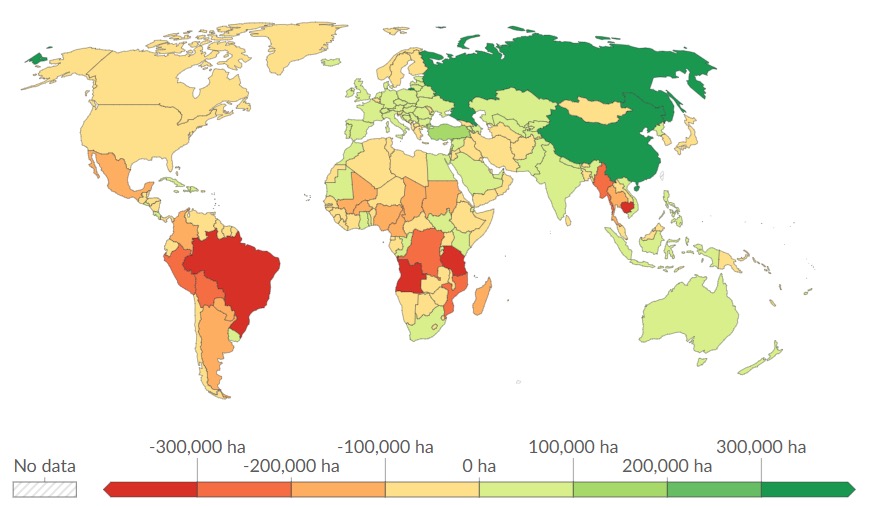
Figure 1 The map shows the rate at which various countries worldwide are losing or restoring their forest cover. Only Russia and China are replanting forest at significant rates. Source: UNFAO 2025
UN Secretary General Antonio Guterres, a long-time advocate of greater efforts to fight desertification and soil loss, argues that female leadership is the key to re-greening the Earth and handing it intact to our grandchildren.
“We depend on land for our survival. Yet we treat it like dirt. Unsustainable land use is eroding soil 100 times faster than natural process can restore them. Up to 40 per cent of our planet’s land is now degraded, imperilling food production, threatening biodiversity and compounding the climate crisis,” he says.
“This hits women and girls the hardest. They suffer disproportionately from the lack of food, water scarcity, and forced migration that result from our mistreatment of land. Yet they have the least control. In many countries laws and practices block women and girls from owning land.
“But where they do, they restore and protect it: increasing productivity, building resilience to drought and investing in health, education and nutrition.
“I urge all governments to eliminate legal barriers to women owning land, and to involve them in policymaking. Support women and girls to play their part in protecting our most precious resource. And together, let’s stop land degradation by 2030.”
Guterres is right. The deserts are spreading due to those men who clear land, abuse it and burn the fossil fuels that turn it arid. Those men who consider the world belongs to them alone, not to our children and their children’s children. Those men who do not give a damn about anybody else. Those men who never grew up.
Empowering women to manage the world’s lands is one of the few truly pragmatic steps that humanity can take to save our civilisation from devouring its own future. Women already lead the world in deciding voluntarily to lower the human population. Now they need to take charge of its physical renewal and restoration.

Julian Cribb AM is an Australian science writer and author of six books on the human existential emergency. His latest book is “How to Fix a Broken Planet” (Cambridge University Press, 2023)