
Encouraging people to adopt low-carbon lifestyles is useful but no silver bullet for climate change. Plus, deep sea mining of thermal vents may look commercially attractive but will lead to the extinction of many unique animals.
Can personal behaviours be changed to reduce emissions?
If all eight billion of us used only renewable energy for all our needs and followed only vegan diets, global greenhouse gas emissions would plummet. That is obvious and sounds attractive in terms of reducing global warming but it’s also completely unrealistic in the foreseeable future for a whole range of reasons. Still worthwhile emissions reductions could be achieved by widespread adoption (particularly in wealthy developed countries and the rapidly emerging economies) of four changes to personal behaviours:
- Replacing the use of personal petrol and diesel driven vehicles with EVs, combined with more walking, cycling and use of public transport.
- Replacing much of our air travel with high-speed rail and teleconferencing.
- Installing home solar panels and batteries and increasing home energy efficiency.
- Eating more plant-rich meals.
The important word above is “widespread”. Trying to change the behaviour of individuals simply with programs to persuade them to change is not terribly successful at the population level. Even with long-term effort, typically at most 10 per cent of the population move in the desired direction.
Achieving widespread adoption of the four high impact behavioural changes recommended above is dependent on government policies that actively support the desired changes by making it easy, attractive and practical for people to change (eg, free public transport and a reliable network of high-speed rail services), providing incentives to change (eg, subsidies for home batteries) and disincentives for individuals to keep producing GHGs (eg, higher taxes on meat products and petrol-driven vehicles).
Clearly, many of the changes individuals might want to make are also facilitated or inhibited by the products that are available to them, so similar principles should be applied by governments to changing the practices of producers and retailers (eg, to reduce food and other product packaging and avoid the destruction of carbon-rich environments such as wetlands and old growth forests).
All levels of government can also promote individual behaviour change by modelling good behaviour themselves – by providing mainly vegetarian options in hospitals and at functions, installing solar panels on government buildings, avoiding frivolous use of air travel and converting all the government’s vehicle fleet to EVs.
But there are many personal behaviours that, while desirable for lots of reasons, do not have much effect on GHG emissions, eg, composting, recycling plastic, planting trees in home gardens and establishing community gardens. Governments should avoid encouraging people to take up such activities in the false belief that they will be doing their bit to combat climate change.
The World Resources Institute has created an online tool to help policymakers compare the emissions-reduction impact in large populations of programs intended to encourage low GHG-emission behaviours and then select the strategies most likely to facilitate the desired change. The tool has two steps:
- Decide which behaviours matter most in terms of reducing emissions.
- Pick the best tool(s) to shift those behaviours.
Governments have a range of activities available to help people change their behaviours: eg, better information about products and personal behaviours (generally the least effective strategy); personalised feedback such as the installation of smart electricity meters and activity reminders by text; financial and other incentives and disincentives; and helping to establish new social norms.
The most effective strategies tend to be those that either change the “choice architecture” that people are exposed to, that is change the environment in which people make decisions (eg, by making sustainable products visible and easily available to shoppers) or encourage people to make a commitment to a change, for instance by signing up for a bikeshare membership.
I used the tool to calculate the effect of providing incentives to five million people to encourage them to shift to renewable home energy and reduce home fossil fuel use. The incentives were projected to be effective in eight per cent of the population (400,000 people) and to reduce emissions by 452,000 tonnes of CO2 equivalent per year, about the same as the emissions of 100,000 cars. On the other hand, providing only information to encourage the change to home energy supply would result in six per cent of people making the change and a saving of 339,000 tonnes of CO2 equivalent per year.
In comparison, providing information to encourage householders to purchase energy efficient appliances to reduce their home energy demand would save only 24,000 tonnes of CO2 equivalent per year (equivalent to a mere 5,200 cars).
However, as we learnt from the considerable success of efforts to reduce the percentage of people who smoke, combining many strategies and persisting over long periods is likely to achieve the best results.
There’s nothing to stop you using the tool to help you make your own decisions but it is principally aimed at decision-makers seeking to create a population-wide impact.
The havoc created by different degrees of global warming
As I’ve related often, the more global warming increases, the more serious are the consequences for the environment, the climate, individual human health, human societies and even our whole race. Unfortunately, the detail can obscure the big picture and turn people off to the threats.
Very helpfully, the figure below clearly and simply summarises the likely consequences of various levels of warming for the rest of this century. The solid line to 2019 shows the five-year average global mean surface temperature (GMST), one of the commonly used yardsticks of global warming. The dotted lines after that consider the likelihood of each level of warming to 2100. Just to be clear, the situation is looking considerably worse now than it was in 2019 but the overall messages still apply.
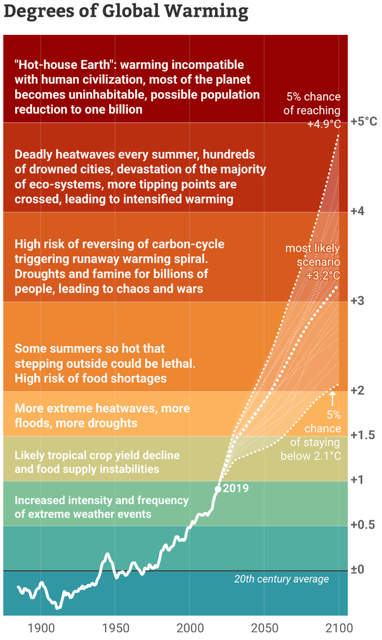
What different degrees of global warming look like | Datawrapper Blog
Thanks to Julian Cribb for bringing this figure to my attention in his P&I article The coming famine on 9 May.
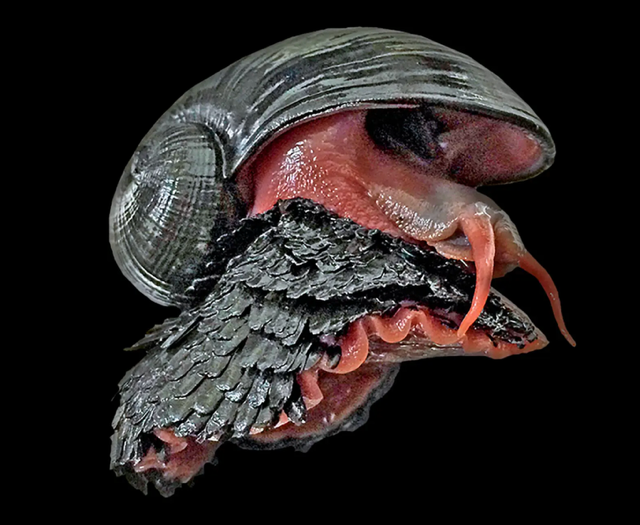
Why is the scaly-foot snail so special?
- It has recovered from near extinction in the Kimberley?
- It lives (in the Himalayas) at a higher altitude than any other snail?
- It is the only animal that sticks to magnets?
- It eats its own shell every year?
Mining of deep ocean vents will cause extinctions
Hydrothermal vents are chimney-like structures in the deep ocean floor where cold sea water seeps into the Earth’s crust, meets hot magma, gets heated to 400oC, collects minerals such as copper, zinc, gold and silver, shoots back into the ocean, cools rapidly and deposits the minerals on the ocean floor. There are about 600 known hydrothermal vents worldwide but probably many more. Most are the size of a football pitch. Did someone say what a great opportunity for deep sea mining?
Remarkably, the walls of the vents themselves and the surrounding areas are rich not only in profit-making opportunities but also strange wildlife such as two-metre-long tube worms, furry crabs, and unusual shrimps, molluscs and snails, including the scaly-foot.
Needless to say, anything that can survive in such conditions needs to be pretty special in many ways, one being that they don’t rely directly (plants) or indirectly (herbivores and carnivores) on solar energy to power their metabolism. Instead, bacteria in the vents turn chemicals such as hydrogen sulphide into chemicals the local fauna can consume.
You’re probably ahead of me here but these unique species, that are incredibly well adapted to their particular extreme conditions, that perhaps occur around only one vent, will be at serious risk of extinction if mining around vents for minerals goes ahead. The denizens of the vents are not currently thought to be in decline but the International Union for Conservation of Nature (IUCN), the global scientific authority on the status of species, estimates that over 60 per cent of the vents’ molluscs will be at risk of extinction from mining. This is mainly because mining will destroy the entire mollusc habitat and also because the sediment disturbed by mining will smother all of the (surprisingly rich) life in the habitats around the vents.
Although the International Seabed Authority regulates deep sea mining outside national waters, it won’t surprise anyone to learn that the US is planning to proceed with deep sea mining in international waters without approval.
Oh yes, the scaly-foot snail. Well, obviously it lives around some of the vents, which makes it special to begin with, but it’s unique in that its external flesh is covered in scales that contain iron sulphide nanoparticles and its shell contains iron. Consequently, it is the only animal that sticks to magnets. Quite an attractive feature, don’t you think.
Bushfires peak during El Niños
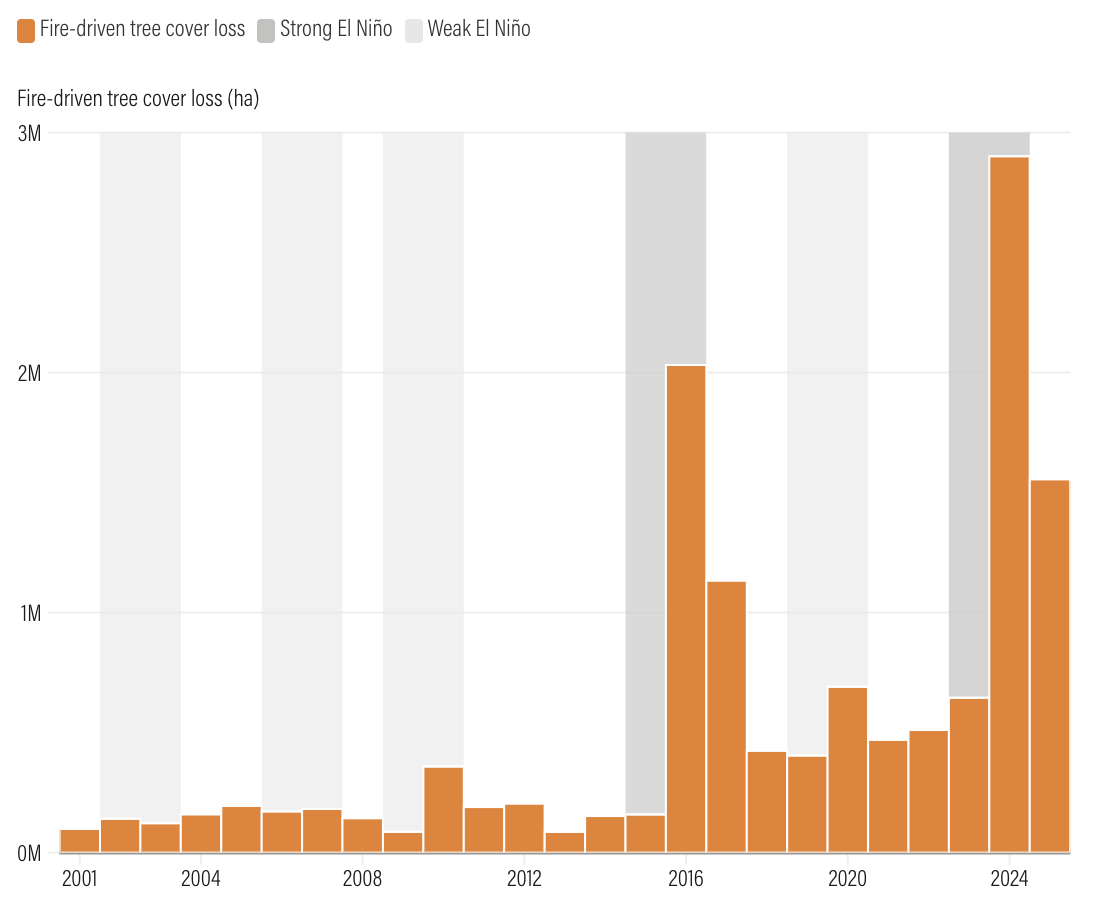
I discussed the coming El Niño a couple of weeks ago and emphasised that a strong ENSO index will not necessarily translate into extreme weather in eastern and southern Australia because of other influences on our weather. However, the graph below indicates that we should be well prepared for a severe bushfire season this coming spring and summer. The El Niño events in 2010, 2016, 2020 and 2024 were all associated with peaks in fire-driven tree loss globally, with the annual averages and the peaks being much higher in the last decade than the previous one.

Peter Sainsbury is a retired public health worker with a long interest in social policy, particularly social justice, and now focusing on climate change and environmental sustainability. He is extremely pessimistic about the world avoiding catastrophic global warming.