The Iran war has damaged US leverage in the Persian Gulf, strengthened Iran’s regional bargaining position and forced Gulf Arab states to reassess their reliance on Washington.
If Iran handles its diplomacy adroitly, the odds favour a continuing Iranian strategic ascendancy in the Persian Gulf.
Iran will not relinquish its capacity to control shipping through the Strait of Hormuz. Its stock of enriched uranium is secure. It has tight domestic control. There appears to be a unity of purpose and a vision of history at leadership levels that will endure, despite any military setbacks and financial pressures levelled against them.
Probably by late June or July, the much-anticipated oil crunch is expected finally to translate into serious global issues of oil availability – especially if the Iranians maintain their current restrictions on the Strait, and the US naval blockade on Iranian ports remains in effect.
The US strategic oil reserve is about to hit its lowest level since its inception. Japan’s strategic oil reserves have fallen dramatically. China may not be willing to continue making available to spot purchasers some of the oil shipments it has in transit at present.
Even if he were to define his goals more clearly and narrowly, it is clear Trump has no realistic diplomatic leverage left to reach a final deal before the need to meet a global energy crisis overtakes other, more conventional, considerations.
If threatened militarily, Iran could opt to increase pressure on the United States by applying restrictions on shipping via the Red Sea. It could threaten undersea communication cables in both the Red Sea and the Gulf.
There is concern, for the region and the world at large, that the outlook for the war may be moving beyond the issues of shipping through the Strait of Hormuz and control over Iranian nuclear material (important as they are) into a truly unpredictable scenario, shaped to a very large extent by Trump’s ego and political instincts.
Against that background, it is too early to say with confidence how the Arab leaderships will respond, individually and collectively, to a more assertive Iran emerging from the war. But rather than accepting external dictates, they will draw their own conclusions about what the protection of their interests in a changed regional environment will require.
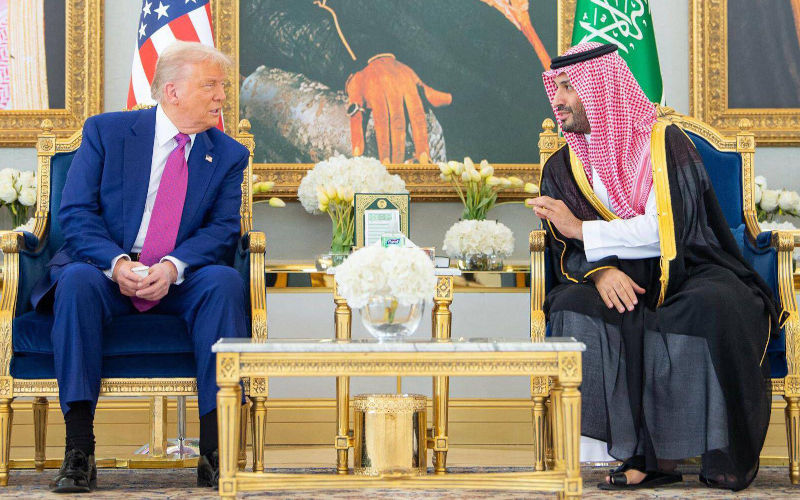
The Saudis were offended by Trump’s recent personal denigration of Mohammed bin Salman. They have no intention of being bullied into joining the Abraham Accords, especially with Israel doing its utmost to prevent the emergence of a Palestinian state, deepening its grip on the West Bank and Gaza, and seemingly set on achieving an ongoing occupation of southern Lebanon.
Instead of adding their weight to the US military effort, they are offering to discuss possible Iranian membership of a regional non-aggression pact.
Having suffered disproportionately from Iranian attacks during the war, and with no prospect of the war ending with its security enhanced, there are rumours the UAE is trying to reach out to Iran as well.
There are significant tensions in the Saudi-UAE relationship at present across a range of regional issues and OPEC. The security dimension of the Gulf Cooperation Council is a hollow shell as a result. But the UAE would be hard put to avoid joining a Saudi-led approach on the part of some of the Persian Gulf Arab states to developing wary but stable postwar relations with Iran, if indeed the Iranians were interested.
The UAE must surely be wondering whether its strategy of signing up to the Abraham Accords to please Trump, engaging closely with prominent pro-Israel US think tanks, and cosying up to Israel more generally was worth it.
Oman, long the regional mediator of choice for all sides, must also be incensed by Trump’s rhetoric about bombing them into line regarding the use of the Strait. Qatar has said the issue of transit fees is open to negotiation.
Irrespective of where they stand regarding relations with Israel and the United States, GCC states will seek to strengthen their independent capacity to defend against Iranian drones and missiles. They will also demand that the Strait be fully open to their maritime traffic as a precondition to discussions about providing Iran with economic incentives to refrain from future attacks.
But they can only incentivise Iranian restraint, not prevent it from closing the Strait if it so chooses.
Iran will probably insist any formal postwar reconciliation with the Persian Gulf Arab states – and possibly the unrestricted use of the Strait by UAE oil shipments – will require the UAE and Bahrain stepping back from the symbolism of membership of the Abraham Accords.
But its demands are unlikely to stop at humiliating Trump and Netanyahu on that score.
Whether ultimately it presents its demands to the Gulf Cooperation Council members individually or collectively, a resurgent Iran will insist on its Gulf neighbours eschewing defence ties with Israel and reducing the US military presence, including in the Emirates and Saudi Arabia.
The Saudis, for their part, have signalled willingness to discuss those expectations in the context of a regional pact.
In terms of regional security, such a ground-shifting outcome to the war may be a turning point in the history of US relations with the Gulf states, but it is not surprising.
Looking ahead, the only thing which is certain is that neither Iran nor the Gulf Arab states will allow the United States to deploy and exercise its military capability in the Persian Gulf with the same degree of freedom it has enjoyed in the past.
Although their weapons systems are largely beholden to US suppliers, distrust of the United States has been a constant part of Arab leadership thinking for decades. It is the primary reason why Saudi Arabia and Qatar have tried, without success, to formalise at treaty level the obligations of the United States in their longstanding defence relationships.
Humiliation by Iran makes the possibility of the United States elevating its security partnerships with individual Persian Gulf states to treaty level all but unthinkable.
Bitterly critical of the US performance in launching the Iran war on behalf of Israel and its failure to defend Arab interests, especially in regard to Palestine, popular antagonism towards the United States is also now impossible for Arab leaderships to ignore.
The problems of judging where the outcomes of the war might lead so far as the future shape of regional security architecture is concerned, however, are manifold. They include the uncertain duration of the present, increasingly tenuous US-Iran military standoff; and whether, when and under what circumstances the overall US contest with Iran might stabilise.
The credibility, however, of Iranian threats to retaliate against the Gulf Arabs if Trump were to seek to achieve negotiating leverage through a renewed military campaign is well established.
With that deterrence implanted in the reckoning of the Gulf leaderships, and with regional leaders gratuitously insulted by Trump to boot, the likelihood of base facilities, overflight and other forms of assistance being provided on the Arab side to a US-Israeli renewal of full-scale hostilities with Iran has declined, if not evaporated entirely.
Once unimaginable as an element of US policy thinking, Trump’s determination not to be personally humiliated is now a strategic issue. And although an ongoing stalemate in the conflict with Iran would come at huge cost to the region (including for Lebanon, Gaza and the West Bank) and for the global economy, the Iranians are not going to make it any easier for Trump to avoid such an outcome.

Bob Bowker is an Honorary Professorial Fellow at the Centre for Arab and Islamic Studies at the Australian National University. He is a former Australian ambassador to several Arab countries.