How effectively middle powers can work together to sustain a rules-based order will depend on how they manage their different relations with the US, China and Russia.
As the United States, China and Russia pursue more unilateral and power-driven foreign policies, attention has turned to the role of middle powers. While cooperation among these states offers a potential counterweight, its effectiveness is constrained by differing regional threat perceptions and continued reliance on the United States. The ability of middle powers to sustain a rules-based order will depend on building flexible networks while managing dependence on great powers.
The United States, China and Russia have openly pursued control of their own spheres of influence. Donald Trump’s administrations have advanced an ‘America First’ agenda aimed at preserving US predominance in the western hemisphere. Russia, under Vladimir Putin, annexed Crimea in 2014 and launched a military invasion of Ukraine in 2022. In China, the consolidation of power under Xi Jinping since 2012 has been accompanied by an expansion of the country’s maritime presence from the South and East China Seas into the western Pacific.
Each power shows little interest in upholding the rules-based liberal international order. Against this backdrop, attention has turned to the role of middle powers. At the World Economic Forum in Davos on 20 January 2026, Canadian Prime Minister Mark Carney called on middle powers to act with greater unity, warning that “we are in the midst of a rupture, not a transition”. At a time when international rules are eroding, he argued that middle powers must be “principled and pragmatic” and need to act collectively, because “if we’re not at the table, we’re on the menu”.
Though Carney did not define ‘middle powers’ explicitly, the central candidates are major countries that maintain close ties with the great powers in their respective regions. These include Canada in North America, EU member states and, in the Asia Pacific, Japan, South Korea, Australia, New Zealand and ASEAN nations among others.
But participation in middle-power cooperation should remain flexible and responsive to its objectives. Some may wish to include India among the ‘great powers’ as defined above. In fact, it has maintained strategic autonomy by adopting an independent stance towards the three major powers. India has the potential to emerge as such a power, although this remains a future prospect. For the foreseeable future, it is likely to show interest in what is, in effect, middle-power cooperation. Also, depending on the issues, such as critical minerals and other natural resources, the role of countries commonly referred to as the Global South cannot be overlooked.
The aims of middle-power cooperation are twofold – to safeguard the sovereignty and interests of middle powers from the overbearing conduct of great powers and to rebuild the liberal international order. As for the latter, its necessity and significance are self-evident. Great powers resort to unilateralism when they deem it necessary, even at the expense of international law and agreements. For middle powers, the rules-based international order is essential to the security and prosperity of their multilateral institutions.
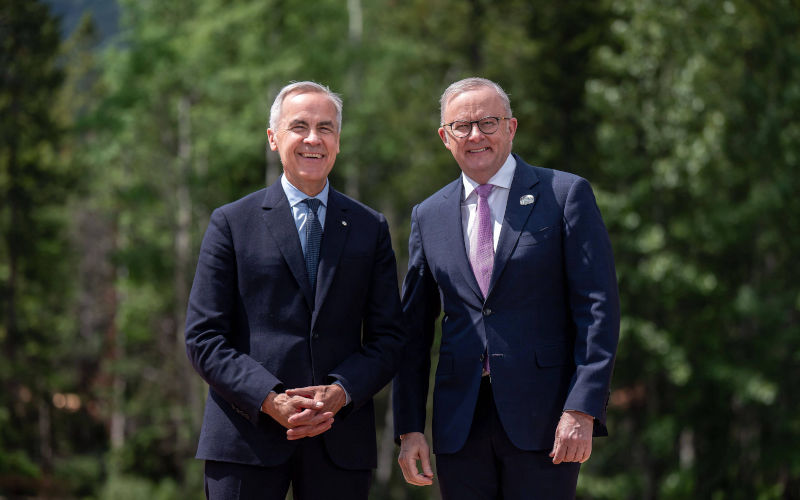
This underscores the need for middle powers to build layered networks of bilateral and multilateral cooperation across a wide range of issues including trade, finance, sustainable development, energy, critical minerals and emerging technologies. This process has already begun. From late February to early March 2026, Prime Minister Carney toured the Indo-Pacific, concluding a series of bilateral agreements with India, Australia and Japan. One next step would be to broaden such agreements by bringing in additional partners and gradually multilateralising them.
The complex challenge for middle powers is navigating the arena of power politics shaped by the three major powers. In this context, cooperation among middle powers is less straightforward, as the sources of threat differ across regions.
For Canada, President Trump – who has floated the idea of Canada as the 51st US state – poses a threat to Canadian sovereignty and economic interests. Deepening the country’s economic ties with China to reduce its dependence on the United States, which accounts for around 70 per cent of its exports and 50 per cent of its imports, is a rational middle power strategy.
By contrast, Japan identifies China as its primary threat, with the strengthening of its alliance with the United States at the core of its middle power strategy. In Europe, Russia – whose territorial ambitions in Ukraine remain undisguised – constitutes the most significant threat. European countries must also carefully manage their relationship with the United States, the cornerstone of NATO.
These divergent threat perceptions shape how middle powers approach cooperation. Across the world, governments are strengthening their sovereign capabilities, including in defence – a trend evident in the Asia Pacific. Yet even if neighbouring middle powers were to combine their efforts, they would still be at a military disadvantage against China, highlighting the importance of a US presence in some form.
Over the medium to long term, however, we must remain alert to the potential transformation and reduction of the United States’ role. At the same time, countries in the Asia Pacific differ in their perceptions of the threat posed by China. Under these conditions, countering China alone cannot serve as the organising principle for middle-power cooperation in the region.
Existing strategies of deterrence and balance may buy time to develop middle-power cooperation, but that time is not unlimited. Recognising this, the framework for cooperation between Japan, South Korea, Australia and New Zealand should be developed more fully. These four countries have been regular guest participants at NATO summit meetings since 2022. As some of the most advanced democracies and economies in the Asia Pacific, they constitute key middle powers, serving both as the core of a regional order and as a bridge to Europe.
If such efforts contribute to developing a broader middle-power network that includes ASEAN states, they could strengthen the autonomy and resilience of a regional order shaped increasingly by middle powers themselves.
Republished from East Asia Forum
Yoshihide Soeya
Yoshihide Soeya is Professor Emeritus at Keio University.