
Kieran Kelly’s Not Really Like Us traces a lifelong fascination with America that gives way to a more cautious view of the US as powerful, vital to Australia – and fundamentally different.
American ‘soft power’ – including books, movies and songs – has been a key factor in sparking a lifelong fascination with the country by Sydney fund manager and former journalist Kieran Kelly.
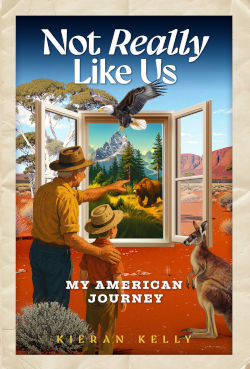 As he recalls in his latest book, Not Really Like Us: My American Journey, Kelly’s first memories of America were books read to him by his mother at his bedside, including Huckleberry Finn, Tom Sawyer and Uncle Tom’s Cabin. As he grew up, she took him to the movies in their hometown of Wellington, in country NSW, where he saw movies such as On the Waterfront and In the Heat of the Night.
His first visit to the US was in 1979, couriering mail from London to New York, sleeping overnight in a warehouse in Queens, spending days walking around New York before hitching into the Deep South.
His fascination with America grew as he subsequently made regular trips to the US for business, travel and, later, visiting family.
During a Covid lockdown in a Sydney hotel, he began writing a book telling Americans what they should know about dealing with Australians, expanding it to include what Australians needed to know about dealing with Americans. This evolved into Not Really Like Us.
Kelly’s book is an ambitious 838-page attempt to tackle the broad range of the Australia–America relationship from a personal viewpoint.
Kelly has interviewed an impressive array of sources, from former prime minister John Howard, former Australian ambassadors to the US Kim Beazley and Joe Hockey, and business leaders such as Jac Nasser and Andrew Liveris, to coffee shop owners in the ski fields of the US and military vets standing on the sides of kids’ soccer matches.
The book had an official launch by former prime minister Tony Abbott AC, but Kelly’s views are different to Abbott’s – more sceptical of Australia relying on any US commitment to come to the defence of Australia.
As Kelly’s friend Lee Benson, sports columnist for the Deseret News in Salt Lake City, describes it, the book is more like walking into a bar and listening to the guy next to you explaining the difference between Australians and Americans.
I first met Kelly when working together as journalists at The Australian Financial Review before he went on to a more profitable career in investment banking and fund management. We have had long debates over the premise of the book.
He started with a personal and deep affection for America from his early childhood days, initially seeing the US as ‘being like us’. But his four-decade-plus American journey saw him constantly wrestling with each shock and reminder that it is a very different place. Americans, he found, had different views on issues such as race, religion and gun control, to the political system and the role of government.
My view, as I argued in our discussions over the book, is that it is a lot more accurate to start with the premise that the US is a very different country with a different history, political system and social structure. While European Australia was established from the ‘top down’ by agents of the British government, the US was forged by independent settlement, a bloody fight to break away from Britain, the use of slavery and the subsequent traumatic Civil War, and the creation of the country, territory by territory, which forged the nation of today.
The structural differences have been proven in recent years as Australia has wrestled to understand the Donald Trump years. While the Australia–America relationship remains strong, Australians’ largely positive perceptions of relations with the US have been tested, particularly under Trump 2.
Kelly sees three phases of the Australian–American relationship over his time – an initial period where most people he met had heard little of Australia.
Then there was a period of great US enthusiasm for Australia, which he attributes to Colleen McCullough’s 1977 novel, The Thorn Birds, which became a popular mini-series in the early 1980s. It was followed by Paul Hogan’s hit movie Crocodile Dundee, released in 1986.
The third phase, he argues, is a more critical view of Australia, perhaps initially sparked by Australian gun control reforms under prime minister John Howard in the wake of the 1996 Port Arthur massacre. In more recent years, Kelly found negative views of Australia were exacerbated by the extent of government-mandated lockdowns during Covid, and then support for the Trump argument that Australia, along with other allies, needs to pull its weight in terms of defence spending.
The question is: where to from here?
It is Australia’s primeval security concerns about being a largely white country in Asia, and the concern about the increasingly powerful role of China in the region, which make some of the questions now being asked more pressing.
The fact that Kelly persisted with the challenge of covering so many issues of the relationship in detail as seen through his personal lens, backing up his interviews and reflections with 45 pages of detailed footnotes, is a testament to both the importance and the vast universe of the topic.
There is always a danger in making mass generalisations about any country, but particularly one as large and complex as the US. But one interesting theme Kelly returns to, from decades of personal interactions, is the difference between Australians’ natural friendliness and the more wary view of strangers in the US, where personal security is much more of a concern.
Kelly describes his joy at meeting people along the way while walking solo through hiking trails in remote areas in the US, only to be greeted with wariness by fellow walkers at his instant friendliness.
The book concludes by asking the question: does Australia have a ‘special relationship’ with the US?
His concluding chapter comes with a warning: “Australians underestimate the disdain many Americans hold for them and their country.”
While it is a conclusion drawn from many interviews and conversations, I see it as being overly negative. But it does recognise an undercurrent in thinking about Australia in the US which he argues is more recent, and of which Australians need to be more cognisant.
Kelly concludes by pointing out the imbalance in the political relationship – with the US being far more important to Australia than Australia is to the US.
After pages of affection, Kelly concludes with a hard, cold dose of realism. “Kissinger summed it up in 1972. ‘The minute the Vietnam war ends, Australians will need us one hell of a lot more than we need them.’ Kissinger is implying that Australia is not a priority for the US. Nothing has changed.”
Kelly’s book represents an awakening from a youth with a romantic view of the US to one with more cautious views honed by decades of interactions.
America, he believes now, is ‘not really like us’.
And yet the US is a rich, colourful, powerful, vibrant nation, full of contradictions – a critical relationship which Australia has much to gain from. But for Australians, one where starting from a view of it being ‘not really like us’ is the way to go.
https://ambientlightmagic.com.au
Also available as an e-book at www.booktopia.com.au
