
Atlassian’s rise made its founders Australian tech icons. ‘Tech Bros’ charts the company’s extraordinary success, immense wealth and the tensions now reshaping the relationship at its heart.
US-listed Australian software company, Atlassian, is one of the great Australian business success stories of recent times.
Founded in Sydney in 2002 by two friends who met at university, Mike Cannon-Brookes and Scott Farquhar, its development from a home office idea to a $US6.6 billion-a-year global software giant has largely received positive to glowing coverage for most of its existence.
But things have changed in the past few years with tensions between the two founders, the break-up of the Cannon-Brookes’ marriage, some large-scale layoffs and some bitter legal disputes – as well as new technology challenging its business model.
It was Cannon-Brookes who had the idea for a start-up, with Farquhar responding to a call-out. The two brought software skills, hard work, a close personal friendship and a similar outlook on life to the business, which listed on the NASDAQ exchange in New York in 2015.
Born within weeks of each other, the two were only 36 at the time, going on to describe their relationship in an interview with this writer for a magazine cover story in The Australian in 2018 as “being like a marriage.”
They were billionaires, ranking among the richest people in Australia, before they were 40 – the new, super cool, jeans-wearing, eco-friendly faces.
Atlassian now has a market capitalisation of $US45 billion with more than 12,000 staff around the world, a business still technically run from Sydney by Cannon-Brookes.
A new book by two journalists with The Australian newspaper, John Stensholt and Perry Williams (former colleagues of mine) seeks to tell the story of Atlassian’s 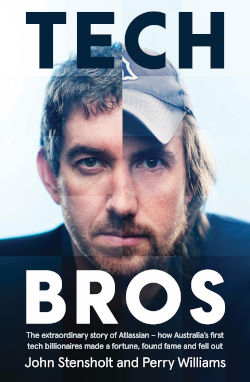 founding, while throwing a spotlight on the more recent tensions between the two founders which saw Farquhar step down as co-chief executive in 2024, ending 23 years in the role.
One of the extraordinary things about the Atlassian story is not that it has been turned into a book, but that it was not done much earlier given the impressive nature of Atlassian’s success.
In a world where US software companies dominate, it was extraordinary that Atlassian’s founders were able to ride the tech boom Mark II from Sydney, breaking the mould of Australian capitalism which has been heavy on companies in the mining and financial services sectors.
But as they have built their business, the two former best mates, who were best men at each other’s weddings, have kept tight control over public access to their inner sanctum including any negative publicity.
The book, as its authors acknowledge, is necessarily constrained by the lack of co-operation from the two founders and many of its senior executives along the way.
But things are changing with the once glowing Atlassian story now having more shades of grey, with more ups and downs, some embarrassing leaked internal messages, criticism of its once lauded work culture, and a share of disgruntled former and existing staff.
But Stensholt and Williams, two of Australia’s most experienced business journalists, have pulled together a combination of public interviews with the pair, company data and interviews with more than 50 sources to produce a very readable account of the company’s history and the recent strains at the top.
The book is not a hatchet job by any means, using many publicly available interviews from the pair to tell their story and acknowledging their efforts in creating a global technology company creating software products such as Jira and Confluence, with customers including some of the world’s largest companies.
But where it breaks new ground is seeking to document the recent tensions between the two and their inner circles.
The book has its fair share of gossip and tidbits including details of their extensive property portfolios and some internal messages and unsourced criticism.
In one Slack message a senior female Atlassian executive suggested to another that they should wear something “really fuckable” to a meeting as it would make Mike’s wife, Annie, “really jealous.”
Another comment from a former executive recalled the company “was the most workplace (he had) ever been in”.
But these all come together to paint a multidimensional picture of two businessmen whose wealth will see them continue to be important players on the Australian corporate scene.
The authors estimate that a share sell-off scheme put in place after Atlassian’s IPO saw each founder gross some $US4.8 billion over the nine years to the end of 2025.
The cash has been funnelled into an extensive portfolio of upmarket property in locations, largely in Sydney and the NSW Southern Highlands, including two waterfront mansions once regarded as trophy homes, owned by the Fairfax family, in the exclusive Sydney suburb of Point Piper.
But we also learn how they have both turned their massive wealth into funding a broad range of local start-ups including Canva, Brighte, AirWallex, SafetyCulture and Tyro Payments.
Their more recent investments have included the Farquhars’ investment in Queensland Airports, Mike Cannon-Brookes’ shareholding in ASX-listed energy company AGL, and ambitious solar venture, SunCable.
The book highlights tensions between the two families, with both having very different wives, recalling how the Farquhars’ plans to renovate Elaine, bought for $70 million in 2017 from John B Fairfax, were stymied by objections believed to have come from the Cannon-Brookes who bought the adjoining Fairwater, once owned by Lady (Mary) Fairfax, for a then national record of $100 million in 2018. (The Farquhars sold Elaine later for a cool $130 million.)
The book is not an analysis of Atlassian’s corporate strategy, nor a technical discussion of why its products were so successful in a highly competitive, Silicon Valley dominated world, focusing more on the two “Tech Bros.”
The book raises some uncomfortable questions: how does Mike Cannon-Brookes reconcile his long-held and very public advocacy for action against climate change and carbon emissions, which have been behind his investments in SunCable and AGL, with ownership of a private jet and Atlassian’s investment in a stake of a Formula One franchise?
How will Atlassian cope with the challenge of artificial intelligence? While some have seen it as a challenge to its software products, Cannon-Brookes argues that it is a positive for the company.
What is the future for Atlassian’s corporate culture, without Farquhar’s moderating hand, with an influx of hard-driving US executives and the company under pressure to produce profits?
The book is a contrast with Damon Kitney’s book, The Price of Fortune about James Packer, who not only opted to co-operate with the author but supported his request to speak to more than 50 people in his world, including those who said things that distressed him.
Atlassian shareholders have also had a rocky ride in recent years, with its price rising to a high of more than $US458 in October 2021, down to a low of $US68.20 in April this year as investors worried about its ongoing losses and the challenge from a new wave of companies and artificial intelligence.
It has since recovered to $US189 in September.
Tech Bros gives a unique insight into where Atlassian has come from and the challenges facing its future.
The “Bros” themselves are still busy writing their own future.
