The death of Dutch migrant Dick Van Teulingen at 101 closes a chapter in Australia’s post-war migration story, shaped by those who left war-torn Europe to build new lives here.
It was a lazy Sunday afternoon searching the internet when I got one of those icy stabs to the heart when you learn that someone you care about has died.
The death of Dick Van Teulingen, in a nursing home in Victoria at the age of 101 in July, marked the end of an era for the group of around 100 Dutch, including my father, who had come to Australia in 1950 on a two-year contract to dredge Port Phillip Bay.
They both came from the small town of Sliedrecht, in southern Holland, one of the dredging centres of a country which has had centuries of experience in the business.
Both my father and Dick married nurses from Williamstown Hospital and opted to stay in Australia when their contract was over. Some returned to Holland while others remained in the Williamstown area.
Theirs were some of the millions of post-war migrant stories which have shaped Australia.
Researching the history of my father’s life in wartime Holland for a book for my family, I got in contact with Dick a few years ago to talk about his life, particularly his own wartime experience from 1940 to 1945. He was 96 years old and still very articulate. He shared some experiences similar to my father’s.
It was the desire to get away from economically devastated Holland, as well as a chance for a new adventure after five years of Occupation and three years of compulsory military service, which drove both of them to seize the opportunity to come to Australia in 1950.
The group of Dutch from Sliedrecht were part of a wave of post-war migrants from Europe. The devastation of the post-war period was a factor driving millions of Europeans in the 1950s to come to Australia for a better life. Some 100,000 Dutch came in the 1950s.
Listening to my father recount his experiences growing up and living through the German Occupation, I was continually struck by the difference growing up in suburban Australia. I decided to pull his reflections into a book, but one which sought to tell a broader story of what happened in his town. And how that led to him coming to Australia.
It comes at a time when Australia is again debating its level of migration. Australia has benefited greatly from the post-war migrants. I believe that it is legitimate for any society to debate the issue of how many migrants it can absorb, particularly at a time when housing supply is nowhere near keeping up. I don’t plan to get into that debate but to reflect on a migrant story.
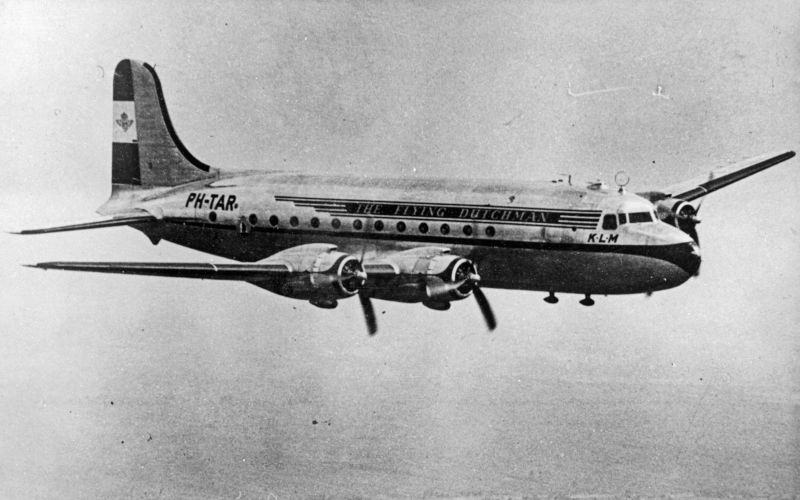
When we got together, Dick gave me a photocopy of the seating plan for the two KLM flights which took their crew to Australia in 1950 – one which left Schiphol on 22 June and a second which left on 22 July. With typical Dutch organisation, the plan set out the names of each passenger and where they sat.
Then in his late 90s, Dick had been crossing off the names of each one as he learned of their death. My own father died at the age of 94 in the Covid times of 2021. Dick had dutifully crossed off his name.
Asking about my father’s time in the Second World War, my father would sometimes accuse me of wanting to “glorify war”. He had not done anything special, he insisted, just survived.
It was not the case, but simply to understand what life was like for someone who had five years living under harsh German Occupation, and how that contrasted with my own middle-class upbringing in suburban Australia.
As the daughter of a post-war migrant, you were made to feel acutely that your father was someone different – someone who “spoke with a funny accent” and liked different food and had a slightly more formal outlook on life than Australian-born parents. He felt it acutely as well, debating one time whether to Anglicise our family name from Korporaal. When he came home one day from his naturalisation ceremony, he was angry he had had to swear allegiance to a British queen.
The Australia of 2026 is a much different place, enriched by migrants from many countries. But in the period of the fifties and sixties, the arrival of thousands of people from non-English-speaking backgrounds was a big change.
Australia is full of migrant stories. Most migrants have come to Australia looking for a better life, determined to work hard.
Dick and my father both came from the same small town in Holland. But, as I learned from talking to Dick, their wartime experiences were very different. My father was 17 in May 1944 when he was rounded up in a group of men at the train station as part of a hostage-taking exercise in retaliation for some shooting of the Resistance. By some miracle, his father was catching the same train. He dragged my father out of the “round up”, arguing that he was only 17, not 18. By some miracle, they were not shot in the back as they walked off.
My father had to go into hiding for the rest of the war. Fortunately, he was able to find a place to stay on a farm, sleeping in a barn at night to the sounds and smells of animals below.
Dick had a very different experience. Being a year older, 18 in 1944, he was liable to be rounded up as slave labour in Germany. He described being rounded up in late 1944 and taken to a prison camp in Dachau, which he managed to survive, despite having his teeth broken when punched in the face by a German guard. He told me a harrowing story of post-war Europe as the freed prisoners hitched rides with Allied army trucks back home. They were so filthy with lice from being in prison that they were sprayed with DDT several times on the way home. But he counted himself lucky that he was only arrested in the final eight months of the war, arguing that those who were sent to prison camps earlier in the war had a much tougher time of it.
Growing up as a “migrant’s daughter”, I was acutely conscious of the difference between my father and the parents of my Australian school friends. Opportunities were never missed to point out how “your father has a funny accent”.
There were advantages to having a different background. I was hired as a journalist on the Financial Review by the legendary Max Walsh, who told me later that he liked hiring the children of migrants as he felt they worked harder.
Dick’s death marks the end of a chapter. A migrant’s life well lived. He had three children, seven grandchildren and six great-grandchildren.
Now there is no one left to cross off the last name of those who came to Australia on those two KLM flights in 1950. I will do it for them.