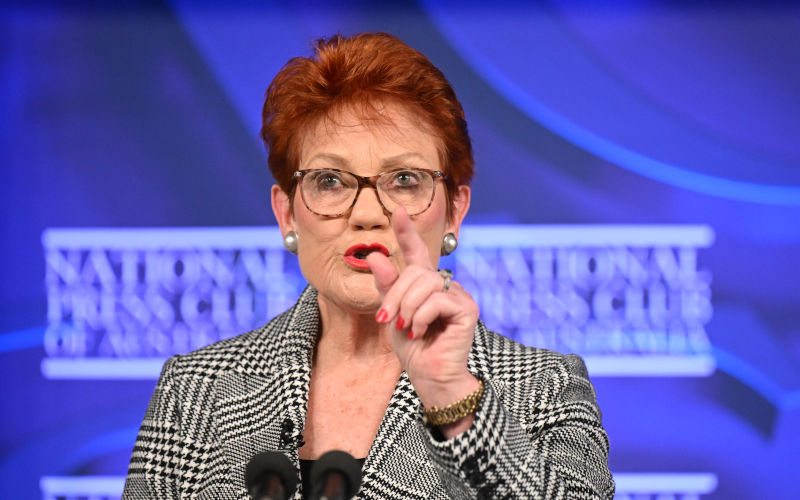
In the second of a two-part series, Robin Brown and Nick Bogiatzis show how it is the politicians most loudly claiming to defend “Western values” who are among the most dedicated to undermining them.
Pauline Hanson stands on the myth of a monocultural Western civilisation under siege. So does Reform UK’s Nigel Farage. US Vice President JD Vance does too. The Liberal Party’s new president Tony Abbott has made a career out of it. These politicians share the political usefulness of invoking “Western values” to exclude, demean and restrict the rights of people outside their preferred cultural group. They are either ignorant of, or dishonest about, the values they claim to defend.
The trick works by invoking genuinely important values – dignity, freedom, the rule of law – and claiming exclusive ownership of them on behalf of a particular cultural group. Then the claim is used to exclude, demean or restrict the rights of people outside that group, hypocritically undermining the very values being trumpeted.
Kwame Anthony Appiah, in his 2016 BBC Reith Lectures, argued that the very notion of “western culture” as a coherent, bounded thing is a modern invention. The classical inheritance routinely claimed as distinctively Western was substantially preserved and transmitted by Islamic scholarship. The works of Plato and Aristotle reached Renaissance Europe largely via Arabic translations made in ninth-century Baghdad. The phrase “western civilisation”, Appiah points out, is more recent than the phonograph.
The Universal Declaration of Human Rights, by many seen as founded in “western” values, was not a Western document but an international negotiation. Chinese Confucian philosopher Peng-chun Chang, who was the drafting committee’s vice-chair, explicitly pushed back against Western philosophical categories. Hansa Mehta of India argued successfully for gender-neutral language. The Declaration was the world’s, not the West’s.
The research is unambiguous. Norris and Inglehart (2004) have long shown that values that converge on dignity, fairness and democratic accountability correlate more strongly with economic development and physical security than with religion or civilisational heritage. Mende (2021), in the Journal of International Political Theory, concludes that human rights are not simply Western in origin or application.
These politicians carry on as though none of this mainstream social science, moral philosophy and political theory exists.
Viktor Orbán is the most instructive international case. He declared at the Conservative Political Action Conference in Dallas in March 2026 that conservatives must protect “Western civilisation” from liberal progressives. At the same time, he had dismantled judicial independence in Hungary, corrupted its media, and built what Freedom House classifies as a “hybrid regime”. He was not the defender of Western values. He was one of their most significant opponents.
Farage has made a comparable career of invoking Western and British values, while weakening institutions such as the European Court of Human Rights and the UN refugee framework, through which those values are actually given legal force. When the rhetoric meets policy, the values lose.
Abbott is the most instructive local case, and his recent Quadrant article shows exactly how far this goes. It is the speech he delivered to the Alliance for Responsible Citizenship in London; Jordan Peterson’s international network. Abbott was once a student priest. The Sermon on the Mount would have been his guiding light, and it probably guided him when he saved a child from drowning and when he saved children from a burning house without waiting to be thanked. Yet in London he told his international audience that sustained mass migration is “the surest and swiftest way to change and punish” a country, designed “to dilute and eventually to extinguish the Anglo-Celtic core culture and the Judeo-Christian foundational ethos”. Muslim migrants are, he said, “especially useful” to this project because “belief in a global caliphate and the conviction that it’s the Koran rather than the legislature that validates law starts to make pluralist democracy unworkable.”
This is not a view from the fringe. This is the Liberal Party president expounding the Eurabia conspiracy theory, the debunked claim that Muslim immigration is a deliberate plot to Islamicise Western societies, from a stage in London to an international conservative audience. It is flatly contradicted by every serious piece of research on the question. And Abbott’s claim in the same speech that British settlement gave Aboriginal Australians “a vastly better life” should be read alongside the 65,000-year moral tradition of this continent documented by Deborah Bird Rose and Marcia Langton. It cannot survive the comparison.
This thinking now sits at the organisational heart of what was once Australia’s party of liberal democracy. The Liberal Party of Menzies, though not without its flaws, stood for institutional integrity, equal citizenship, freedom of conscience and the rule of law. Polling consistently shows that today’s party will not compete with One Nation by redefining itself through cultural identity politics. Voters are simply shifting over. With our compulsory voting system, the only viable path is back to the middle ground; back to the values the party was actually founded on.
Hungary’s story offers a reason for cautious optimism. Orbán spent 15 years dismantling democratic institutions, rigging electoral boundaries, capturing the media and intimidating the judiciary, all while presenting himself as the indispensable defender of Christian civilisation. JD Vance flew to Budapest to shore up Orbán’s support days before the vote. It made no difference. On 12 April 2026, Peter Magyar’s Tisza party won 53.6 per cent of the vote to Orbán’s 37.8 per cent, a supermajority in parliament. Magyar told tens of thousands of supporters gathered along the Danube that together they had “liberated Hungary”.
Abraham Lincoln supposedly said that you can fool all of the people some of the time, and some of the people all of the time, but you cannot fool all of the people all of the time. Even with 15 years and the full resources of the state, Orbán could not make the myth hold.
Human dignity, equality before the law, freedom of conscience, universal compassion, accountability of power are not threatened by cultural diversity. They are threatened by the politics of exclusion that Hanson, Farage, Orbán and Abbott represent. These values were never the exclusive property of Western civilisation. They are the shared moral heritage of humanity, including the 65,000-year heritage of this continent. And the politicians most loudly claiming to defend them are, in practice, among the most dedicated to undermining them.
Serious public policy practitioners engage with evidence. Populists ignore it, because the myth is more useful than the reality. But the myth has limits. Hungary recently found them.
Read part one of this article:

Robin Brown
Robin Brown is Deputy Chair of Fairer Future. He has advised Australian and overseas governments, businesses and NGOs on consumer protection, competition policy and regulatory accountability. Formerly head of the Consumers’ Federation of Australia, he helped secure the landmark court ruling that enabled bans on second‑hand tobacco smoke and spearheaded creation of both the Consumers’ Health Forum and the Australian Communications Consumer Action Network.

Nick Bogiatzis
Nick Bogiatzis is a retired federal public servant, published author, and experienced public policy adviser with a Master of Public Administration from Harvard University, following graduation from the Universities of Queensland and Tasmania. His career and interests have focused on social policy, multiculturalism and the challenges of democratic dialogue in diverse societies. With experience in Australia and overseas, Nick combines global perspective with a deep understanding of Australia’s cultural and political landscape. He is particularly interested in how societies navigate difference, conflict and change — and in creating the conditions for honest, respectful conversation.