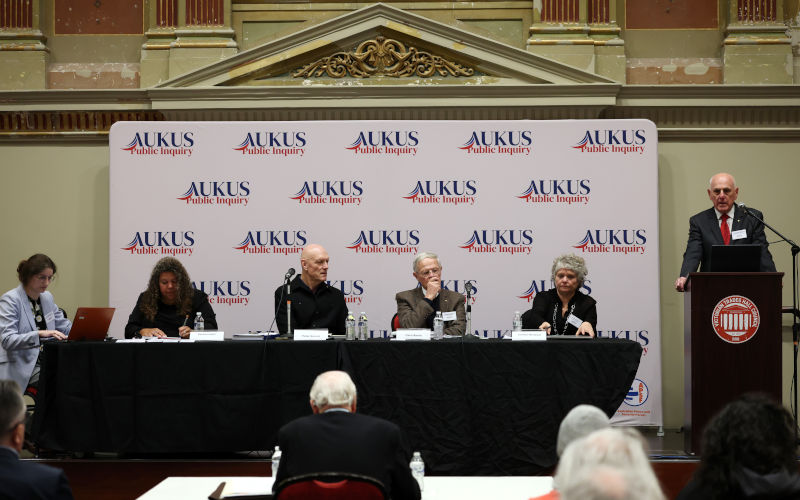
Evidence to the public inquiry into AUKUS is exposing risks around nuclear accidents, sovereignty, jobs, waste and Australia’s role as a US military base.
I have been watching and listening to the livestream broadcast of the Public Inquiry into AUKUS. Truthfully, I have been doing more than watching. As a board member of the Australian Peace and Security Forum, which is supporting the Inquiry, I have been hanging on every piece of evidence, every presentation, every media story.
The presentations and evidence offered have been nothing less than extraordinary and deeply disturbing. For instance, when former Defence Minister, Linda Reynolds, was asked at the hearing in Fremantle – good on her for appearing – whether she thought having nuclear submarines stationed near Fremantle would make Fremantle more of a nuclear target, her answer was clear. “Of course it would.”
When, later in the day, Dr Colin Hughes, former head of Public Health in Perth, spoke about what would happen in the event of a nuclear accident, he described how the tanks holding contaminated water would be breached, with radiation spewing into the ocean, poisoning the seagrass beds and the ecology for thousands of years.
In his scenario some victims are found alive close to the blast zone. Workers who survived the explosion emerge dazed and bleeding. Others suffer traumatic injuries from collapsing structures and flying debris. Ambulances begin transporting casualties, but many patients arrive faster than they can be processed. The regional hospital is overwhelmed within the first hour.
This is the stuff of nightmares. At his conclusion, Hughes reminded the audience of local Fremantle people that there was, so far, no plan in place to evacuate the people of Fremantle the 25 kilometres that would be necessary should such an accident occur.
AUKUS is going ahead without any such planning.
It was almost equally shocking to hear at the Adelaide hearing, former Senator Christopher Pyne, current chairman of consulting firm Pyne and Partners and non-executive director of Canberra-based defence manufacturer, Highcom, describe what he considered one of the most exciting aspects of AUKUS as “…not just a submarine procurement, but also a new US submarine base in the Indian Ocean. For the Americans to have a submarine base in the Indian Ocean is a massive strategic advantage.”
That submarine base is called Australia.
On the simple question of whether AUKUS will come in on time, and on budget, Pyne’s answer was direct and honest, “No I don’t think it will come in on time or on budget. I can say that now because I am not in government.”
He concluded by opining that timeliness and budget were not the main issue – the main issue is national security.
We also heard Matt Murphy. Assistant National Secretary of the Electrical Trades Union of Australia, unpack the story of jobs.
“When Australia cancelled the French Attack class contract in September 2021, we did not just cancel a submarine. We cancelled a deal for 12 conventionally powered submarines to be built onshore, in Australia, by Australian workers. At its peak, that program was set to support around 900 tradespeople directly, and at least 5,000 jobs across the broader supply chain — with real flow-on effects to the vocational education and training sector, our universities and Australian industry more generally. That work is gone.
“In its place, we were given an announcement — not a deal, an announcement — of a policy pathway. The SSN-AUKUS arrangement as currently structured contains around 20 per cent less Australian material than the French contract. The highest-technology work will be done overseas, not here. Regardless of the method of propulsion, a rushed decision to build these boats in the United States or the United Kingdom means two generations of Australian workers will lose access to highly skilled, well paid, WHS-insured and secure jobs. That risk has not diminished. It has grown.”
The AUKUS jobs fantasy was challenged again by Jack Thrower, from The Australia Institute. The submission was long but the talking points short. While both the Prime Minister and the South Australian Premier make bold predictions about AUKUS and jobs creation, the facts are more people work in legal and accounting than defence, more people make beer and wine than are employed in ship building and if the project goes ahead, each promised AUKUS job would be costed at close to $18 million per job.
And on the subject of nuclear waste – the high-level nuclear waste Australia will be obliged to store – there has been no consultation with First Nation Peoples on whose land it will be stored, and no willingness to release what the Government has already developed about this storage. They appear to have made a decision about where to store this dangerous, high-level waste but have no plans to make that information available.
We are about half-way through the hearings in this inquiry. We still have Sydney, Newcastle, Wollongong and Canberra – and perhaps Brisbane if we can raise the funds. We have heard much about the lack of consultation with local communities and First Nation peoples, the lack of preparedness in the event of an accident, the loss of sovereignty involved in this project. We have heard local people, men and women, weep as they tried to express their anxiety for their families and future. We have had the privilege of hearing from international strategists who have challenged the foundational thinking. After each hearing, I have left shocked by the evidence.
But today I had a familiar sense: “surely when people hear this evidence things will change”. I found this disturbing because I have had this thought before.
I had the same thought when I was reporting on the abuse of refugees held within Australia’s detention regime for the Australian Financial Review. I had such faith that when the people of Australia knew what was going on in those camps, things would change, the camps would come back into public administration, we would all come to our senses.
I was wrong about that. Those abuses got worse, the number of people broken by that regime grew and the Australian people kept voting for policies that destroyed people.
Today I am caught between hope and despair. As the findings of our Inquiry come to light and people are given the chance to get a better idea of what this will cost all of us, I wonder if we will act in our own interests?
Will we have sufficient heart and soul to protect the people and places we love, to think critically about our international relationships? Will we have the imagination to create a defence of Australia based on reality and our own national interest? Will we respond differently to this new threat, or, as with the brutal detention regime, will we forgo our responsibilities as citizens and leave it to our political leadership to decide?
Today I am not so sure of that outcome.

Julie Macken has worked for many years as a senior writer with the Australian Financial Review. She was a consultant to then-shadow minister for the Environment, Peter Garrett, before managing the traditional media for Greenpeace Australia Pacific. She was director of Communications for the NSW Greens successful 2015 state election campaign and currently works as a Justice and Peace Facilitator at the Justice and Peace Office of the Sydney Archdiocese. She has just finished her PhD on the question of why the Australian state treats asylum seekers as it does.
My published book, Australia’s schism in the soul; colonisation, asylum seekers and a nation’s failure to mourn