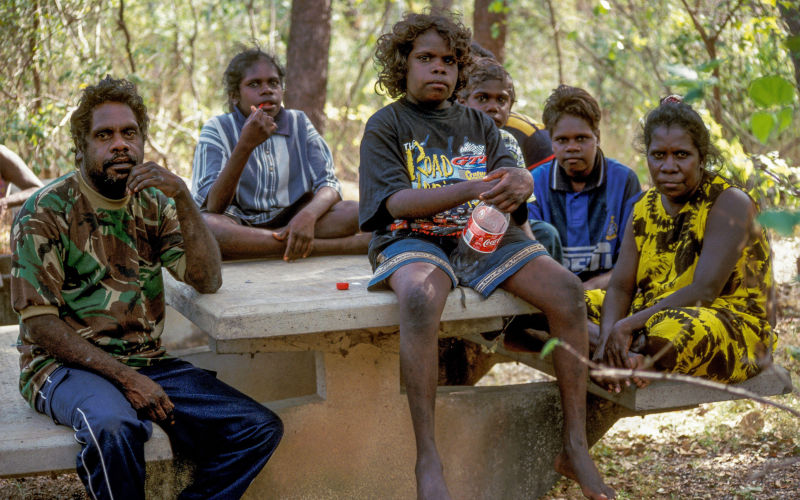
An Aboriginal-developed program revealed that lasting social change depends not only on structural reform, but on people discovering and using the agency they already possess.
When I first arrived in Australia, I believed social change worked rather differently. My academic training had taught me that lasting progress came primarily from challenging unjust structures and institutions. Those struggles mattered deeply, and still do. But soon after arriving in Alice Springs, colleagues and I at the Menzies School of Health Research were asked to evaluate an Aboriginal-developed program called Family Wellbeing. That assignment quietly transformed how I thought about power, politics and change.
By then we had evaluated a range of health and community initiatives. Evaluation budgets of $20,000, $50,000 or even $100,000 were not unusual. Family Wellbeing, the first Indigenous-developed program I encountered, came with just $3,000 to evaluate its impact. I assumed the modest funding reflected its significance.
I was wrong.
Over the following months, we encountered something unlike any program we had previously evaluated. Family Wellbeing did not begin by telling people what to do. Instead, it invited participants to reflect on their experiences, recognise strengths they already possessed, understand how power operated in their lives and support one another to take action. Many spoke of finding the confidence to repair fractured relationships, confront violence or addiction, return to education, assume leadership roles and create change within their communities. We realised we were witnessing something far more significant than the budget suggested.
Family Wellbeing treats empowerment as both an individual and collective process. Its underlying logic is deceptively simple: as people strengthen their confidence, skills and relationships, they become better able to influence not only their own lives but also the institutions around them. We watched this unfold repeatedly. Participants reinterpreted painful experiences, recognised capacities they had never acknowledged and gradually translated newfound confidence into action. Small personal shifts – a difficult conversation at home, a decision to study, a willingness to mentor others – rippled through families, workplaces and communities. Rather than waiting for institutions to transform people’s lives, the program helped people become active participants in transforming both their own circumstances and, ultimately, the institutions around them.
That experience challenged one of my deepest assumptions. Structural reform remained essential. But enduring change was rarely achieved by institutions acting alone. It also depended on ordinary people discovering they possessed more agency than they had imagined.
One day Ananse asked the river why it never fought the rocks blocking its path.
“Because,” the river replied, “my purpose is not to defeat the rocks. It is to reach the sea.”
Only later did Ananse understand that persistence often achieves what force cannot.
My scepticism had not disappeared immediately. When I first read the course materials, they spoke of healing, self-awareness, inner strengths and empowerment. As someone who believed social justice depended principally on changing the wider conditions that produced inequality, I wondered whether this focus on the individual was misplaced. Teaching people to feel better about themselves without confronting structural disadvantage seemed naïve.
Then I started listening.
Each week participants described how they were using what they had learned to change relationships at home, at work and in their communities. One woman, after enduring an abusive relationship for more than two decades, told her partner, “You must blame Family Wellbeing.” For the first time in her life, she said, she was no longer afraid to stand up for herself.
Within weeks, participants were attempting things they had considered impossible only a month earlier.
The penny dropped. Family Wellbeing was not encouraging people simply to think positively. It worked more like a chain of falling dominoes. A person who discovers they can set a boundary with an abusive partner begins to believe they can return to study. Someone who gains confidence at work speaks differently to their children. Stronger families nurture stronger workers, volunteers and leaders. Stronger organisations become better able to solve community problems. Personal empowerment was not an alternative to structural reform. More often, it was the beginning of it.
The more I watched, the less I understood Australia’s priorities. The least-funded program I had evaluated was producing some of the quickest and most profound changes I had witnessed. Yet while participants rebuilt relationships, returned to study, found confidence at work and imagined futures once beyond them, the program itself lurched from one short-term grant to the next.
That puzzled me then, and it puzzles me still.
Australia often asks whether Indigenous communities are taking enough responsibility for their future. Family Wellbeing suggested a prior question: what helps people become capable of carrying that responsibility? Instead of asking whether people wanted responsibility, perhaps we should have asked whether we were investing seriously in programs that strengthened people’s capacity to exercise it.
Over the years I saw the same lesson reinforced in community after community across Australia, including Yarrabah, where community-controlled organisations combined practical services with local leadership and long-term commitment. The details differed, but the underlying principle remained remarkably consistent. Durable change was most likely when communities were trusted to build on their own strengths rather than treated as passive recipients of solutions designed elsewhere.
Australia has no shortage of debates about Indigenous affairs. Funding levels dominate headlines. Programs are announced, reviewed and replaced. Reports accumulate. Those conversations matter, but perhaps they sometimes begin with the wrong question. Alongside asking how much we spend, we should also ask what helps people discover, strengthen and use their own capabilities. The answer may not always be comfortable, because it requires patience, trust and a willingness to support change that grows from within communities themselves.
Looking back, I no longer remember Family Wellbeing primarily as the first Aboriginal-developed program I evaluated. I remember it as the program that quietly evaluated me.
Like Ananse, I had spent too much time looking at the rocks. Aboriginal communities were already showing me how the river kept moving. Perhaps Australia’s greatest challenge is not deciding where the river should flow, but recognising, and sustaining, the currents already finding their way to the sea.
Komla Tsey
Komla Tsey is a Ghanaian–Australian writer, retired Professor of Education for Social Sustainability, and part-time Professorial Research Fellow at the Jawun Research Institute, Central Queensland University. His writing explores education, democratic culture, identity, Indigenous empowerment, colonial legacies and the moral certainties that shape public life. His forthcoming memoir, Botoku Child, traces a journey from a small village in Ghana to universities and communities across the world, examining how inherited beliefs, curiosity and lived experience shape both personal lives and democratic societies.