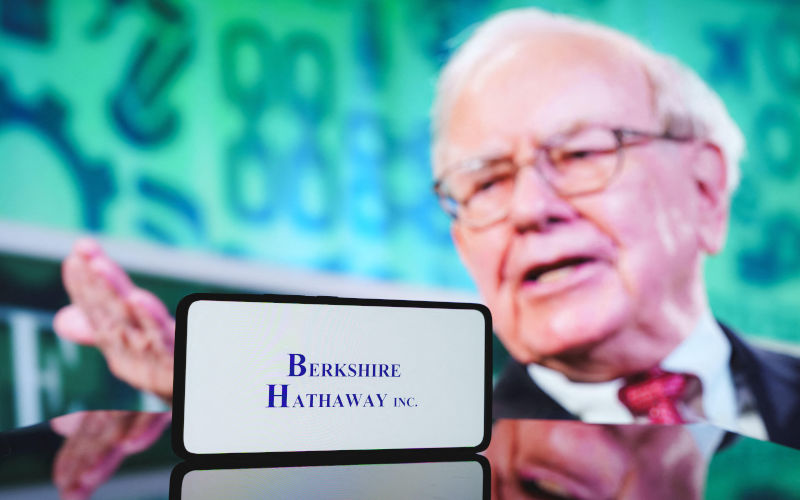
Warren Buffett’s departure as Berkshire Hathaway chairman marks a turning point for the company he built. As his successors take charge, the rise of AI is raising fresh questions about the value of his patient, long-term approach to investing.
The move by 96-year-old US billionaire Warren Buffett to step down as chairman of Berkshire Hathaway, the $US1 trillion conglomerate he took control of more than 60 years ago, marks the end of an era for American capitalism.
The legendary investor, who has had a strong following in the Australian funds management community, is stepping back from the role of chairman, after relinquishing his role as chief executive in January this year.
Buffett has appointed his 71-year-old son, Howard Buffett, as chair. Howard has been a board member of the company since 1993, but is not seen as an experienced fund manager or investor, his main role being a farmer and a ‘philanthropist’, giving away money earned by his father.
Howard’s role, as he said in his statement, is to “help protect the culture and values that make this company exceptional”.
Buffett’s investment philosophy involves strong cultural guardrails – patient, long-term investing in quality companies and letting good managers get on with their job, always acting in a reputable manner, and avoidance of leveraged risk.
While Buffett’s age made his departure inevitable, his legendary status as one of the supermen of global investing, and his words of wisdom in his annual reports and at the Berkshire Hathaway annual meetings (sometimes dubbed the Woodstock for Capitalists), have still left his many loyal shareholders wondering about the future of their investments.
It raises questions about whether his hand-picked successor as CEO, 64-year-old Greg Abel, can deliver the same outstanding returns Buffett did after taking over struggling New England textile company Berkshire Hathaway in 1965.
More fundamentally, there are questions on how much Buffett’s unique brand of value investing is relevant in today’s world.
While Buffett’s Berkshire Hathaway has had a stellar run over the decades, its performance in recent years has not kept pace with the S&P 500 index, which has been driven by tech stocks and the anticipation of AI-driven profits.
From the small town of Omaha, Nebraska, Buffett built up an empire which includes investments in railroads, housing, energy and insurance, a powerful portfolio of shares as well as accumulating a cool $US370 billion-plus cash pile.
Companies under the Berkshire Hathaway umbrella include Johns Manville, BNSF Railway, Dairy Queen, Duracell, Fruit of the Loom clothing, insurance group GEICO, NetJets and Pampered Chef.
For decades Buffett avoided tech stocks, which did not fit in with his strategy, but he eventually changed his tune with investments in Apple and Google owner Alphabet.
He was close friends with Microsoft founder Bill Gates until Gates’ ties with Jeffrey Epstein emerged.
But these days Berkshire is still seen as an industrial conglomerate with a strong insurance arm and a giant cash pile no one quite knows what will be used for – but one which could be useful in the case of a financial crisis.
Famous for his ‘aw shucks’, folksy comments at his annual meetings, which could attract as many as 50,000 attendees, Buffett surprised his shareholders at the end of the Berkshire Hathaway meeting in May 2025 when he announced his plans to step down as chief executive at the end of the year.
The market reacted negatively to the news he was stepping back to the role of chairman and appointing Abel, who joined the company almost 30 years ago, as his successor, sending its B shares down from $US539 before the announcement to a low of $US465 in August last year.
The shares recovered to $US507 this year, as the market was getting to know Abel – but also assured by his announcement this year that the company was prepared to buy back shares if it thought the price was right.
But they fell again on the surprise announcement that Buffett was exiting the chairman’s role so quickly, despite his observations that “Father Time always wins” and that he will stay on as a director with the role of “chair emeritus”.
While his older partner, Charlie Munger, passed away in 2023 aged 99, Buffett had an aura of invincibility, with thousands of fund managers and investors around the world claiming to be following his investment strategies.
I first met Buffett at a conference on ‘junk bonds’ at Columbia University in New York in 1985. As the US correspondent for the Australian Financial Review, I was keen for an interview with this fund manager from a little-known mid-western town who was getting attention, despite not being a Wall Street hot shot.
Buffett was no fan of highly leveraged investments and was critical of the ‘junk bonds’ which had fuelled the 1980s stock market boom, and he went on to astutely avoid the fallout from the 1987 crash.
Buffett’s office was modest, with metal filing cupboards full of annual reports and company information. His comments were filled with down-to-earth, sensible observations, about investing for the long term, being patient, looking for value, buying into companies with good management and letting them do their thing.
He was full of quotable quotes, including criticism of short-term forecasting, management experts and groupthink investing where people pay too much and sell too cheap.
One of his most famous quotes is that investors should be fearful when others are greedy and greedy when others are fearful.
Legendary for studying annual reports and corporate reports in fine detail, Buffett steps down in an era when the world is getting closer and closer to ‘perfect information’.
These days artificial intelligence is supercharging the ability to collect and analyse corporate data, in a way which is available to everyone with a digital connection – not just smart players in financial capitals around the world, or hard-working, super-savvy investors in Omaha.
While it sounds like a good idea, the notion of a smart investor being able to study financial accounts and buy into a great investment with predictable long-term returns at a great price in current-day markets – finding value that no one else seems to – is now a pipedream.
But Buffett’s high-cash, low-debt strategy will also pay off in an era of rising interest rates and potential financial disruption.
Investing is now about taking a punt on the future, in many cases, with companies which are relatively new.
In the end, investing will always be about judgement in uncertain times. Buffett famously recommended that people who don’t want to do the hard work behind true investing should just buy a sharemarket index such as the S&P 500.
Buffett leaves a formidable legacy and, although Father Time is catching up with him, studying his investment approach will still yield valuable lessons, even in an AI-driven world.
Disclaimer: Glenda Korporaal owns Berkshire Hathaway B shares.
