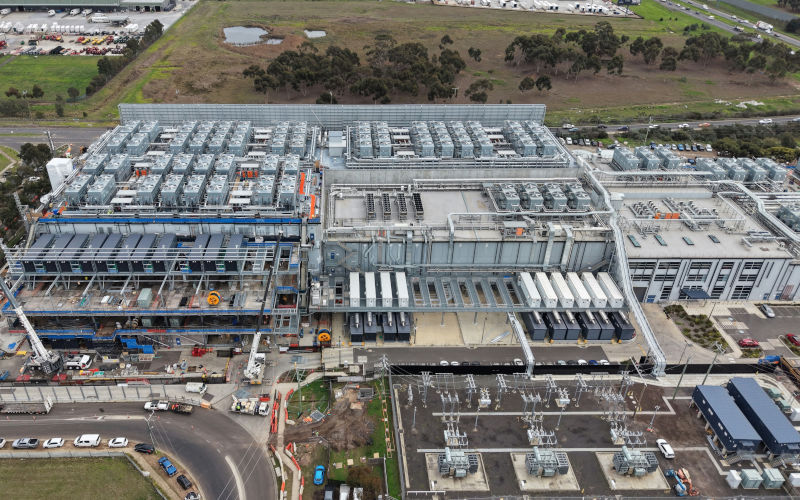
Hyperscale data centres are adding new pressure to already stressed freshwater systems, testing whether governments can allocate, monitor and protect water fairly.
Water resources around the globe are under enormous stress. Freshwater sources are declining in quantity and quality due to over-exploitation of rivers and aquifers, eutrophication caused by excessive nutrients from fertilisers and detergents, salinity intrusion, and release of untreated organic waste. These challenges are now complicated by the rise of hyperscale data centres to provide the computing power that Artificial Intelligence (AI) technology companies require.
Hyperscale data centres hold many thousands of servers and may use as much water daily as a small town. They are fast becoming a test of governments’ ability to allocate water fairly and responsibly – and for a supporting international architecture that could assist countries in getting a fair deal.
The latest UN monitoring report on the global goal on water and sanitation (Sustainable Development Goal 6) shows that countries have made great progress in providing water and sanitation services. In Central Asia and South Asia, for example, rural coverage for safely treated drinking water improved by 15 per cent between 2015, when the Sustainable Development Goals (SDGs) were adopted, and 2024. East Asia and Southeast Asia also have increased their momentum in rolling out services to previously under-served populations. These gains are now under threat, if water resources are squandered.
In the southern state of Johor, Malaysia, household water cuts earlier this year prompted demonstrations against the building of a new data centre at Gelang Patah, on the outskirts of the state capital. In the western suburbs of Melbourne, plans for several data centres, including a hyperscale centre at Plumpton, spanning 350 hectares, have prompted protests over fears of water and energy deficits, heat impacts, and loss of land needed for housing.
Much will depend on how data centres are managed and regulated. These include choices over cooling technologies, restrictions on their use of potable water, funding of water treatment infrastructure, and how their water consumption will be monitored and reported.
By adopting the SDGs, countries have opted to take part in a system of peer review and feedback on their achievements. The system isn’t perfect – national-level data doesn’t necessarily reflect local trouble spots, for example – but the SDGs provide impetus for countries to establish comparable monitoring frameworks, and to use that data to inform policy. Right now, too few countries are doing so.
The latest UN monitoring report on SDG 6 warns that data gaps on water quality and quantity persist. Where information is unavailable on water withdrawals and environmental flows (water that is left to maintain natural ecosystems), governments will not be able to effectively assess and manage levels of water stress. Hyperscale data centres present an opportunity for countries to tailor their monitoring systems to managing this new challenge. That is important, given the current scale of water stress globally; already, ten per cent of the world’s population lives in countries with extreme levels of water stress.
Water systems are complex: they cross boundaries, and they travel not only in liquid form but in water that is absorbed into the landscape in forests and grasslands, and in atmospheric flows through evaporation and precipitation. That means that countries need to cooperate to manage not only shared surface water resources but the whole water cycle.
At the High-Level Political Forum on Sustainable Development (HLPF), the annual UN meeting in New York to review progress on the SDGs, speakers called for stronger multilateral arrangements on water. These could include regular intergovernmental meetings to keep up the political momentum and a review architecture with accountability mechanisms.
The SDGs were adopted as a 15-year framework, and were meant to be achieved by 2030. On the latest indicators, implementation of SDG 6 on water must greatly accelerate; even so, the 2030 deadline is unlikely to be met. Speaking to HLPF delegates at the opening of the HLPF, Saroj Kumar Jha, Director of the World Bank Group’s Water Department, urged, “SDG 6 needs not only acceleration but transformation – into a durable architecture for how we govern the global water cycle.”
By 2030, the world will likely have many more hyperscale data centres. Time will tell if their impacts on water stress can be adequately resolved – and whether governments can establish the governance architecture that is needed, both nationally and as a community of nations.

Delia Paul
Delia Paul, PhD, is a human geographer and an affiliate of Monash University’s Global Peace and Security Hub in Australia. Her research focuses on the intersection of environmental governance and peace building, and the role of civil society in enabling both. As an associate of the International Institute for Sustainable Development, she writes regularly for Earth Negotiations Bulletin, reporting on the global governance of water, biodiversity, and sustainable development. Her most recent research project investigated innovative responses to climate mobility in the Asia-Pacific region.